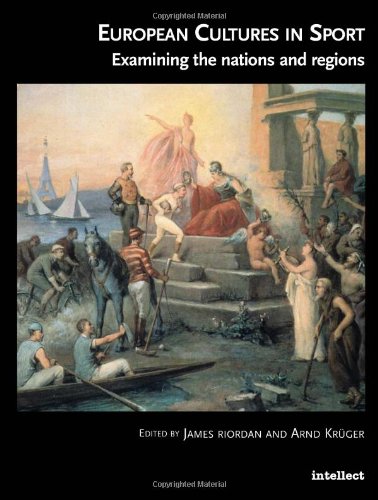
EUROPEAN CULTURES IN SPORT
Verkauft von Romtrade Corp., STERLING HEIGHTS, MI, USA
AbeBooks-Verkäufer seit 17. April 2013
Neu - Softcover
Zustand: Neu
Versand innerhalb von USA
Anzahl: 1 verfügbar
In den Warenkorb legenVerkauft von Romtrade Corp., STERLING HEIGHTS, MI, USA
AbeBooks-Verkäufer seit 17. April 2013
Zustand: Neu
Anzahl: 1 verfügbar
In den Warenkorb legenThis is a Brand-new US Edition. This Item may be shipped from US or any other country as we have multiple locations worldwide.
Bestandsnummer des Verkäufers ABNR-260789
Sport occupies a key position in the cultural profile of a nation. This study forms a comparative guide to sport across Europe, in terms of its relative political and social status, its development, and the ways in which it has contributed to national achievement. Covering sport in ten major European states, each native contributor to the study presents: • a brief historical background: major sports successes, Olympic positions, sporting traditions, • organisation of sport: its structure and financing, • elite sport: how talent is spotted, nurtured and remunerated, sports academies, national qualification schemes, • the role of science and medicine in sport,
Introduction James Riordan and Arnd Krüger,
England and Wales Marc Keech,
Scotland Ian Thomson,
Denmark Else Trangbaek,
Germany Arnd Krüger,
The Soviet Union and Eastern Europe James Riordan and Hart Cantelon,
France Thierry Terret,
Spain Teresa Gonzalez Aja and Patrick Stumm,
Italy Angela Teja and Marco Impiglia,
England and Wales
Marc Keech
The recent historiography of sport in England and Wales has been concerned with two important issues. The first area of study has focused on the emergence of sport into recognisable modern forms, linked as it was to the social, economic, political and cultural structures of the eighteenth- and nineteenth-century society. The second, and more recent, focus has examined more contemporary aspects of the development of sport since the end of the Second World War. Here, increasing levels of state intervention have been juxtaposed against three prevailing ideologies which have shaped sport in England and Wales, amateurism, welfarism and commercialism. The chapter examines these themes through four key periods. The first, 1870-1914, examines the influence of the processes of urbanisation and industrialisation on the creation of what have become 'modern' sports. The second, 1914-1945, explores the impact of inter-war poverty and the growth of sport as a spectacle. From 1945 to 1970 the continuity of sporting practices is contrasted with the growing recognition of the professional and commercial value of sport. Since 1970, the development of sport in England and Wales has been characterised by the debates concerning whether sport is 'for all', or for 'a few'. Throughout, it is acknowledged that sport has been a predominantly male preserve, only recently reflecting upon how women can be empowered through sport.
A great deal of historical writing has concentrated on the history of sport in Britain (see Mason, 1989; Birley, 1993; 1995, Holt, 1989) and these works often incorporated some mention of sport in Scotland and also Northern Ireland. The unique constitution of the United Kingdom has been historically dominated by the English, with a larger population and significantly more resources. Until 1922 it governed the whole of Ireland as well as Scotland and Wales, hence the interchangeable and sometimes indiscriminate use of 'English' to mean 'British' which has reflected the distribution of power within the state. Only recently has devolution led to the creation of a Welsh assembly that has the power to allocate resources. Thus, it is important to acknowledge that political, economic and socio-cultural change in England was often replicated in Wales and many sporting trends followed a similar path.
1870-1914: From the old to the new
Popular recreations, medieval activities and folk games had many of their origins in the Roman occupations of Britain. Through time, activities became moulded by and rooted in the elite, agrarian or parochial identities of localised communities. Many activities were based on wagering; for example on animal baiting or cock fighting, whilst the upper classes would pursue field sports such as hunting and shooting. By the 1870s Britain was the most industrialised nation in the world; its manufacturing base was firmly located in towns and cities and it had established a reliable network of transport and communications. Prior to this period sport was not a mass participation pastime and the origins of modern sport in England and Wales were rooted in the elite educational system of the nineteenth century.
Many characteristics of modern sport in England and Wales were shaped by the extensive development of physical education and activity in public schools. Mangan (1981) provides the most comprehensive account of this period. During the latter half of the nineteenth century public schools institutionalised what were seen as two important principles. First, there was a move to competitive team games, based on the premise that these activities had an ethical basis and would teach participants to play for others and not just oneself. Second, it was believed that the moral values of physical education could be transferred beyond the playing field. Such ideologies reflected the thoughts of Jean-Jacques Rousseau, the French philosopher and in part, emerged from the innovative developments that took place through gymnastics in France and elsewhere in Europe. As Jennifer Hargreaves (1994) notes, similar values were ascribed to the development of pioneering physical education colleges for young women. By 1905 Dartford College offered the first full-time course in the theory and practice of physical education (Hargreaves, 1994: p.78). During this period middle- and some working-class girls gained their experience of physical activity through their schooling. Ideas and meanings attached to gymnastics, games, athletics, swimming and dance have had a lasting effect upon how women think about their bodies and the development of female sports became inextricably and fundamentally linked to the development of the women's physical education profession (Hargreaves, 1994: pp.86-7).
The ability of physical education to transmit moral values such as fairness, decency and, through adherence to the rules of the game, has often been questioned but the conformity of the upper classes to these values, embedded at the public schools, has had a strong legacy throughout the twentieth century. By 1906 physical education and some sporting activities were beginning to be incorporated into the state school curricula, but in public schools the amount of, and importance attached to, physical education and sport were exemplified by the number of competitions. As Holt (1981) writes, 'the full importance of games and their distinctive social function cannot be grasped without some understanding of the changing relationship within and between the middle and upper classes in nineteenth-century Britain as a whole' (p.95). By the end of the nineteenth century, Britain possessed a remarkably homogenous and cohesive elite, sharing to a high degree a common education and a common outlook and set of values (Briggs, 1965: pp.152-3, cited in Holt, 1989: p.95).
Towns and cities were rapidly growing, boosted by the manufacturing industries and whose landscapes in the latter half of the nineteenth century were dominated by large factories and crowded streets. Large swathes of the population migrated from rural communities, which had been devastated by the collapse of the common field system of farming. The provision of rational recreation activities, governed by the view and use of sport as a form of moral education which was often held by humanitarian and educational organisations, promoted a vision of society in which collective goals of improved industrial productivity and social cohesion could emerge. As Horne et al. note (1999: p.2) many activities were appropriated by the working class as their own and 'the changing society was governed by contractual relations in spheres of life such as work and the family ... it was biased toward individualism ... and rooted in factory-labour discipline rather than the social or inherited relations of the community'. John Hargreaves (1986) concluded that the rational recreation movement, which aimed to improve, educate and refine popular culture of the masses, did not...
„Über diesen Titel“ kann sich auf eine andere Ausgabe dieses Titels beziehen.
We guarantee the condition of every book as it's described on the Abebooks web
sites. If you're dissatisfied with your purchase (Incorrect Book/Not as
Described/Damaged) or if the order hasn't arrived, you're eligible for a refund
within 30 days of the estimated delivery date. If you've changed your mind about
a book that you've ordered, please use the Ask bookseller a question link to
contact us and we'll respond within 2 business days. The contact persons name is
Constantin Marandici and the m...
Wenn Sie Verbraucher sind, steht Ihnen ein Widerrufsrecht nach folgender Maßgabe zu. Verbraucher ist jede natürliche Person, die ein Rechtsgeschäft zu Zwecken abschließt, die überwiegend weder ihrer gewerblichen noch ihrer selbständigen beruflichen Tätigkeit zugerechnet werden können.
WIDERRUFSBELEHRUNG
Widerrufsrecht
Sie haben das Recht, binnen vierzehn Tagen ohne Angabe von Gründen diesen Vertrag zu widerrufen.
Die Widerrufsfrist beträgt vierzehn Tage ab dem Tag, an dem Sie oder ein von Ihnen benannter Dritter, der nicht der Beförderer ist, die letzte Ware oder die letzte Teilsendung bzw. das letzte Stück in Besitz genommen haben bzw. hat.
Um Ihr Widerrufsrecht auszuüben, müssen Sie uns, Romtrade Corp., 39137 BYERS DR., 48310, STERLING HEIGHTS, Michigan, U.S.A., +1 586-977-9198, mittels einer eindeutigen Erklärung (z.B. ein mit der Post versandter Brief, Telefax oder E-Mail) über Ihren Entschluss, diesen Vertrag zu widerrufen, informieren. Sie können dafür das beigefügte Muster-Widerrufsformular verwenden, das jedoch nicht vorgeschrieben ist. Sie können auch eine andere eindeutige Erklärung auf der Webseite "Meine Bestellungen" in Ihrem "Nutzerkonto" elektronisch ausfüllen und übermitteln. Machen Sie von dieser Möglichkeit Gebrauch, so werden wir Ihnen unverzüglich (z. B. per E-Mail) eine Bestätigung über den Eingang eines solchen Widerrufs übermitteln. Zur Wahrung der Widerrufsfrist reicht es aus, dass Sie die Mitteilung über die Ausübung des Widerrufsrechts vor Ablauf der Widerrufsfrist absenden.
Folgen des Widerrufs
Wenn Sie diesen Vertrag widerrufen, haben wir Ihnen alle Zahlungen, die wir von Ihnen erhalten haben, einschließlich der Lieferkosten (mit Ausnahme der zusätzlichen Kosten, die sich daraus ergeben, dass Sie eine andere Art der Lieferung als die von uns angebotene, günstigste Standardlieferung gewählt haben), unverzüglich und spätestens binnen vierzehn Tagen ab dem Tag zurückzuzahlen, an dem die Mitteilung über Ihren Widerruf dieses Vertrags bei uns eingegangen ist. Für diese Rückzahlung verwenden wir dasselbe Zahlungsmittel, das Sie bei der ursprünglichen Transaktion eingesetzt haben, es sei denn, mit Ihnen wurde ausdrücklich etwas anderes vereinbart; in keinem Fall werden Ihnen wegen dieser Rückzahlung Entgelte berechnet. Wir können die Rückzahlung verweigern, bis wir die Waren wieder zurückerhalten haben oder bis Sie den Nachweis erbracht haben, dass Sie die Waren zurückgesandt haben, je nachdem, welches der frühere Zeitpunkt ist. Sie haben die Waren unverzüglich und in jedem Fall spätestens binnen vierzehn Tagen ab dem Tag, an dem Sie uns über den Widerruf dieses Vertrags unterrichten, an Romtrade Corp., 39137 BYERS DR., 48310, STERLING HEIGHTS, Michigan, U.S.A., +1 586-977-9198, zurückzusenden oder zu übergeben. Die Frist ist gewahrt, wenn Sie die Waren vor Ablauf der Frist von vierzehn Tagen absenden.
Sie tragen die unmittelbaren Kosten der Rücksendung der Waren. Sie müssen für einen etwaigen Wertverlust der Waren nur aufkommen, wenn dieser Wertverlust auf einen zur Prüfung der Beschaffenheit, Eigenschaften und Funktionsweise der Waren nicht notwendigen Umgang mit ihnen zurückzuführen ist.
Ausnahmen vom Widerrufsrecht
Das Widerrufsrecht besteht nicht bzw. erlischt bei folgenden Verträgen:
ENDE DER WIDERRUFSBELEHRUNG
Muster-Widerrufsformular
(Wenn Sie den Vertrag widerrufen wollen, dann füllen Sie bitte dieses Formular aus und senden Sie es zurück)
An: (Romtrade Corp., 39137 BYERS DR., 48310, STERLING HEIGHTS, Michigan, U.S.A., +1 586-977-9198)
Hiermit widerrufe(n) ich/wir* den von mir/uns* abgeschlossenen Vertrag über den Kauf der folgenden Waren*/ die Erbringung der folgenden Dienstleistung*
Bestellt am*/erhalten am*:
Name des/der Verbraucher(s):
Anschrift des/der Verbraucher(s):
Unterschrift des/der Verbraucher(s) (nur bei Mitteilung auf Papier):
Datum:
* Unzutreffendes streichen.

Orders usually ship within 2 business days. Shipping costs are based on books weighing 2.2 LB, or 1 KG. If your book order is heavy or oversized, we may contact you to let you know extra shipping is required. We use USPS, DHL and ARAMEX for shipping.
| Bestellmenge | 5 bis 10 Werktage | 3 bis 6 Werktage |
|---|---|---|
| Erster Artikel | EUR 0.00 | EUR 0.00 |
Die Versandzeiten werden von den Verkäuferinnen und Verkäufern festgelegt. Sie variieren je nach Versanddienstleister und Standort. Sendungen, die den Zoll passieren, können Verzögerungen unterliegen. Eventuell anfallende Abgaben oder Gebühren sind von der Käuferin bzw. dem Käufer zu tragen. Die Verkäuferin bzw. der Verkäufer kann Sie bezüglich zusätzlicher Versandkosten kontaktieren, um einen möglichen Anstieg der Versandkosten für Ihre Artikel auszugleichen.