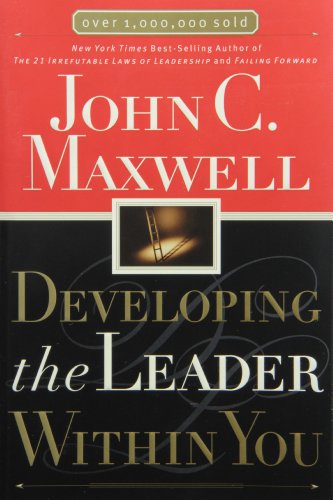
In this repackaged bestseller John Maxwell examines the differences between leadership styles, outlines principles for inspiring, motivating, and influencing others. These principles can be used in any organization to foster integrity and self-discipline and bring a positive change.
Developing the Leader Within You also allows readers to examine how to be effective in the highest calling of leadership by understanding the five characteristics that set "leader managers" apart from "run-of-the-mill managers."
In this John Maxwell classic, he shows readers how to develop the vision, value, influence, and motivation required of successful leaders.
Developing the Leader Within You
By John C. MaxwellThomas Nelson
Copyright © 1993 John C. Maxwell
All right reserved.ISBN: 978-0-7852-6666-2Contents
Introduction.......................................................................vii1. The Definition of Leadership: Influence.........................................12. The Key to Leadership: Priorities...............................................193. The Most Important Ingredient of Leadership: Integrity..........................354. The Ultimate Test of Leadership: Creating Positive Change.......................495. The Quickest Way to Gain Leadership: Problem Solving............................756. The Extra Plus in Leadership: Attitude..........................................977. Developing Your Most Appreciable Asset: People..................................1158. The Indispensable Quality of Leadership: Vision.................................1399. The Price Tag of Leadership: Self-Discipline....................................16110. The Most Important Lesson of Leadership: Staff Development.....................179Epilogue...........................................................................201Notes..............................................................................203About the Author...................................................................208
Chapter One
The Definition of Leadership:
Influence
Everyone talks about it; few understand it. Most people want it; few achieve it. There are over fifty definitions and descriptions of it in my personal files. What is this intriguing subject we call "leadership"?
Perhaps because most of us want to be leaders, we become emotionally involved when trying to define leadership. Or, perhaps because we know one, we try to copy his or her behavior and describe leadership as a personality. Ask ten people to define leadership and you'll probably receive ten different answers. After more than five decades of observing leadership within my family and many years of developing my own leadership potential, I have come to this conclusion: Leadership is influence. That's it. Nothing more; nothing less. My favorite leadership proverb is: He who thinketh he leadeth and hath no one following him is only taking a walk.
James C. Georges, of the ParTraining Corporation, said it quite effectively in a recent interview with Executive Communications:
What is leadership? Remove for a moment the moral issues behind it, and there is only one definition: Leadership is the ability to obtain followers.
Hitler was a leader and so was Jim Jones. Jesus of Nazareth, Martin Luther King, Jr., Winston Churchill, and John F. Kennedy all were leaders. While their value systems and management abilities were very different, each had followers. Once you define leadership as the ability to get followers, you work backward from that point of reference to figure out how to lead.
Therein lies the problem. Most people define leadership as the ability to achieve a position, not to get followers. Therefore, they go after a position, rank, or title and, upon their arrival, think they have become a leader. This type of thinking creates two common problems: Those who possess the "status" of leader often experience the frustration of few followers, and those who lack the proper titles may not see themselves as leaders and therefore don't develop their leadership skills.
My goal with this book is to help you accept leadership as influence (that is, the ability to get followers), and then work backward from that point to help you learn how to lead. Each chapter is designed to place in your hand another principle that will assist your leadership development. This first chapter is designed to expand the level of your influence.
Insights About Influence
Everyone Influences Someone
Sociologists tell us that even the most introverted individual will influence ten thousand other people during his or her lifetime! This amazing statistic was shared with me by my associate Tim Elmore. Tim and I concluded that each one of us is both influencing and being influenced by others. That means that all of us are leading in some areas, while in other areas we are being led. No one is excluded from being a leader or a follower. Realizing your potential as a leader is your responsibility. In any given situation with any given group, there is a prominent influencer. Let me illustrate. The mother may be the dominant influencer over a child in the morning before school begins. Mom may choose what to eat and what to wear. The child who is influenced before school may become the influencer of other children once school begins. Dad and Mom may meet at a restaurant for lunch and both be influenced by the waiter, who suggests the house specialty. The time dinner is served in the evening may be set because of either the husband's or wife's work schedule.
The prominent leader of any group is quite easily discovered. Just observe the people as they gather. If an issue is to be decided, who is the person whose opinion seems most valuable? Who is the one others watch the most when the issue is being discussed? Who is the one with whom people quickly agree? Most importantly, who is the one the others follow? Answers to these questions will help you discern who the real leader is in a particular group.
We Never Know Who or How Much We Influence The most effective way to understand the power of influence is to think of the times you have been touched by the influence of a person or an event. Big events leave marks on all our lives and memories. For example, ask a couple of people born prior to 1930 what they were doing when they heard that Pearl Harbor had been bombed, and they will describe in detail their feelings and surroundings when they heard the terrible news. Ask someone born before 1955 to describe what he or she was doing when the news that John F. Kennedy had been shot was broadcast. Again, you will find no loss for words. A similar response occurs with the younger generation when asked about the day the Challenger blew up. These were big events that touched everyone.
Think also of the little things or people who influenced you in a powerful way. In reflecting on my own life, I think of the influence of a camp I attended as a youth and how it helped determine my career choice. I think of my seventh-grade teacher, Glen Leatherwood ... the bubble lights on our Christmas tree that gave me the "Christmas feeling" every year ... the affirming note I received from a professor in college ... The list is endless. Life consists of influencers who daily find us vulnerable to their impressions and, therefore, have helped mold us into the persons we are. J. R. Miller said it well: "There have been meetings of only a moment which have left impressions for life, for eternity. No one can understand that mysterious thing we call influence ... yet ... everyone of us continually exerts influence, either to heal, to bless, to leave marks of beauty; or to wound, to hurt, to poison, to stain other lives."
This truth also sobers me when I realize my influence as a father. A friend gave me a plaque with this poem on it. Now it sits on my desk:
The Little Chap Who Follows Me A careful man I want to be, A little fellow follows me; I do not dare to go astray For...