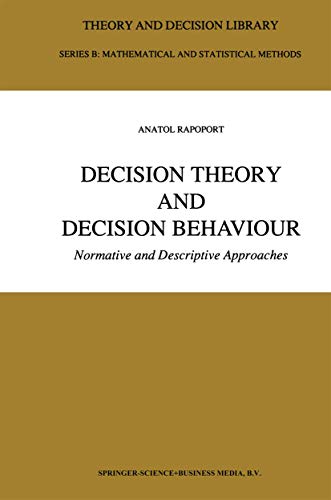
Decision Theory and Decision Behaviour: Normative and Descriptive Approaches (Theory and Decision Library B)
Rapoport, Anatol
ISBN 10: 9048140471 ISBN 13: 9789048140473
Verlag: Springer, 2010
Neu
Softcover
Verkäufer
Ria Christie Collections, Uxbridge, Vereinigtes Königreich
Verkäuferbewertung 5 von 5 Sternen

AbeBooks-Verkäufer seit 25. März 2015
Dieser Artikel ist nicht mehr verfügbar.
Beschreibung
Beschreibung:
In. Bestandsnummer des Verkäufers ria9789048140473_new
Inhaltsangabe:
This book presents the content of a year's course in decision processes for third and fourth year students given at the University of Toronto. A principal theme of the book is the relationship between normative and descriptive decision theory. The distinction between the two approaches is not clear to everyone, yet it is of great importance. Normative decision theory addresses itself to the question of how people ought to make decisions in various types of situations, if they wish to be regarded (or to regard themselves) as 'rational'. Descriptive decision theory purports to describe how people actually make decisions in a variety of situations. Normative decision theory is much more formalized than descriptive theory. Especially in its advanced branches, normative theory makes use of mathematicallanguage, mode of discourse, and concepts. For this reason, the definitions of terms encountered in normative decision theory are precise, and its deductions are rigorous. Like the terms and assertions of other branches of mathematics, those of mathematically formalized decision theory need not refer to anything in the 'real', i. e. the observable, world. The terms and assertions can be interpreted in the context of models of real li fe situations, but the verisimilitude of the models is not important. They are meant to capture only the essentials of adecision situation, which in reallife may be obscured by complex details and ambiguities. It is these details and ambiguities, however, that may be crucial in determining the outcomes of the decisions.
Reseña del editor: This book presents the content of a year's course in decision processes for third and fourth year students given at the University of Toronto. A principal theme of the book is the relationship between normative and descriptive decision theory. The distinction between the two approaches is not clear to everyone, yet it is of great importance. Normative decision theory addresses itself to the question of how people ought to make decisions in various types of situations, if they wish to be regarded (or to regard themselves) as 'rational'. Descriptive decision theory purports to describe how people actually make decisions in a variety of situations. Normative decision theory is much more formalized than descriptive theory. Especially in its advanced branches, normative theory makes use of mathematicallanguage, mode of discourse, and concepts. For this reason, the definitions of terms encountered in normative decision theory are precise, and its deductions are rigorous. Like the terms and assertions of other branches of mathematics, those of mathematically formalized decision theory need not refer to anything in the 'real', i. e. the observable, world. The terms and assertions can be interpreted in the context of models of real li fe situations, but the verisimilitude of the models is not important. They are meant to capture only the essentials of adecision situation, which in reallife may be obscured by complex details and ambiguities. It is these details and ambiguities, however, that may be crucial in determining the outcomes of the decisions.
„Über diesen Titel“ kann sich auf eine andere Ausgabe dieses Titels beziehen.
Bibliografische Details
Titel: Decision Theory and Decision Behaviour: ...
Verlag: Springer
Erscheinungsdatum: 2010
Einband: Softcover
Zustand: New
Beste Suchergebnisse beim ZVAB
Decision Theory and Decision Behaviour | Normative and Descriptive Approaches
Anbieter: preigu, Osnabrück, Deutschland
Verkäuferbewertung 5 von 5 Sternen
Taschenbuch. Zustand: Neu. Decision Theory and Decision Behaviour | Normative and Descriptive Approaches | Anatol Rapoport | Taschenbuch | x | Englisch | 2010 | Springer | EAN 9789048140473 | Verantwortliche Person für die EU: Springer Verlag GmbH, Tiergartenstr. 17, 69121 Heidelberg, juergen[dot]hartmann[at]springer[dot]com | Anbieter: preigu. Artikel-Nr. 107247093
Neu kaufen
EUR 277,75
EUR 70,00 shipping
Versand von Deutschland nach USA
Versand von Deutschland nach USA
Anzahl: 5 verfügbar

Foto des Verkäufers
Decision Theory and Decision Behaviour : Normative and Descriptive Approaches
Verlag:
Springer Netherlands, Springer Netherlands, 2010
ISBN 10: 9048140471
ISBN 13: 9789048140473
Neu
Taschenbuch
Anbieter: AHA-BUCH GmbH, Einbeck, Deutschland
Verkäuferbewertung 5 von 5 Sternen
Taschenbuch. Zustand: Neu. Druck auf Anfrage Neuware - Printed after ordering - This book presents the content of a year's course in decision processes for third and fourth year students given at the University of Toronto. A principal theme of the book is the relationship between normative and descriptive decision theory. The distinction between the two approaches is not clear to everyone, yet it is of great importance. Normative decision theory addresses itself to the question of how people ought to make decisions in various types of situations, if they wish to be regarded (or to regard themselves) as 'rational'. Descriptive decision theory purports to describe how people actually make decisions in a variety of situations. Normative decision theory is much more formalized than descriptive theory. Especially in its advanced branches, normative theory makes use of mathematicallanguage, mode of discourse, and concepts. For this reason, the definitions of terms encountered in normative decision theory are precise, and its deductions are rigorous. Like the terms and assertions of other branches of mathematics, those of mathematically formalized decision theory need not refer to anything in the 'real', i. e. the observable, world. The terms and assertions can be interpreted in the context of models of real li fe situations, but the verisimilitude of the models is not important. They are meant to capture only the essentials of adecision situation, which in reallife may be obscured by complex details and ambiguities. It is these details and ambiguities, however, that may be crucial in determining the outcomes of the decisions. Artikel-Nr. 9789048140473
Neu kaufen
EUR 331,86
EUR 63,34 shipping
Versand von Deutschland nach USA
Versand von Deutschland nach USA
Anzahl: 1 verfügbar
Beispielbild für diese ISBN
Decision Theory and Decision Behaviour: Normative and Descriptive Approaches (Theory and Decision Library B)
Anbieter: Revaluation Books, Exeter, Vereinigtes Königreich
Verkäuferbewertung 5 von 5 Sternen
Paperback. Zustand: Brand New. 448 pages. 9.25x6.10x1.00 inches. In Stock. Artikel-Nr. x-9048140471
Neu kaufen
EUR 443,42
EUR 14,24 shipping
Versand von Vereinigtes Königreich nach USA
Versand von Vereinigtes Königreich nach USA
Anzahl: 2 verfügbar