
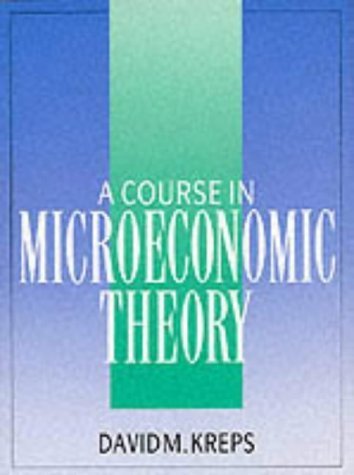
David kreps has developed a text in microeconomics that succeeds in being both
challenging and user-friendly. The book is designed for final-year undergraduate
and graduate students of microeconomics theory, with numerous problem sets and
exercises. The author uses a wide variety of markets for examples with a
concentration in industrial economics. He provides a very broad coverage of
traditional and modern approaches to microeconomic theory, with a careful
progression from the traditional approach to modern developments.
David kreps has developed a text in microeconomics that succeeds in being both
challenging and user-friendly. The book is designed for final-year undergraduate
and graduate students of microeconomics theory, with numerous problem sets and
exercises. The author uses a wide variety of markets for examples with a
concentration in industrial economics. He provides a very broad coverage of
traditional and modern approaches to microeconomic theory, with a careful
progression from the traditional approach to modern developments.
The book begins with an exposition of the standard models of choice and the
market, with extra attention paid to choice under uncertainty and dynamic choice.
General and partial equilibruim approaches are blended, so that the student sees
the approaches not as completely different from each other but as points along a
continuum. The book then turns to more modern developments. The reader is first
introduced to noncooperative game theory and is shown how to model games and
determine solution concepts. Models with incomplete information, the folk
theorem and reputation, and bilateral bargaining are covered in depth, with
application to entry deterrence, implicit collusion, and reputation for quality.
Information economics is explored next: moral hazard and incentives, adverse
selection and market signalling and mechanism design. The work closes with a
discussion of firms as organizations', giving the reader a taste of
transaction-cost economics.
DAVID KREPS is the Paul E Holden Professor of Economics,
Stanford University.