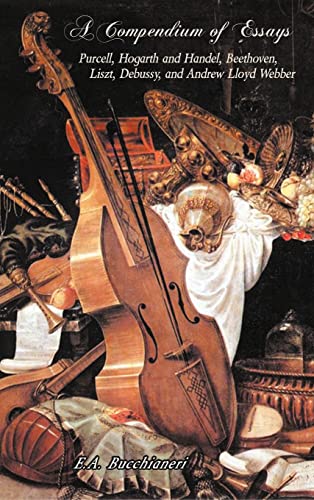
SIX ESSAYS. THREE CENTURIES. MUSIC IN CONVERSATION WITH ART, LITERATURE, PHILOSOPHY, AND THEATRE.
Music does not develop in isolation. Composers respond to the artistic ideals, philosophical debates, social expectations, political changes, literary movements, and theatrical conventions of their times.
A Compendium of Essays brings together six wide-ranging studies that trace these connections from the Baroque era to contemporary musical theatre. E.A. Bucchianeri examines familiar composers and works from unexpected perspectives, placing music beside painting, literature, philosophy, history, and stagecraft.
The collection begins with Henry Purcell's Dido and Aeneas and its possible moral and educational significance for young women. It then turns to William Hogarth's The Rake's Levée, offering a musical interpretation of the celebrated satirical image and reconsidering the presence and cultural significance of Handel within the scene.
A substantial essay on Beethoven follows the changing philosophical character of his symphonies. Drawing upon Edmund Burke's concept of the sublime, the discussion traces the development of Beethoven's musical thought from the earliest symphonies through the heroic middle period and onward to the Ninth.
The collection then examines Liszt's Faust Symphony, its relationship to Goethe, and Liszt's role in the development of the symphonic poem.
Further essays explore Orientalism and Debussy's progressive musical language before concluding with Andrew Lloyd Webber's The Phantom of the Opera as an example of a modern musical-theatre renaissance.
The six essays explore:
- Purcell's Dido and Aeneas as a possible musical exemplum
- Hogarth, Handel, and the musical symbolism of The Rake's Levée
- Beethoven's symphonies through history, philosophy, and the sublime
- Liszt, Goethe, the Faust Symphony, and the symphonic poem
- Orientalism, cultural encounter, and Debussy's developing style
- Andrew Lloyd Webber's Phantom of the Opera and the renewal of musical theatre
Illustrations and musical examples accompany several essays, supporting the author's analytical arguments and cultural interpretations. The volume also includes a select bibliography and a comprehensive index.
Written for music lovers, students, performers, researchers, and readers interested in the wider arts, A Compendium of Essays reveals unexpected connections across centuries of artistic life-from Purcell's operatic tragedy to the masked world of the modern musical stage.
E.A. Bucchianeri is an author and independent researcher whose work explores literature, music, art, religion, and cultural history. Born in Carson City, Nevada, Bucchianeri grew up in Virginia City and was educated at Loreto Academy and University College Cork, Ireland, earning a Bachelor of Music degree. Publications include the two-volume study 'Faust: My Soul Be Damned for the World', 'Handel's Path to Covent Garden', 'Phantom Phantasia', and the Gadfly Saga novels. E.A. Bucchianeri currently lives in Fátima, Portugal.