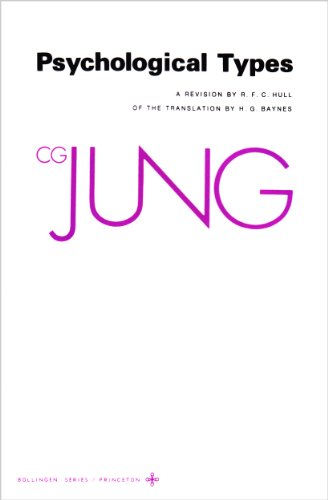
Collected Works of C. G. Jung, Volume 6 Psychological Types

Jung, C. G./ Adler, Gerhard (Editor)/ Fordham, Michael (Editor)/ McGuire, William (Editor)/ Hull, R. F. C. (Translator)/ Baynes, Helton G. (Translator)

ISBN 10: 0691018138 ISBN 13: 9780691018133
Verlag: Bollingen Foundation, 1976
Neu Paperback

Verkäufer Revaluation Books, Exeter, Vereinigtes Königreich Verkäuferbewertung 5 von 5 Sternen 5 Sterne, Erfahren Sie mehr über Verkäufer-Bewertungen

AbeBooks-Verkäufer seit 6. Januar 2003


Beschreibung

Beschreibung:

a revision / edition. 632 pages. 9.00x6.00x1.50 inches. In Stock. Bestandsnummer des Verkäufers 0691018138

Diesen Artikel melden

Inhaltsangabe:

One of the most important of Jung's longer works, and probably the most famous of his books, Psychological Types appeared in German in 1921 after a "fallow period" of eight years during which Jung had published little. He called it "the fruit of nearly twenty years' work in the domain of practical psychology," and in his autobiography he wrote: "This work sprang originally from my need to define the ways in which my outlook differed from Freud's and Adler's. In attempting to answer this question, I came across the problem of types; for it is one's psychological type which from the outset determines and limits a person's judgment. My book, therefore, was an effort to deal with the relationship of the individual to the world, to people and things. It discussed the various aspects of consciousness, the various attitudes the conscious mind might take toward the world, and thus constitutes a psychology of consciousness regarded from what might be called a clinical angle."


In expounding his system of personality types Jung relied not so much on formal case data as on the countless impressions and experiences derived from the treatment of nervous illnesses, from intercourse with people of all social levels, "friend and foe alike," and from an analysis of his own psychological nature. The book is rich in material drawn from literature, aesthetics, religion, and philosophy. The extended chapters that give general descriptions of the types and definitions of Jung's principal psychological concepts are key documents in analytical psychology.

Auszug. © Genehmigter Nachdruck. Alle Rechte vorbehalten.:

PSYCHOLOGICAL TYPES

By C. G. JUNG, GERHARD ADLER, H. G. BAYNES

PRINCETON UNIVERSITY PRESS

Copyright © 1971 PRINCETON UNIVERSITY PRESS
All rights reserved.
ISBN: 978-0-691-01813-3

Contents

EDITORIAL NOTE, v,
FOREWORD TO THE FIRST SWISS EDITION, xi,
FOREWORDS TO THE SEVENTH AND EIGHTH SWISS EDITIONS, xii,
FOREWORD TO THE ARGENTINE EDITION, xiv,
Introduction, 3,
I. The Problem of Types in the History of Classical and Medieval Thought, 8,
II. Schiller's Ideas on the Type Problem, 67,
III. The Apollinian and the Dionysian, 136,
IV. The Type Problem in Human Character, 147,
V. The Type Problem in Poetry, 166,
VI. The Type Problem in Psychopathology, 273,
VII. The Type Problem in Aesthetics, 289,
VIII. The Type Problem in Modern Philosophy, 300,
IX. The Type Problem in Biography, 322,
X. General Description of the Types, 330,
XI. Definitions, 408,
Epilogue, 487,
APPENDIX: FOUR PAPERS ON PSYCHOLOGICAL TYPOLOGY, 497,
TABLE: CORRELATION OF PARAGRAPH NUMBERS, 557,
BIBLIOGRAPHY, 567,
INDEX, 585,


CHAPTER 1

THE PROBLEM OF TYPES IN THE HISTORY OF CLASSICAL AND MEDIEVAL THOUGHT


1. PSYCHOLOGY IN THE CLASSICAL AGE: THE GNOSTICS, TERTULLIAN, ORIGEN

8 So long as the historical world has existed there has always been psychology, but an objective psychology is only of recent growth. We could say of the science of former times that in proportion to the lack of objective psychology there is an increase in the rate of subjectivity. Hence, though the works of the ancients are full of psychology, only little of it can be described as objective psychology. This may be due in no small measure to the peculiar character of human relationships in classical and medieval times. The ancients had, so to speak, an almost entirely biological valuation of their fellow-men; this is everywhere apparent in their habits of life and in the legislation of antiquity. The medieval man, in so far as his value judgments found any expression at all, had on the contrary a metaphysical valuation of his fellows, and this had its source in the idea of the imperishable value of the human soul. This metaphysical valuation, which may be regarded as compensatory to the standpoint of antiquity, is just as unfavourable as the biological one so far as a personal valuation is concerned, which alone can form the basis of an objective psychology.

9 Although not a few people think that a psychology can be written ex cathedra, nowadays most of us are convinced that an objective psychology must be founded above all on observation and experience. This foundation would be ideal if only it were possible. The ideal and aim of science do not consist in giving the most exact possible description of the facts—science cannot compete as a recording instrument with the camera and the gramophone—but in establishing certain laws, which are merely abbreviated expressions for many diverse processes that are yet conceived to be somehow correlated. This aim goes beyond the purely empirical by means of the concept, which, though it may have general and proved validity, will always be a product of the subjective psychological constellation of the investigator. In the making of scientific theories and concepts many personal and accidental factors are involved. There is also a personal equation that is psychological and not merely psychophysical. We see colours but not wave-lengths. This well-known fact must nowhere be taken to heart more seriously than in psychology. The effect of the personal equation begins already in the act of observation. One sees what one can best see oneself. Thus, first and foremost, one sees the mote in one's brother's eye. No doubt the mote is there, but the beam sits in one's own eye—and may considerably hamper the act of seeing. I mistrust the principle of "pure observation" in so-called objective psychology unless one confines oneself to the eye-pieces of chronoscopes and tachistoscopes and suchlike "psychological" apparatus. With such methods one also guards against too embarrassing a yield of empirical psychological facts.

10 But the personal equation asserts itself even more in the presentation and communication of one's own observations, to say nothing of the interpretation and abstract exposition of the empirical material. Nowhere is the basic requirement so indispensable as in psychology that the observer should be adequate to his object, in the sense of being able to see not only subjectively but also objectively. The demand that he should see only objectively is quite out of the question, for it is impossible. We must be satisfied if he does not see too subjectively. That the subjective observation and interpretation accord with the objective facts proves the truth of the interpretation only in so far as the latter makes no pretence to be generally valid, but valid only for that area of the object which is being considered. To this extent it is just the beam in one's own eye that enables one to detect the mote in one's brother's eye. The beam in one's own eye, as we have said, does not prove that one's brother has no mote in his. But the impairment of one's own vision might easily give rise to a general theory that all motes are beams.

11 The recognition and taking to heart of the subjective determination of knowledge in general, and of psychological knowledge in particular, are basic conditions for the scientific and impartial evaluation of a psyche different from that of the observing subject. These conditions are fulfilled only when the observer is sufficiently informed about the nature and scope of his own personality. He can, however, be sufficiently informed only when he has in large measure freed himself from the levelling influence of collective opinions and thereby arrived at a clear conception of his own individuality.

12 The further we go back into history, the more we see personality disappearing beneath the wrappings of collectivity. And if we go right back to primitive psychology, we find absolutely no trace of the concept of an individual. Instead of individuality we find only collective relationship or what Lévy-Bruhl calls participation mystique. The collective attitude hinders the recognition and evaluation of a psychology different from the subject's, because the mind that is collectively oriented is quite incapable of thinking and feeling in any other way than by projection. What we understand by the concept "individual" is a relatively recent acquisition in the history of the human mind and human culture. It is no wonder, therefore, that the earlier all-powerful collective attitude prevented almost completely an objective psychological evaluation of individual differences, or any scientific objectification of individual psychological processes. It was owing to this very lack of psychological thinking that knowledge became "psychologized," i.e., filled with projected psychology. We find striking examples of this in man's first attempts at a philosophical explanation of the cosmos. The development of individuality, with the consequent psychological differentiation of man, goes hand in hand with the de-psychologizing work of objective science.

13 These reflections may explain why objective psychology has such a meagre source in the material handed down to us from antiquity. The differentiation of the four temperaments, which we took over from the ancients, hardly rates as a psychological typology since the temperaments are scarcely more than psychophysical colourings....

„Über diesen Titel“ kann sich auf eine andere Ausgabe dieses Titels beziehen.

Bibliografische Details

Titel: Collected Works of C. G. Jung, Volume 6 ...
Verlag: Bollingen Foundation
Erscheinungsdatum: 1976
Einband: Paperback
Zustand: Brand New

Beste Suchergebnisse beim ZVAB

Beispielbild für diese ISBN

Jung, C. G.; Baynes, Helton G.;Adler, Gerhard;Fordham, Michael;McGuire, William;Hull, R. F. C.
Verlag: Princeton Univ Pr, 1976
ISBN 10: 0691018138 ISBN 13: 9780691018133
Gebraucht paperback

Anbieter: Magers and Quinn Booksellers, Minneapolis, MN, USA

Verkäuferbewertung 5 von 5 Sternen 5 Sterne, Erfahren Sie mehr über Verkäufer-Bewertungen

paperback. Zustand: Acceptable. May have underlining, highlighting, margin notes, remainder marks, inscriptions, book plates, tears, significant wear, and/or a missing dust jacket, box, or discs. Damaged item. Artikel-Nr. 1540617

Verkäufer kontaktieren

Gebraucht kaufen

EUR 9,87
EUR 3,40 Versand
Versand innerhalb von USA

Anzahl: 1 verfügbar

In den Warenkorb

Beispielbild für diese ISBN

C. G. Jung
ISBN 10: 0691018138 ISBN 13: 9780691018133
Gebraucht Softcover

Anbieter: World of Books (was SecondSale), Montgomery, IL, USA

Verkäuferbewertung 5 von 5 Sternen 5 Sterne, Erfahren Sie mehr über Verkäufer-Bewertungen

Zustand: Good. Item in good condition. Textbooks may not include supplemental items i.e. CDs, access codes etc. Artikel-Nr. 00103354824

Verkäufer kontaktieren

Gebraucht kaufen

EUR 13,36
Versand gratis
Versand innerhalb von USA

Anzahl: 1 verfügbar

In den Warenkorb

Foto des Verkäufers

C. G. Jung
ISBN 10: 0691018138 ISBN 13: 9780691018133
Gebraucht Paperback

Anbieter: Southampton Books, Sag Harbor, NY, USA

Verkäuferbewertung 5 von 5 Sternen 5 Sterne, Erfahren Sie mehr über Verkäufer-Bewertungen

Paperback. Zustand: Very Good. FIRST THUS. First Edition Thus, 9th Printing (1990). Published by C, 1999. Octavo. Paperback. Book is very good with shelf/edgewear and previous owner pencil underlining and margin notes on few pages.100% positive feedback. 30 day money back guarantee. NEXT DAY SHIPPING! Excellent customer service. Please email with any questions. All books packed carefully and ship with free delivery confirmation/tracking. All books come with free bookmarks. Ships from Sag Harbor, New York. Artikel-Nr. 415344

Verkäufer kontaktieren

Gebraucht kaufen

EUR 17,55
EUR 3,40 Versand
Versand innerhalb von USA

Anzahl: 1 verfügbar

In den Warenkorb

Beispielbild für diese ISBN

Carl Gustav Jung
ISBN 10: 0691018138 ISBN 13: 9780691018133
Gebraucht Softcover

Anbieter: medimops, Berlin, Deutschland

Verkäuferbewertung 5 von 5 Sternen 5 Sterne, Erfahren Sie mehr über Verkäufer-Bewertungen

Zustand: acceptable. Ausreichend/Acceptable: Exemplar mit vollständigem Text und sämtlichen Abbildungen oder Karten. Schmutztitel oder Vorsatz können fehlen. Einband bzw. Schutzumschlag weisen unter Umständen starke Gebrauchsspuren auf. / Describes a book or dust jacket that has the complete text pages (including those with maps or plates) but may lack endpapers, half-title, etc. (which must be noted). Binding, dust jacket (if any), etc may also be worn. Artikel-Nr. M00691018138-B

Verkäufer kontaktieren

Gebraucht kaufen

EUR 19,44
EUR 10,00 Versand
Versand von Deutschland nach USA

Anzahl: 1 verfügbar

In den Warenkorb

Foto des Verkäufers

Jung, C. G., Gerhard Adler und R. F. C. Hull:
Verlag: PRINCETON UNIV PR, 1976
ISBN 10: 0691018138 ISBN 13: 9780691018133
Gebraucht Softcover

Anbieter: Berliner Büchertisch eG, Berlin, Deutschland

Verkäuferbewertung 5 von 5 Sternen 5 Sterne, Erfahren Sie mehr über Verkäufer-Bewertungen

Softcover. Zustand: Befriedigend. Revised. 634 S. Akzeptables Exemplar, deutliche Gebrauchsspuren, Cover/SU bestoßen, Schnitt/Papier nachgedunkelt, Anstreichungen/Anmerkungen im Text, ist aber noch gut zu gebrauchen; Acceptable copy, noticeable wear, cover/dust jacket shows wear, edges/text pages show yellowing/darkening, interior highlighting/writing, but still of use. C231212aB28 ISBN: 9780691018133 Sprache: Englisch Gewicht in Gramm: 657. Artikel-Nr. 676886

Verkäufer kontaktieren

Gebraucht kaufen

EUR 24,27
EUR 100,00 Versand
Versand von Deutschland nach USA

Anzahl: 1 verfügbar

In den Warenkorb

Foto des Verkäufers

C. G. Jung|Gerhard Adler|R. F.c. Hull
Verlag: PRINCETON UNIV PR, 1992
ISBN 10: 0691018138 ISBN 13: 9780691018133
Neu Softcover

Anbieter: moluna, Greven, Deutschland

Verkäuferbewertung 5 von 5 Sternen 5 Sterne, Erfahren Sie mehr über Verkäufer-Bewertungen

Zustand: New. A work in the domain of practical psychology. It discusses various aspects of consciousness, the various attitudes the conscious mind might take toward the world, and thus constitutes a psychology of consciousness regarded from what might be called a clinic. Artikel-Nr. 329701095

Verkäufer kontaktieren

Neu kaufen

EUR 34,63
EUR 48,99 Versand
Versand von Deutschland nach USA

Anzahl: 3 verfügbar

In den Warenkorb

Beispielbild für diese ISBN

Jung, C. G./ Adler, Gerhard (Editor)/ Fordham, Michael (Editor)/ McGuire, William (Editor)/ Hull, R. F. C. (Translator)/ Baynes, Helton G. (Translator)
Verlag: Bollingen Foundation, 1976
ISBN 10: 0691018138 ISBN 13: 9780691018133
Neu Paperback

Anbieter: Revaluation Books, Exeter, Vereinigtes Königreich

Verkäuferbewertung 5 von 5 Sternen 5 Sterne, Erfahren Sie mehr über Verkäufer-Bewertungen

Paperback. Zustand: Brand New. a revision / edition. 632 pages. 9.00x6.00x1.50 inches. In Stock. Artikel-Nr. __0691018138

Verkäufer kontaktieren

Neu kaufen

EUR 39,49
EUR 14,42 Versand
Versand von Vereinigtes Königreich nach USA

Anzahl: 1 verfügbar

In den Warenkorb

Beispielbild für diese ISBN

Jung, C. G./ Adler, Gerhard (Editor)/ Fordham, Michael (Editor)/ McGuire, William (Editor)/ Hull, R. F. C. (Translator)/ Baynes, Helton G. (Translator)
Verlag: Bollingen Foundation, 1976
ISBN 10: 0691018138 ISBN 13: 9780691018133
Neu Paperback

Anbieter: Revaluation Books, Exeter, Vereinigtes Königreich

Verkäuferbewertung 5 von 5 Sternen 5 Sterne, Erfahren Sie mehr über Verkäufer-Bewertungen

Paperback. Zustand: Brand New. a revision / edition. 632 pages. 9.00x6.00x1.50 inches. In Stock. Artikel-Nr. xr0691018138

Verkäufer kontaktieren

Neu kaufen

EUR 41,57
EUR 14,42 Versand
Versand von Vereinigtes Königreich nach USA

Anzahl: 2 verfügbar

In den Warenkorb

Beispielbild für diese ISBN

Jung, C. G./ Adler, Gerhard (Editor)/ Fordham, Michael (Editor)/ McGuire, William (Editor)/ Hull, R. F. C. (Translator)/ Baynes, Helton G. (Translator)
Verlag: Bollingen Foundation, 1976
ISBN 10: 0691018138 ISBN 13: 9780691018133
Neu Paperback

Anbieter: Revaluation Books, Exeter, Vereinigtes Königreich

Verkäuferbewertung 5 von 5 Sternen 5 Sterne, Erfahren Sie mehr über Verkäufer-Bewertungen

Paperback. Zustand: Brand New. a revision / edition. 632 pages. 9.00x6.00x1.50 inches. In Stock. Artikel-Nr. xi0691018138

Verkäufer kontaktieren

Neu kaufen

EUR 41,57
EUR 14,42 Versand
Versand von Vereinigtes Königreich nach USA

Anzahl: 2 verfügbar

In den Warenkorb

Foto des Verkäufers

C G Jung
ISBN 10: 0691018138 ISBN 13: 9780691018133
Neu Taschenbuch

Anbieter: AHA-BUCH GmbH, Einbeck, Deutschland

Verkäuferbewertung 5 von 5 Sternen 5 Sterne, Erfahren Sie mehr über Verkäufer-Bewertungen

Taschenbuch. Zustand: Neu. Neuware - One of the most important of Jung's longer works, and probably the most famous of his books, Psychological Types appeared in German in 1921 after a 'fallow period' of eight years during which Jung had published little. He called it 'the fruit of nearly twenty years' work in the domain of practical psychology,' and in his autobiography he wrote: 'This work sprang originally from my need to define the ways in which my outlook differed from Freud's and Adler's. In attempting to answer this question, I came across the problem of types; for it is one's psychological type which from the outset determines and limits a person's judgment. My book, therefore, was an effort to deal with the relationship of the individual to the world, to people and things. It discussed the various aspects of consciousness, the various attitudes the conscious mind might take toward the world, and thus constitutes a psychology of consciousness regarded from what might be called a clinical angle.' In expounding his system of personality types Jung relied not so much on formal case data as on the countless impressions and experiences derived from the treatment of nervous illnesses, from intercourse with people of all social levels, 'friend and foe alike,' and from an analysis of his own psychological nature. The book is rich in material drawn from literature, aesthetics, religion, and philosophy. The extended chapters that give general descriptions of the types and definitions of Jung's principal psychological concepts are key documents in analytical psychology. Artikel-Nr. 9780691018133

Verkäufer kontaktieren

Neu kaufen

EUR 43,52
EUR 63,78 Versand
Versand von Deutschland nach USA

Anzahl: 1 verfügbar

In den Warenkorb