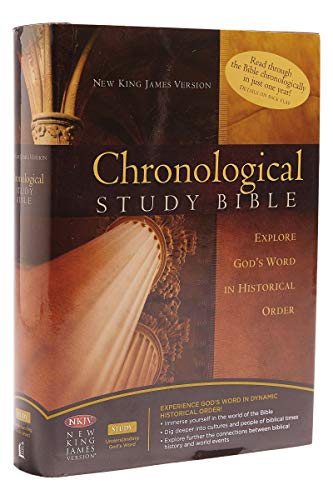
Take a journey through the history and culture of the Bible with the only study Bible that unfolds in historical order.
The Chronological Study Bible presents the text of the New King James Version in chronological order - the order in which the events actually happened - with notes, articles, and full-color graphics that connect the reader to the history and culture of Bible times. It is the only NKJV study Bible arranged in chronological order.
Features include:
- The entire NKJV text with translators’ notes, arranged in chronological order, provides absorbing and effective Bible study
- Full-color illustrations of places, artifacts, and cultural phenomena give the reader a dramatic, “you are there” experience
- Fascinating articles connect the Bible text to world history and culture
- Daily Life Notes help you relate to how people lived in Bible times
- Time Panels and Charts show the flow of Bible history
- In-text and full-page color maps of the biblical world provide a visual representation of Israel and other biblical locations for better context
- Easy-to-read large10-point type size
Part of the Signature Series line of Thomas Nelson Bibles
Chronological Study Bibles sold to date: More than 400,000
The New King James Version® - More than 60 million copies sold
The Chronological STUDY BIBLE
Thomas Nelson
Copyright © 2008 Thomas Nelson, Inc.
All right reserved.ISBN: 978-0-7180-2068-2Contents
Features......................................................................viContributors..................................................................ixIntroduction..................................................................xReading Theological History...................................................xiiRearranging the Bible's Canonical Order.......................................xiiiNew King James Version........................................................xixEPOCH 1 Before the Patriarchs (Creation-2000 BC)..............................1The Beginnings of Human Civilization..........................................2EPOCH 2 The Patriarchs, Israel's Ancestors (2000-1500 BC).....................18The Changing of the Empires...................................................19Egypt in the Middle Bronze Age................................................51EPOCH 3 The Rise of a Unified People (1500-1200 BC)...........................69Egypt and the Exodus..........................................................70The Conquest of Canaan........................................................229EPOCH 4 From Tribes to a Nation (1200-930 BC).................................257A Tribal Confederation in Israel..............................................258The United Monarchy in Israel.................................................300EPOCH 5 The Fall of Two Nations (930-586 BC)..................................515The Divided Monarchy in Israel................................................517The Neo-Assyrian Empire.......................................................576The Neo-Babylonian Empire.....................................................688EPOCH 6 Exile and Return (586-332 BC).........................................839Exile in Babylon..............................................................841Wisdom in the Ancient Near East...............................................895The Persian Empire............................................................940EPOCH 7 Between the Two Testaments (332-37 BC)................................1057The Greek Empire..............................................................1059The Roman Empire..............................................................1073EPOCH 8 The Coming of the Messiah (37 BC-AD 30)...............................1076Introductions to Jesus Christ.................................................1078Early Lives of John the Baptist and Jesus.....................................1079Beginning of Jesus' Ministry..................................................1089The Galilean Ministry.........................................................1096From Galilee to Jerusalem.....................................................1158Jesus' Final Journey..........................................................1165Final Ministry in Judea.......................................................1183Jesus' Final Week in Jerusalem................................................1195EPOCH 9 The Church Age (AD 30-100)............................................1249The Gospel to the Jews........................................................1251The Gospel to the Gentiles....................................................1263The Gospel to the Gentile World...............................................1272The Gospel from Jerusalem to Rome.............................................1344Apocalyptic Writings and the End Time.........................................1408Cultural and Historical Topics................................................1431Glossary......................................................................1449Concordance...................................................................1469Index of Scripture Passages...................................................1665Daily Reading Plans...........................................................1671
Chapter One
EPOCH ONE
CREATION-2000 B.C.
The Bible begins its story with the accounts of creation and of human-kind's early history. The epoch extending from undatable creation to about 2000 B.C. witnessed the beginning both of life itself and of humankind's first civilizations. This is the time before the patriarchs Abraham, Isaac, and Jacob, long before Israel became a specific people. It is the time of humankind's earliest ancestors.
The very earliest part of this epoch is called "prehistory" because it covers the story of humans before there were recorded events. The advent of writing around 3000 B.C. eventually ended "prehistory," as humans began preserving information concerning their economies, laws, and religions. The various written documents of this period, including lists of kings, inscriptions from buildings, and historical epics, mark the start of the historical era.
ARCHAEOLOGY AND THE PAST
Archaeologists arrange historical and cultural evidence according to the most vital metal of each period, such as stone, copper, bronze, or iron. The earliest period, called the Stone Age, is divided into the Old Stone, Middle Stone, and New Stone ages. A later period, the Bronze Age, is also divided into the Early Bronze, Middle Bronze, and Late Bronze ages. The dates for these periods are approximate, of course, because cultural changes always come gradually. Very early dates are based on theories of evolution and geology, and interpreters of the Bible differ on how such dates relate to the creation accounts in Genesis.
The Old Stone Age is designated by the name "Paleolithic." It was an age of hunting and food-gathering. People lived in caves or temporary shelters. They made implements of flint or chipped stone, and subsisted from what they could gather from nature itself.
The Middle Stone Age is called the Mesolithic period. It was a transitional stage to a food-producing economy. During this period real settlements first appeared, and there was an evolution in the arts of civilization.
The New Stone Age, or Neolithic period, is distinguished by several advances. One of the most notable, the invention of pottery, divides the New Stone Age into a prepottery period (c. 8000-5500 B.C.) and a pottery period (c. 5500-4000 B.C.). Other developments included agriculture, textiles, and the domestication of animals.
The Copper-Stone Age, or Chalcolithic period, saw a transition to a significant use of copper. At some sites from this period, dwellings were underground, entered by shafts from the surface and connected by tunnels. Copper working was found in the many pits, ovens, and fireplaces common in such sites.
The Early Bronze Age is the period in which we leave "prehistory" and enter the "historical" period. This is the period in which written records appear. The Mesopotamians pioneered writing, but Egypt was quick to recognize the benefits of it. At the site of Arad in Palestine, archaeologists have uncovered a potsherd bearing the signature of Narmer, who is often identified with Menes, the pharaoh of Egypt's first dynasty.
THE PEOPLES AND GROUPS
The story of the Bible is linked with the histories of two great lands: Mesopotamia and Egypt. In Mesopotamia two different cultures developed, one in the south and the other in the north.
The earliest known inhabitants of Mesopotamia lived in the southern part, the land of Sumer or southern Babylonia. Known as Sumerians, this culture greatly influenced all of the ancient Near East, including the Israelites. The Sumerians developed a township system of government,...