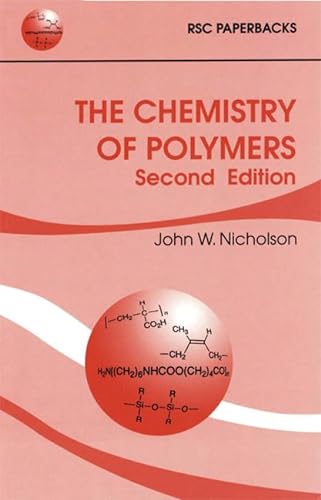
The Chemistry of Polymers
Sprache: Englisch
Verlag: Royal Society of Chemistry, The, 1997
- Softcover
- Gebraucht

Anbieter: Better World Books Ltd, Dunfermline, Vereinigtes KönigreichBetter World Books Ltd
AbeBooks-Verkäufer/-in seit 13. Oktober 2008
Zustand: Gebraucht - Befriedigend
EUR 6,78
Anzahl: 1 verfügbar
In den WarenkorbArtikelbeschreibung vom Verkäufer
Former library copy. Pages intact with minimal writing/highlighting. The binding may be loose and creased. Dust jackets/supplements are not included. Includes library markings. Stock photo provided. Product includes identifying sticker. Better World Books: Buy Books. Do Good.
Bestandsnummer des Verkäufers GRP16667202
- Titel
- The Chemistry of Polymers
- Autor
- Nicholson, John W.
- Verlag
- Royal Society of Chemistry, The
- Veröffentlichungsjahr
- 1997
- Zustand
- Good
- Einband
- Softcover
- Sprache
- Englisch
- ISBN-10
- 0854045589
- ISBN-13
- 9780854045587
- Ausgabe
- 2nd.
- Artikelgewicht
- 0,882 Pfund
- Abmessungen
- N/A
This updated new edition of the well established and highly readable introductory text book on polymer science is ideal for those requiring a broad overview of the subject. Following on from the success of the earlier editions, The Chemistry of Polymers, fourth edition, continues to explore the subject from an applications point of view, providing a comprehensive introduction to all aspects of polymer science including synthesis, structure, properties, degradation and dendrimers. Recent advances in special topics in polymer chemistry and polymers and the environment are also discussed in an informative and up-to-date manner.
Highlights include new sections on RAFT polymerization, polymers in drug delivery and polymer LEDs and updated sections on green polymerization, polymers for solar cells and polymers from renewable sources showcasing the recent developments and applications in this exciting area.
The Chemistry of Polymers, fourth edition, is essential reading for university students, teachers and scientists who wish to acquire an up-to-the-minute overview of polymer science and its many specialised topics in an informative and easy to read style.
„Inhaltsangabe“ gehört möglicherweise zu einer anderen Auflage dieses Titels.
Auszug. © Genehmigter Nachdruck. Alle Rechte vorbehalten.
The Chemistry of Polymers
By John W. NicholsonThe Royal Society of Chemistry
All rights reserved.
Contents
Chapter 1 Polymer Chemistry, 1,
Chapter 2 Polymerisation Reactions, 27,
Chapter 3 Polymer Structure, 47,
Chapter 4 Crosslinking, 63,
Chapter 5 Polymer Solutions, 77,
Chapter 6 Methods of Determining Relative Molar Mass, 94,
Chapter 7 Mechanical Properties of Polymers, 112,
Chapter 8 Polymer Degradation, 139,
Chapter 9 Special Topics in Polymer Chemistry, 155,
Chapter 10 Polymers and the Environment, 173,
Bibliography, 183,
Subject Index, 185,
CHAPTER 1
Polymer Chemistry
BASIC CONCEPTS
A polymer is a large molecule built up from numerous smaller molecules. These large molecules may be linear, slightly branched, or highly interconnected. In the latter case the structure develops into a large three-dimensional network.
The small molecules used as the basic building blocks for these large molecules are known as monomers. For example the commercially important material poly(vinyl chloride) is made from the monomer vinyl chloride. The repeat unit in the polymer usually corresponds to the monomer from which the polymer was made. There are exceptions to this, though. Poly(vinyl alcohol) is formally considered to be made up of vinyl alcohol (CH2CHOH) repeat units but there is, in fact, no such monomer as vinyl alcohol. The appropriate molecular unit exists in the alternative tautomeric form, ethanal CH3CHO. To make this polymer, it is necessary first to prepare poly(vinyl ethanoate) from the monomer vinyl ethanoate, and then to hydrolyse the product to yield the polymeric alcohol.
The size of a polymer molecule may be defined either by its mass (see Chapter 6) or by the number of repeat units in the molecule. This latter indicator of size is called the degree of polymerisation, DP. The relative molar mass of the polymer is thus the product of the relative molar mass of the repeat unit and the DP.
There is no clear cut boundary between polymer chemistry and the rest of chemistry. As a very rough guide, molecules of relative molar mass of at least 1000 or a DP of at least 100 are considered to fall into the domain of polymer chemistry.
The vast majority of polymers in commercial use are organic in nature, that is they are hased on covalent compounds of carbon. This is also true of the silicones which, though based on silicon-oxygen backbones, also generally contain significant proportions of hydrocarbon groups. The other elements involved in polymer chemistry most commonly include hydrogen, oxygen, chlorine, fluorine, phosphorus, and sulfur, i.e. those elements which are able to form covalent bonds, albeit of some polarity, with carbon.
As is characteristic of covalent compounds, in addition to primary valence forces, polymer molecules are also subject to various secondary intermolecular forces. These include dipole forces between oppositely charged ends of polar bonds and dispersion forces which arise due to perturbations of the electron clouds about individual atoms within the polymer molecule. Hydrogen bonding, which arises from the particularly intense dipoles associated with hydrogen atoms attached to electronegative elements such as oxygen or nitrogen, is important in certain polymers, notably proteins. Hydrogen bonds have the effect of fixing the molecule in a particular orientation. These fixed structures are essential for the specific functions that proteins have in the biochemical processes of life.
THE HISTORY OF THE CONCEPT OF THE MACROMOLECULE
Modern books about polymer chemistry explain that the word polymer is derived from the Greek words 'poly' meaning many and 'meros' meaning part. They often then infer that it follows that this term applies to giant molecules built up of large numbers of interconnected monomer units. In fact this is misleading since historically the word polymer was coined for other reasons. The concept of polymerism was originally applied to the situation in which molecules had identical empirical formulae but very different chemical and physical properties. For example, benzene (C6 H6 empirical formula CH) was considered to be a polymer of acetylene (C2H2; empirical formula also CH). Thus the word 'polymer' is to be found in textbooks of organic chemistry published up to about 1920 but not with its modern meaning.
The situation is confused, however, by the case of certain chemicals. Styrene, for example, was known from the mid-nineteenth century as a clear organic liquid of characteristic pungent odour. It was also known to convert itself under certain circumstances into a clear resinous solid that was almost odour-free, this resin then being called metastyrene. The formation of meta-styrene from styrene was described as a polymerisation and metastyrene was held to be a polymer of styrene. However, these terms applied only in the sense that there was no change in empirical formula despite the very profound alteration in chemical and physical properties. There was no understanding of the cause of this change and certainly the chemists of the time had no idea of what had happened to the styrene that was remotely akin to the modern view of polymerisation.
Understanding of the fundamental nature of those materials now called polymers had to wait until the 1920s, when Herman Staudinger coined the word 'macromolecule' and thus clarified thinking. There was no ambiguity about this new term - it meant 'large molecule', again from the Greek, and these days is used almost interchangeably with the word polymer. Strictly speaking, though, the words are not synonymous. There is no reason in principle for a macromolecule to be composed of repeating structural units; in practice, however, they usually are. Staudinger's concept of macromolecules was not at all well received at first. His wife once recalled that he had 'encountered opposition in all his lectures'. Typical of this opposition was that of one distinguished organic chemist who declared that it was as if zoologists 'were told that somewhere in Africa an elephant was found who was 1500 feet long and 300 feet high'.
There were essentially three reasons for this opposition. Firstly, many macromolecular compounds in solution behave as colloids. Hence they were assumed to be identical with the then known inorganic colloids. This in turn implied that they were not macromolecular at all, but were actually composed of small molecules bound together by ill-defined secondary forces. Such thinking led the German chemist C. D. Harries to pursue the search for the 'rubber molecule' in the early years of the twentieth century. He used various mild degradations of natural rubber, which he believed would destroy the colloidal character of the material and yield its constituent molecules, which were assumed to be fairly small. He was, of course, unsuccessful.
The second reason for opposition to Staudinger's hypothesis was that it meant the loss of the concept of a single formula for a single compound. Macromolecules had to be written in the form (CH2CHX)n, where n was a large number. Moreover, no means were available, or indeed are available, for discretely separating molecules where n = 100 from those where n = 101. Any such attempted fractionation always gives a distribution of values of n and, even if the mean value of a fraction is actually n = 100, there are significant numbers of molecules of n...

„Über diesen Titel“ gehört möglicherweise zu einer anderen Auflage dieses Titels.
Better World Books Ltd
Dunfermline, Vereinigtes Königreich
AbeBooks-Verkäufer/-in seit 13. Oktober 2008
Versandkosten von Vereinigtes Königreich nach USA
| Artikel | 11 bis 28 Werktage | 11 bis 28 Werktage |
|---|---|---|
| Erster Artikel | EUR 5,83 | EUR 5,83 |
Zahlungsarten
Shop-Beschreibung
Better World Books is the world’s leading socially conscious online bookseller and has sold over 100 million books. Each sale generates funds for global literacy. We offer low prices, fast shipping, and have a 100% money back guarantee.
Unternehmensdaten der Verkäuferin bzw. des Verkäufers
Better World Books LTD.
THIRD FLOOR, ONE LONDON SQUARE, CROSS LANES
GUILDFORD, Vereinigtes Königreich GU1 1UN
Verkaufsbedingungen
Better World Books (BWB) values your satisfaction and offers you returns within thirty (30) days after the estimated delivery date on most items. All returned items must be in the original condition; used items should include the SKU sticker located on the spine or back of the product.
If you have an incomplete, incorrect, or damaged shipment, please contact our Customer Care team via Abebooks contact seller options before proceeding with the return.Please keep in mind that because we deal mostly in used books, any extra components, such as CDs, DVDs, figurines, or access codes are not included.
Widerrufsrecht
Wenn Sie Verbraucher sind, können Sie gemäß den folgenden Bestimmungen vom Vertrag zurücktreten. Verbraucher ist jede natürliche Person, die zu Zwecken handelt, die nicht ihrer kaufmännischen, gewerblichen, künstlerischen oder beruflichen Tätigkeit zugerechnet werden können.
Informationen zum Widerrufsrecht
Gesetzliches Widerrufsrecht
Sie haben das Recht, den Vertrag innerhalb von 14 Tagen ohne Angabe von Gründen zu widerrufen.
Die Widerrufsfrist beträgt 14 Tage ab dem Tag, an dem Sie oder ein von Ihnen benannter Dritter, der nicht der Transporteur ist, die letzte Ware oder den letzten Posten oder das letzte Exemplar in Besitz genommen hat.
Um das Widerrufsrecht auszuüben, füllen Sie auf unserer Website unter „Meine Einkäufe" in „Mein Nutzerkonto" eine eindeutige Erklärung elektronisch aus und senden Sie sie ab. Wir werden Ihnen unverzüglich eine Bestätigung über den Eingang eines solchen Widerrufs auf einem dauerhaften Datenträger (z. B. per E-Mail) übermitteln.
Um die Widerrufsfrist einzuhalten, reicht es aus, dass Sie Ihre Mitteilung über die Ausübung des Widerrufsrechts vor Ablauf der Widerrufsfrist absenden.
Auswirkungen des Widerrufs
Wenn Sie diesen Vertrag widerrufen, erstatten wir Ihnen alle Zahlungen, die wir von Ihnen erhalten haben, einschließlich der Lieferkosten (mit Ausnahme der zusätzlichen Kosten, die entstehen, wenn Sie eine andere Art der Lieferung als die von uns angebotene günstigste Standardlieferung gewählt haben).
Wir können einen Abzug von der Rückerstattung für den Wertverlust der gelieferten Waren vornehmen, wenn der Verlust auf eine unnötige Behandlung durch Sie zurückzuführen ist.
Wir werden die Rückerstattung unverzüglich und nicht später als 14 Tage nach dem Tag vornehmen, an dem wir über Ihre Entscheidung, diesen Vertrag zu widerrufen, informiert wurden.
Für die Rückerstattung verwenden wir dasselbe Zahlungsmittel, das Sie für die ursprüngliche Transaktion verwendet haben, es sei denn, Sie haben ausdrücklich etwas anderes vereinbart; in keinem Fall werden Ihnen aufgrund einer solchen Rückerstattung Gebühren berechnet.
Wir können die Rückzahlung verweigern, bis wir die Waren wieder zurückerhalten haben oder Sie den Nachweis erbracht haben, dass Sie die Waren zurückgesandt haben, je nachdem, was eher eintritt.
Sie müssen die Waren unverzüglich und in jedem Fall spätestens 14 Tage ab dem Tag, an dem Sie uns über den Widerruf dieses Vertrags unterrichten, an Better World Books Ltd, Dunfermline, United Kingdom, zurücksenden oder übergeben. Die Frist ist eingehalten, wenn Sie die Ware vor Ablauf der Frist von 14 Tagen zurücksenden. Sie müssen die direkten Kosten der Rücksendung der Waren tragen. Sie haften nur für einen etwaigen Wertverlust der Waren, der auf eine Behandlung zurückzuführen ist, die nicht zur Prüfung der Art, Eigenschaften und Funktionsweise der Waren erforderlich ist.
Ausnahmen vom Widerrufsrecht
Das Widerrufsrecht gilt nicht für:
- Die Lieferung von Zeitungen, Zeitschriften oder Magazinen mit Ausnahme von Abonnementverträgen; und
- Die Lieferung digitaler Inhalte, die nicht auf einem physischen Medium (z. B. auf einer CD oder DVD) geliefert werden, wenn Sie bei Ihrer Bestellung akzeptiert haben, dass wir mit der Lieferung beginnen können und dass Sie nach Beginn der Lieferung den Vertrag nicht mehr widerrufen können.
Versandbedingungen
Please allow 1-2 business days for order fulfillment.