
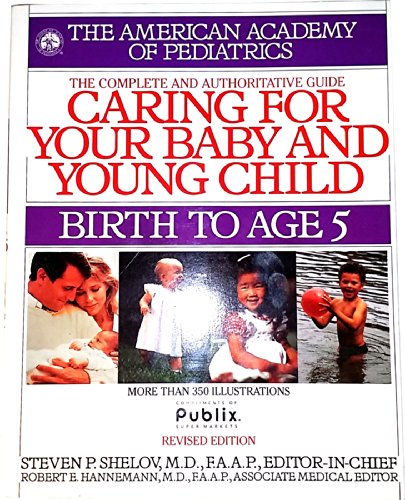
Caring for Your Baby and Young Child: Birth to Age 5
The American Academy of Pediatrics~Stephen P. Shel
ISBN 10: 0553379623 ISBN 13: 9780553379624
Verlag: Bantam, 1998
Gebraucht
Softcover
Verkäufer
Wonder Book, Frederick, MD, USA
Verkäuferbewertung 5 von 5 Sternen

Heritage Bookseller
AbeBooks-Mitglied seit 1996
Dieser Artikel ist nicht mehr verfügbar.
Beschreibung
Beschreibung:
Good condition. A copy that has been read but remains intact. May contain markings such as bookplates, stamps, limited notes and highlighting, or a few light stains. Bestandsnummer des Verkäufers G14Q-00863
Inhaltsangabe:
The organization that represents the nation's finest pediatricians and the most advanced research and practice in the field of child care answers all your medical and parenting questions. Here is sound, reassuring advice on child rearing that covers everything from preparing for childbirth to toilet training to nurturing your child's self-esteem.
Here, too, is an indispensable guide to recognizing and solving common childhood health problems, plus detailed instructions for coping with emergency medical situations.
Comprehensive, accurate, and up-to-date, Caring for Your Baby and Young Child includes:
Basic care from infancy through age five
Guidelines and milestones for physical, emotional, social, and cognitive growth
A complete health encyclopedia covering injuries, illnesses, congenital diseases, and other disabilities
Safety checks for home, outdoors, and car
A guide for choosing child-care programs
A discussion of family issues from sibling rivalry and adoption to stepfamilies and working mothers
And much more
Caring for Your Baby and Young Child is an essential child-care resource for all parents who want to provide the very best care for their children--and the one guide pediatricians routinely recommend and parents can safely trust.
Auszug. © Genehmigter Nachdruck. Alle Rechte vorbehalten.:
Foreword
The American Academy of Pediatrics is an organization of 53,000 primary care pediatricians, pediatric medical subspecialists, and pediatric surgical specialists committed to the attainment of optimal physical, mental, and social health for all infants, children, adolescents, and young adults. This book is part of the Academy's ongoing education efforts to provide parents with quality information on a broad spectrum of children's health issues.
What distinguishes this child-care book from the many others in bookstores and on library shelves is that it has been developed and extensively reviewed by members of the American Academy of Pediatrics. A six-member editorial board developed the initial material with the assistance of more than seventy-five contributors and reviewers. The final draft was then reviewed by countless numbers of pediatricians. Because medical information on children's health is constantly changing, every effort has been made to ensure that this book contains the most up-to-date information available.
It is the Academy's hope that this book will become an invaluable resource and reference guide for parents. We believe it is the best source of information on matters of children's health and well-being. We are confident readers will find the book extremely valuable, and we encourage them to use this book in concert with the advice and counsel of their own pediatrician who will provide individual guidance and help on issues related to the health of their children.
Joe M. Sanders, Jr., M.D.
Executive Director
American Academy of Pediatrics
Choosing a Pediatrician
Every pediatrician is committed to helping parents raise healthy children with the greatest possible ease, comfort, pleasure, and success. However, different pediatricians have different approaches, so you may want to interview several pediatricians before selecting the one who best suits your family's particular preferences and needs. Conduct these visits before the baby arrives, so the pediatrician you choose can give your newborn her very first exam.
Here are some considerations to help you make your choice:
The Training of Pediatricians
Pediatricians are graduates of four-year medical schools with three additional years of residency training solely in pediatrics. Under supervised conditions, the pediatrician-in-training acquires the knowledge and skills necessary to treat a broad range of conditions, from the mildest childhood illnesses to the most serious diseases.
With the completion of residency training, the pediatrician is eligible to take a written examination given by the American Board of Pediatrics. If he or she passes this examination, a certificate is issued, which you will probably see on the pediatrician's office wall. If you see the initials FAAP after a pediatrician's name, it means he or she is a Fellow (member) of the American Academy of Pediatrics. Only Board-certified pediatricians can become members of this professional organization.
Following their residency, some pediatricians elect an additional one to three years of training in a subspecialty, such as neonatology (the care of sick and premature newborns) or pediatric cardiology (the diagnosis and treatment of heart problems in children). These pediatric subspecialists are generally called upon to consult with general pediatricians when a patient develops uncommon or special problems. If a subspecialist is ever needed to treat your child, your regular pediatrician will help you find the right one for your child's problem.
How to Find a Pediatrician for Your Baby
A good place to start looking for a pediatrician is by asking your obstetrician for referrals. He or she will know local pediatricians who are competent and respected within the medical community. Other parents also can recommend pediatricians who have successfully treated their children.
Once you have the names of several pediatricians you wish to consider, arrange a personal interview with each of them during the final months of your pregnancy. Most pediatricians routinely grant such preliminary interviews. Both parents should attend these meetings if possible, to be sure you both agree with the pediatrician's policies and philosophy about child rearing. Don't be afraid or embarrassed to ask any questions. Here are a few suggestions to get you started:
How soon after birth will the pediatrician see your baby?
Most hospitals ask for the name of your pediatrician when you're admitted to deliver your baby. The delivery nurse will then call that pediatrician or his associate on call as soon as your baby is born. If you had any complications during either pregnancy or the delivery, your baby should be examined at birth. Otherwise, the examination can take place anytime during the first twenty-four hours of life. Ask the pediatrician if you can be present during that initial examination. This will give you an opportunity to learn more about your baby and get answers to any questions you may have.
When will your baby's next exams take place?
Pediatricians routinely examine newborns and talk with parents before the babies are discharged from the hospital. This lets the doctor identify any problems that may have arisen and also gives you a chance to ask questions that have occurred to you during your hospital stay, before you take the baby home. Your pediatrician will also let you know when to schedule the first office visit for your baby (as early as one day after discharge), and how he or she may be reached if a medical problem develops before then.
When is the doctor available by phone?
Many pediatricians have a specific call-in period each day when you can phone with questions. If members of the office staff routinely answer these calls, you should find out what their training is. Also ask your pediatrician for guidelines to help you determine which questions can be resolved with a phone call and which require an office visit.
What hospital does the doctor prefer to use?
Ask the pediatrician where to go if your child becomes seriously ill or is injured. If the hospital is a teaching hospital with interns and residents, find out who would actually care for your child if he was admitted.
What happens if there is an emergency?
Find out if the pediatrician takes her own emergency calls at night. If not, how are such calls handled? Also, ask if the pediatrician sees patients in the office after regular hours or if you must instead take your child to an emergency room. When possible, it's often easier and more efficient to see the doctor in her office, because hospitals frequently require lengthy paperwork and extended waits before your child receives attention. On the other hand, serious medical problems are usually better handled at the hospital, where staff and medical equipment are always available.
Who "covers" the practice when your pediatrician is unavailable?
If your physician is in a group practice, it's wise to meet the other doctors, since they may treat your child in your pediatrician's absence. If your pediatrician practices alone, he probably will have an arrangement for coverage with other doctors in the community. Usually your pediatrician's answering service will automatically refer you to the doctor on call, but it's still a good idea to ask for the...
„Über diesen Titel“ kann sich auf eine andere Ausgabe dieses Titels beziehen.
Bibliografische Details
Titel: Caring for Your Baby and Young Child: Birth ...
Verlag: Bantam
Erscheinungsdatum: 1998
Einband: Softcover
Zustand: Good