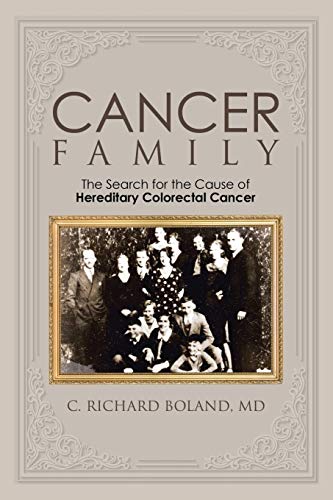
It is 1946, and a young man stares out his third-story apartment window. He has returned from the war with metastatic cancer and assumes he will die, leaving his wife and infant daughter behind. Instead, he lives another twenty-four years, raising a family of four children, before he succumbs to a second colon cancer. His son, the author, recognizes that there is a hereditary cancer syndrome in the family and resolves to solve the problem as a medical researcher. Eventually, hereditary colorectal cancer is recognized as a medical entity, and multiple genes responsible for this hereditary condition are isolated. However, the mutation responsible in the author's family escaped detection. In 2001, his laboratory identifies the mutation responsible for the problem and develops a specific test for the family. This permits the mutation carriers to obtain life-saving care, altering the natural history of the disease for his family and others.
Cancer Family
The Search for the Cause of Hereditary Colorectal Cancer
By C. Richard BolandAuthorHouse
Copyright © 2015 Clement Boland
All rights reserved.
ISBN: 978-1-5049-2868-7Contents
Prologue (Summer, 1946), ix,
Chapter 1 In Medias Res (1969-70), 1,
Chapter 2 Cancer in the Family (1970), 4,
Chapter 3 The Boland Family (1870-1926), 7,
Chapter 4 Clement Richard Boland, Sr: from Robesonia to Endwell (1926-1970), 20,
Chapter 5 C. Richard Boland, Jr., Endwell, New York (1947-1965), 46,
Chapter 6 Notre Dame to Yale Medical School (1965-69), 69,
Chapter 7 Life-Changing Events (1969-1970), 81,
Chapter 8 Learning to be a Doctor (1970-1977), 90,
Chapter 9 From Running to Fighting (1977-1979), 118,
Chapter 10 Learning to do Research (1979-84), 128,
Chapter 11 Michigan, Molecular Biology and Cancer Genetics (1984-1990), 151,
Chapter 12 The Sabbatical (1990), 161,
Chapter 13 Solving Lynch Syndrome (1990-1994), 177,
Chapter 14 The Transformative Years (1994-2001), 205,
Chapter 15 Cracking the Mystery: Trudy, Rita, Bert and Yan (1994-2000), 222,
Chapter 16 Matt and Jennifer (2001), 233,
Chapter 17 The Test and its Impact (2001-present), 246,
Chapter 18 Suzanne (2006-2015), 255,
Chapter 19 Where is Everyone Now? (2001-2015), 267,
Epilogue: Genetic Variation and Adaptation, 285,
Appendix: The History of Lynch Syndrome (1895-2013), 289,
Acknowledgements, 315,
CHAPTER 1
In Medias Res (1969-70)
Ancient epics often began their story in the middle of things — in medias res. Actually, the Latin phrase as written implies a more active situation, as the protagonist is thrust into the midst of things, and is immediately in motion. He recognizes that he is in a problematic situation, and must take action. To explain the situation, the narrative first must look back, which provides the historical context, and then move forward. So my story begins — in the middle, and into the midst.
In September, 1969, I started Yale Medical School in New Haven, Connecticut, about four hours by car east of Endwell, New York, where I had lived since age four. Endwell was the next town west, just a few miles down the Susquehanna River, from Johnson City, where I was born. I came home for Thanksgiving after my first three months of medical school. It was November, 1969; my first vacation break from this new journey. The sixties were almost gone, a tough time during which the world flipped upside down. I had previously gone to college about seven hundred miles west. Unlike that journey, New Haven to Endwell would mean easy trips home. I was entering the profession of my father; time to get to know him better. That felt good.
The events of the 1960s had a polarizing effect between fathers and sons. However, as a medical student, the edginess of the sixties no longer stood between my father and me. Pursuing my father's profession created a transformation in me. Dad was very excited to hear about what they were teaching in medical school. "What's new? How are you enjoying anatomy (one of the first courses)? Can you stand the smell of the cadaver room? What are they teaching now?" Very positive exchanges. On the Sunday morning after Thanksgiving, as I readied for my return from upstate New York to Connecticut, and I gave Dad a hug just. He winced with pain.
"What's the matter?" I asked.
"Oh, it's nothing".
Mom interrupted, "This has been going on for some weeks now and he won't see anyone."
I encouraged him to have it evaluated. I left, with school on my mind, not knowing what this portended.
There were about three weeks between the Thanksgiving and Christmas breaks. Yale Medical School was filled with a lot of people just like me. It was fun but competitive, and I loved the course material. Each day was intense but I couldn't get enough of the information. It was not an overload, just a load, and it came effortlessly. I had been back at school about three weeks when my life began to change on Wednesday morning, December 17. I was in a microbiology lab, and we were at the bench discussing how many viruses and bacteria could live on bars of soap. A teaching assistant came to me with a message from the Dean of Students' office: "call home". I found a pay phone, and called. Mom told me that Dad was in the hospital. His pain had worsened, and he couldn't stand up straight. He was evaluated, and they found colon cancer. An operation was scheduled for Friday.
I headed back to upstate New York the next morning. It was a gray morning, as I headed west on Route-17 through the Catskill Mountains. I was totally preoccupied with what was happening at home, and was stopped (with about ten other drivers on a long downhill stretch) for going seventy-five in a seventy zone. I tried to tell the state policeman that I had a special circumstance, but he handed me a clipboard, told me to fill out the form, and dashed to the person stopped behind me. He spent about five seconds with me, collected his fine, and went to the next driver. Never mind. I had just passed through a small-town toll gate.
I got home safely and went directly to Wilson Memorial Hospital in Johnson City, the hospital where my mother and all four of her children had been born. Dad was the Chief of Pediatrics. Mom intercepted me in the hallway outside his room. They found two colon cancers — one at the junction of his small and large intestine, and another further down. Surgery was planned for the next day. I was confident he would be cured by the operation; that's what we did with modern medicine. The surgeon opened him up, but couldn't remove anything, so he sewed him back up. The tumor appeared to involve the liver. I spent the night after surgery with him. They advised him to go to Roswell Park, the cancer center in Buffalo, New York, for specialized surgery. So, off he and Mom went, and I caught up on the day of the planned surgery. In mid-February, the Roswell Park surgeons also realized that the cancer was too advanced, and after eight hours of surgery, that operation was also aborted. He was sent home to die for the second time in his forty-nine years. He died on July 26, 1970, leaving me with a medical mystery to solve.
CHAPTER 2
Cancer in the Family (1970)
There had been occasional, quiet talk in the family about Dad's "illness" during his time in the Army. That discussion was not specifically suppressed, but there was never a lot said about cancer in the family. I knew from family reunions — mostly funerals and weddings — that discussions of health were carried out privately. All other matters could be vigorously discussed in groups: political discussions, opinions, grand family legends, and recollections. But when we were with Dad's family, it would have been easier to bring a live rattlesnake into the room to perform tricks than to openly ask who in the family had died of cancer.
One of the unspoken reasons for fearing any discussion of a familial predisposition to cancer was the nasty history of eugenics that contaminated Western science from the late Victorian era until the end of the Nazi political experiment in 1945. Darwin's explanation for the generation of species in the biological world was a polarizing concept, one that pitted the scientific world against traditionalists and the religious world. Some extrapolated these concepts from the biological into the social realm. The term "eugenics" was coined by Francis Galton, a polymath cousin of Darwin....