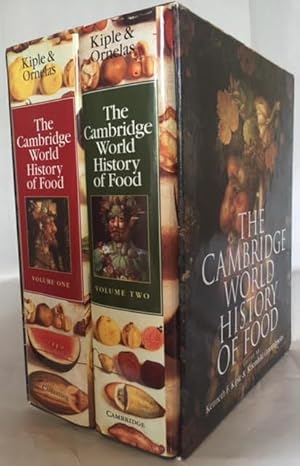
A monumental two-volume work detailing the history of food and nutrition throughout human existence.
Part VIII: A Historical Dictionary of the World's Plant Foods
White Potato
An enlarged tip of an under-ground stem that stores energy in the form of starch, the potato (Solanum tuberosum) may have been domesticated in the highlands of Peru as many as 10,000 years ago. Certainly it was a well-established crop some 5,000 to 6,000 years ago and, along with other tubers, maize, and quinoa, served as the foundation of the Andean diet. There were hundreds of varieties - some sweet, some bitter, some red, some blue, and some black - that were baked, boiled, used in soups and porridges, and even eaten for desert. In addition, the ancient Peruvians discovered how to preserve potatoes by a process of freezing ad drying, with the resulting product called chuqo.
Outside the Andean region there were and are a great number of species of wild potatoes, the tubers and leaves of which served as food for other Native Americans from North through Central to South America. But apparently it was only in the Andes that the potato was domesticated, and the Spaniards reaching Peru in the 1530s who had never seen a potato before thought at first that potatoes were truffles. The Incas called the potato a papa, a name the Spanish adopted. However, because they also adopted the Caribbean Indian name for the sweet potato, batata, sufficient confusion ensued that the potato (papa) was eventually given the name of the sweet potato (batata).
Potatoes were carried back to Spain in 1539 by returning conquistadors and followed the same route as the tomato to reach Spanish territory in Italy, where a hungry peasantry quickly embraced them. They reached the British Isles more circuitously, bringing about even more semantic confusion in the process. The story is that the confusion began when Francis Drake in 1586 picked up some potatoes at Cartegena in the Caribbean, then went to Virginia before returning to England. This created the impression that the potato had originated in Virginia. It also gave rise to the name "Virginia potato", which received scientific blessing in John Gerard's Herbal of 1597, and neither the impression or the name was fully dispelled until the 1930s work of Russian geneticists Nikolai Vavilov established or reestablished an American origin for the potato.
Hardy and easy to grow, potatoes were therefore an inexpensive food which caught on quickly enough that the poor of Ireland were planting them in "lazybeds" by the early 1640s. The timing was fortunate, because at the end of the end of the decade the English, under Oliver Cromwell, began killing and transporting thousands of Irish, and those who survived the English, did so o potatoes. Potatoes were also planted for the poor relatively early on in England but were not much appreciated there. On the continent, potatoes were regarded with even less enthusiasm because they were thought to cause leprosy - a suspicion that lingered on in France until well into the eighteenth century. More over, potatoes were denounced by religious fundamentalists because the vegetable had not been mentioned in the Bible. Nonetheless, beginning in about 1650, potatoes stared to gain acceptance in the Netherlands and then became widespread throughout the Low Countries by the middle of the following century.
Elsewhere, in Germany and Russia, rulers compelled the peasantry to plant potatoes, sometimes at gunpoint, and by the end of the eighteenth century even the French were eating them. Resistance to the tubers, however, continued well on into the nineteenth century in Russia, where (in the aftermath of two famines) they were at last uniformly adopted. By the beginning of the twentieth century, Russia was among the leading potato-producing countries of the world, with a good bit of that production being vodka.
Meanwhile the peripatetic potato, which had left the New World to become the "Virginia Potato" in the British Isles, returned to the Americas as the "Irish Potato", reaching Boston in 1718 with Irish immigrants. The following year, potatoes were planted in New Hampshire, although another century elapsed before they really caught on in North America. Elsewhere, the Spaniards and Portuguese had carried the potatoes to Africa and disseminated them throughout the East. By the middle of the seventeenth century they were grown in even the most remote regions of China and, along with sweet Potatoes were helping to fuel a population explosion. Because potatoes produce far more calories per acre than cereal crops, they were also to some immeasurable extent responsible for the population explosion in Europe during the eighteenth and nineteenth centuries.
The Iris potato famine - which began in 1845 with the loss of half the potato crop and saw its total loss in 1846, causing the death or migration of millions - was, in retrospect, inevitable. The Irish potato crop had failed numerous times during the previous 100 years, each time encouraging tenant farmers to select potato varieties that were the highest yielding. But in so doing, they narrowed the genetic base and bred potatoes with little resistance to fungal diseases. Perhaps ironically, the fungus (phytophthora infestans) that caused the potato famine reached Ireland from North America, probably on potatoes imported for breeding purposes.
The devastating blight that killed one million persons was a stark reminder of the dangers of too much reliance on a single crop, yet at the same time it galvanized plant breeders to develop potatoes that were not only disease resistant but also stored and shipped well. Unfortunately, their product has turned out to be not particularly tasty. The relatively few potato varieties available outside of the Andean region are often divided into the dry and mealy kinds, such as Idaho or russet potatoes, utilized for baking and mashing, and the moist and waxy kinds (new potatoes, for example), which are scalloped and made into potato salads
Common names and synonyms: American fry (fries), common potato, Irish potato, french fry (fries), Idaho potato, Irish potato, new potato, papa, potato chip(s), red potato, round potato, Russet Burbank, russet potato, Virginia potato.