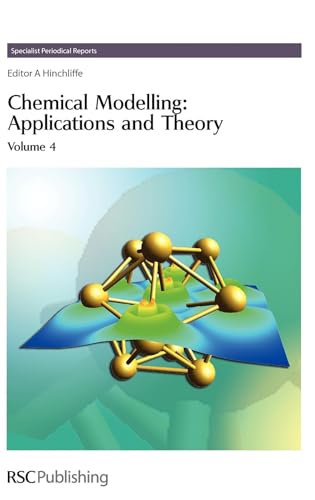
CHEMICAL MODELLING: APPLICATIONS AND THEORY VOL 4
Verkauft von Romtrade Corp., STERLING HEIGHTS, MI, USA
AbeBooks-Verkäufer seit 17. April 2013
Neu - Hardcover
Zustand: Neu
Versand innerhalb von USA
Anzahl: 1 verfügbar
In den Warenkorb legenVerkauft von Romtrade Corp., STERLING HEIGHTS, MI, USA
AbeBooks-Verkäufer seit 17. April 2013
Zustand: Neu
Anzahl: 1 verfügbar
In den Warenkorb legenThis is a Brand-new US Edition. This Item may be shipped from US or any other country as we have multiple locations worldwide.
Bestandsnummer des Verkäufers ABBB-235241
Computer-Aided Drug Design 2003–2005 By Bernard Coupez, Henrik Möbitz and Richard A. Lewis, 1,
Modelling Biological Systems By Adrian J. Mulholland, 23,
Polarizabilities, Hyperpolarizabilities and Analogous Magnetic Properties By David Pugh, 69,
Applications of Density Functional Theory to Heterogeneous Catalysis By David S. Scholl, 108,
Numerical Methods in Chemistry By T.E. Simos, 161,
Determination of Structure in Electronic Structure Calculations By Michael Springborg, 249,
Simulation of Liquids By B.D. Todd and D.J. Searles, 324,
Combinatorial Enumeration in Chemistry By A. Milicevic and N. Trinajstic, 405,
Many-Body Perturbation Theory and its Application to the Molecular Structure Problem By S. Wilson, 470,
Computer-Aided Drug Design 2003-2005
BY BERNARD COUPEZ, HENRIK MOBITZ AND RICHARD A. LEWIS
Novartis Institutes for Biomedical Research, Basel CH-4002, Switzerland
1 Introduction
The themes for this review again have been driven strongly by the need of the Pharmaceutical industry to make the discovery process quicker and more reliable. Virtual screening in all its forms is at the heart of most research, from bioavailability niters through to rigorous estimations of the free energy of binding. Two areas of relative heat have been docking/scoring, and ADME/ Tox. On the other hand, 3D-QSAR and pharmacophores have become quiet. Part of the reason for this may arise from the successes in high-throughput crystallography, delivering more targets and complexes, the relative failure of HTS, and the increase in the amount of high quality data coming from late-phase research/early-phase development concerning the fate of clinical candidates. These trends look set to continue in the future, and the next two years should yield many new breakthroughs.
2 ADME/Tox and Druggability
There has been a fresh impetus to the modelling of ADME, Toxicity and druggability phenomena, partly driven by a desire to understand why such complex phenomena can, apparently, be described so simply, and partly to see if better models can be built, to improve the attrition rate in medicinal chemistry still further.
2.1 Druggability and Bioavailability. – In the continuing debate over what physicochemical properties are required for bioavailability, Vieth et al. have surveyed 1729 marketed drugs with respect to their route of administration, h-bonding capability, lipophilicity and flexibility. One conclusion they draw is that these properties have not varied substantially over time, implying that oral bioavailability is independent of target or molecular complexity. Compounds with lower molecular weight, balanced lipophilicity and less flexibility tend to be favoured. Leeson and Davis claim that molecular weight, flexibility, the number of O and N atoms and hydrogen-bond acceptors have risen, by up to 29%. This may be partly due to the choice of 1983 as the reference year, or the advent of more complex targets with greater selectivity needs (e.g. kinases). In the same vein, a study re-examined the correlation of flexibility and polar surface area (PSA) with bioavailability proposed by Veber et al. One conclusion is that there are significant differences in the ways of denning flexibility and PSA, and the correlations depend markedly on the method used (this is not surprising, as neither quantity is precisely definable). A second conclusion was that the limits denned (Number of rotatable bond< 10, PSA< 140 Å2 excluded a significant number of compounds with acceptable rat bioavailability. In the authors' words, "This observation underscores the potential danger of attempting to generalise a very complicated endpoint and of using that generalisation in a prospective selection application". Despite this, another bioavail-ability score has been devised, to predict the probability that a compound has > 10% bioavailability in the rat. Compounds are grouped by ionisation class (anions, cations, neutral). It was found that the standard rule-of-5 does well for cations and neutrals (88% of the compounds predicted to have low bioavailability are observed as such). Anionic compounds were better described by PSA limits. Some simple rules are given to compute the bioavailability score. In Abbott laboratories, this score is now routinely computed for all compounds and is used for hit-list triaging. It will be interesting to see if the results can be repeated on other data sets; the paper has certainly sparked much interest in the modelling community. Wegner provides support for the idea that human intestinal absorption correlates with PSA, by generating a classification model. The justification is that the error in the experimental data is 25%, and 80% of the observations occur in the top and bottom quartiles, that is, the data is more binary than evenly spread. In addition to PSA, other descriptors that reflect the electronic character of atoms and their environment also came to the fore.
2.2 Metabolism, Inhibitors and Substrates. – The field of cytochrome modelling is becoming more mature as we begin to understand the limitations of the experimental data and the subtleties of the mechanisms (the whole field of cytochrome P450 modelling, including homology, pharmacophore and 3D-QSAR models has been reviewed in detail recently). Empirical models are still preferred, especially for rapid evaluation of large libraries. In one case, use of a jury system improved prediction accuracy to over 90%. Chohan et al. have developed 4 models for Cytochrome P450 (Cyp) 1A2 inhibition, and identified the expected descriptors as being important to the QSAR (lipophilicity, aromaticity, HOMO/LUMO energies). Perhaps a more interesting result in this paper was the use of the k index to assess predictive powers of the models using test data.
k = observed agreement-chance agreement/total observed-chance agreement
This index should prove useful for data sets that are diverse and noisy. The validity of QSAR model predictions has also been studied by Guha and Jurs. The protocol is quite straightforward. The initial QSAR models were built, and the residuals of the compounds in the training set were used to classify the trains set predictions into good and bad. The threshold for the classification is arbitrary. Test compounds were predicted, and the predictions were grouped by substructural similarity to the nearest neighbour in the training set. It was seen that test compounds that had neighbours with low/good residuals were themselves well-predicted, with the reverse being the case for neighbours with high residuals. The success rate for classifying the strength of the prediction was 73% to 94%. The Merck group performed a retrospective study of in-house data sets, and concluded that the distance to the nearest neighbour, and the number of nearest neighbours (local density) were the two most useful measures for predicting prediction quality. They also concluded that distance does not have to be measured in the same descriptor space as was used to build the QSAR model. Topological descriptors combined with a Dice coefficient worked equally well.
A number of groups have been active in the prediction of the most likely sites of metabolism of molecules that are...
„Über diesen Titel“ kann sich auf eine andere Ausgabe dieses Titels beziehen.
We guarantee the condition of every book as it's described on the Abebooks web
sites. If you're dissatisfied with your purchase (Incorrect Book/Not as
Described/Damaged) or if the order hasn't arrived, you're eligible for a refund
within 30 days of the estimated delivery date. If you've changed your mind about
a book that you've ordered, please use the Ask bookseller a question link to
contact us and we'll respond within 2 business days. The contact persons name is
Constantin Marandici and the m...
Wenn Sie Verbraucher sind, steht Ihnen ein Widerrufsrecht nach folgender Maßgabe zu. Verbraucher ist jede natürliche Person, die ein Rechtsgeschäft zu Zwecken abschließt, die überwiegend weder ihrer gewerblichen noch ihrer selbständigen beruflichen Tätigkeit zugerechnet werden können.
WIDERRUFSBELEHRUNG
Widerrufsrecht
Sie haben das Recht, binnen vierzehn Tagen ohne Angabe von Gründen diesen Vertrag zu widerrufen.
Die Widerrufsfrist beträgt vierzehn Tage ab dem Tag, an dem Sie oder ein von Ihnen benannter Dritter, der nicht der Beförderer ist, die letzte Ware oder die letzte Teilsendung bzw. das letzte Stück in Besitz genommen haben bzw. hat.
Um Ihr Widerrufsrecht auszuüben, müssen Sie uns, Romtrade Corp., 39137 BYERS DR., 48310, STERLING HEIGHTS, Michigan, U.S.A., +1 586-977-9198, mittels einer eindeutigen Erklärung (z.B. ein mit der Post versandter Brief, Telefax oder E-Mail) über Ihren Entschluss, diesen Vertrag zu widerrufen, informieren. Sie können dafür das beigefügte Muster-Widerrufsformular verwenden, das jedoch nicht vorgeschrieben ist. Sie können auch eine andere eindeutige Erklärung auf der Webseite "Meine Bestellungen" in Ihrem "Nutzerkonto" elektronisch ausfüllen und übermitteln. Machen Sie von dieser Möglichkeit Gebrauch, so werden wir Ihnen unverzüglich (z. B. per E-Mail) eine Bestätigung über den Eingang eines solchen Widerrufs übermitteln. Zur Wahrung der Widerrufsfrist reicht es aus, dass Sie die Mitteilung über die Ausübung des Widerrufsrechts vor Ablauf der Widerrufsfrist absenden.
Folgen des Widerrufs
Wenn Sie diesen Vertrag widerrufen, haben wir Ihnen alle Zahlungen, die wir von Ihnen erhalten haben, einschließlich der Lieferkosten (mit Ausnahme der zusätzlichen Kosten, die sich daraus ergeben, dass Sie eine andere Art der Lieferung als die von uns angebotene, günstigste Standardlieferung gewählt haben), unverzüglich und spätestens binnen vierzehn Tagen ab dem Tag zurückzuzahlen, an dem die Mitteilung über Ihren Widerruf dieses Vertrags bei uns eingegangen ist. Für diese Rückzahlung verwenden wir dasselbe Zahlungsmittel, das Sie bei der ursprünglichen Transaktion eingesetzt haben, es sei denn, mit Ihnen wurde ausdrücklich etwas anderes vereinbart; in keinem Fall werden Ihnen wegen dieser Rückzahlung Entgelte berechnet. Wir können die Rückzahlung verweigern, bis wir die Waren wieder zurückerhalten haben oder bis Sie den Nachweis erbracht haben, dass Sie die Waren zurückgesandt haben, je nachdem, welches der frühere Zeitpunkt ist. Sie haben die Waren unverzüglich und in jedem Fall spätestens binnen vierzehn Tagen ab dem Tag, an dem Sie uns über den Widerruf dieses Vertrags unterrichten, an Romtrade Corp., 39137 BYERS DR., 48310, STERLING HEIGHTS, Michigan, U.S.A., +1 586-977-9198, zurückzusenden oder zu übergeben. Die Frist ist gewahrt, wenn Sie die Waren vor Ablauf der Frist von vierzehn Tagen absenden.
Sie tragen die unmittelbaren Kosten der Rücksendung der Waren. Sie müssen für einen etwaigen Wertverlust der Waren nur aufkommen, wenn dieser Wertverlust auf einen zur Prüfung der Beschaffenheit, Eigenschaften und Funktionsweise der Waren nicht notwendigen Umgang mit ihnen zurückzuführen ist.
Ausnahmen vom Widerrufsrecht
Das Widerrufsrecht besteht nicht bzw. erlischt bei folgenden Verträgen:
ENDE DER WIDERRUFSBELEHRUNG
Muster-Widerrufsformular
(Wenn Sie den Vertrag widerrufen wollen, dann füllen Sie bitte dieses Formular aus und senden Sie es zurück)
An: (Romtrade Corp., 39137 BYERS DR., 48310, STERLING HEIGHTS, Michigan, U.S.A., +1 586-977-9198)
Hiermit widerrufe(n) ich/wir* den von mir/uns* abgeschlossenen Vertrag über den Kauf der folgenden Waren*/ die Erbringung der folgenden Dienstleistung*
Bestellt am*/erhalten am*:
Name des/der Verbraucher(s):
Anschrift des/der Verbraucher(s):
Unterschrift des/der Verbraucher(s) (nur bei Mitteilung auf Papier):
Datum:
* Unzutreffendes streichen.
Orders usually ship within 2 business days. Shipping costs are based on books weighing 2.2 LB, or 1 KG. If your book order is heavy or oversized, we may contact you to let you know extra shipping is required. We use USPS, DHL and ARAMEX for shipping.
| Bestellmenge | 5 bis 10 Werktage | 3 bis 6 Werktage |
|---|---|---|
| Erster Artikel | EUR 0.00 | EUR 0.00 |
Die Versandzeiten werden von den Verkäuferinnen und Verkäufern festgelegt. Sie variieren je nach Versanddienstleister und Standort. Sendungen, die den Zoll passieren, können Verzögerungen unterliegen. Eventuell anfallende Abgaben oder Gebühren sind von der Käuferin bzw. dem Käufer zu tragen. Die Verkäuferin bzw. der Verkäufer kann Sie bezüglich zusätzlicher Versandkosten kontaktieren, um einen möglichen Anstieg der Versandkosten für Ihre Artikel auszugleichen.