“They kept it up to the very end. Only the engulfing ocean had power to drown them into silence. The band was playing ‘Nearer, My God, to Thee.’ I could hear it distinctly. The end was very close.” —CHARLOTTE COLLYER, TITANIC SURVIVOR
The movies, the documentaries, the museum exhibits. They often tell the same story about the “unsinkable” Titanic, her wealthy passengers, the families torn apart, and the unthinkable end. But never before has “that glorious band”—the group of eight musicians who played on as the Titanic slipped deeper and deeper into the Atlantic Ocean—been explored in such depth. Steve Turner’s extensive research reveals a fascinating story including dishonest agents, a clairvoyant, social climbers, and a fraudulent violin maker. Read what brought the band members together and how their music served as the haunting soundtrack for one of modern history’s most tragic maritime disasters.
BOOK REVIEWS
The Band that Played On by Steve Turner is, surprisingly, the first book since the great ship went down to examine the lives of the eight musicians who were employed by the Titanic. What these men did?standing calmly on deck playing throughout the disaster?achieved global recognition. But their individual stories, until now, have been largely unknown. What Turner has uncovered is a narrow but unique slice of history?one more chapter of compelling Titanic lore.
Turner, a music journalist, pursued living relatives of the band members and squeezed all that he could out of “inherited photographs, documents, and anecdotes” enabling him to sketch brief but poignant portraits of eight young (or at least youngish) men, all born in an optimistic era and all members of the rising middle class. To their parents, their girlfriends, and surely to themselves as well, the future must have seemed bright right up until the early morning hours of April 15, 1912…
There is much that we do not know about the final hours of these men. Why did they make the decision to play on the deck that night? What was in their hearts and minds? …
Even the Titanic survivors who witnessed their final performance quibbled over some details. Did the band march or did they kneel? Was their last number “Autumn” or was it “Nearer, My God, to Thee”? Did they stop playing during the final moments and pack their instruments away or were they still playing as the ship went down? All agreed, however, that all eight band members behaved with remarkable calm and courage. Within hours of the ship’s sinking, their story was circulating and they had already become heroes…
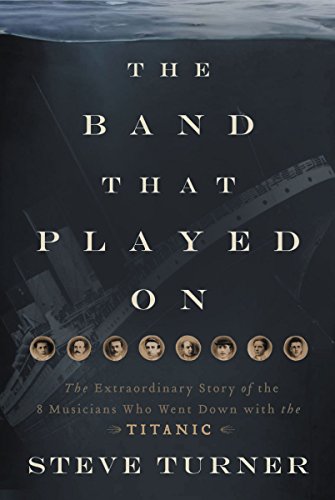
THE BAND THAT PLAYED ON
The Extraordinary Story of the 8 Musicians Who Went Down with the TitanicBy Steve TurnerThomas Nelson
Copyright © 2011 Steve Turner
All right reserved.ISBN: 978-1-59555-219-8Contents
Introduction.................................................................................vii1. "That glorious band.".....................................................................12. "The world's greatest liner.".............................................................173. "A man with the highest sense of duty."...................................................334. "I will write to you on board the Titanic."...............................................495. "An exceptionally good performer on the piano."...........................................596. "A thorough and conscientious musician."..................................................737. "The life of every ship he ever played on."...............................................918. "An intellectual turn of mind."...........................................................1019. "The Titanic is now about complete."......................................................11110. "We have a fine band."...................................................................12111. "A solemnity too deep for words."........................................................13512. "It is with great sadness that I have to give you the painful news.".....................15513. "If you think you have a legal claim."...................................................17714. "A natural fruit of the evil of the age."................................................18715. "The sweets of notoriety."...............................................................19716. "I should cling to my old violin.".......................................................213Sources......................................................................................223General Bibliography.........................................................................225Printed Sources..............................................................................227Notes........................................................................................239Picture Credits..............................................................................243About the Author.............................................................................245Index........................................................................................247
Chapter One
"That Glorious Band."
On the night of April 18, 1912, a dimly lit low-slung steamer with a single black funnel graciously eased its way up the lower reaches of the Hudson River headed toward Cunard's Pier 54. Never before had the arrival of one ship been the focus of so much anticipation and speculation. New York's traffic was gridlocked, police barriers had been erected around the west end of 12th Street, and the eyes of the world were focused on a gangway that would soon connect lower Manhattan with the British steamer Carpathia.
More than fifty tugboats manned by journalists had been nipping at the vessel as she made her approach, hoping to be rewarded with shouted-out answers to questions or handwritten scraps of information that would put them one step ahead of their competitors in the scramble for headlines. Reporters with megaphones made offers of $50 or $100 for firsthand reports, while photographers lit up the side of the ship with their flashes of magnesium powder. Some of them even tried to invade it when a rope ladder was let down for the river pilot to climb on, and they had to be forced back by Second Officer James Bisset.
The object of all the attention was not the ship's prebooked passengers who'd set out for the Mediterranean exactly a week before, but the more than 706 survivors of the world's worst shipwreck who'd been hauled on board from the freezing Atlantic. The Titanic had gone down almost four days previously, and the story of its loss had dominated the front pages of newspapers around the world. But beyond knowing that it had collided with an iceberg, and that the majority of the crew and passengers had died, very few hard facts had reached the shore. An early report had suggested that all were safe, and a wrongly attributed wireless message gave the impression that the damaged Titanic was being towed slowly back to port.
Speculation had developed that a cover-up was being mounted, that the meager output from the Carpathia's wireless room—a provisional list of survivors—and the refusal to answer press inquiries was a stalling tactic to give the chairman of the White Star Line, J. Bruce Ismay, himself a Titanic survivor, time to concoct an official explanation that would absolve him and his company of negligence charges. An intercepted wireless message from the Carpathia indicated that Ismay wanted the Carpathia to let its passengers off farther downriver to avoid the press.
The public naturally wanted to know how this apparently invincible liner had come to grief on what should have been a routine Atlantic crossing, but for most of the curious the explanation would have little or no immediate impact on their lives. For the friends and families of Titanic passengers, the need to know was vital to their peace of mind. Many of them gathered in the shed at the entrance to Pier 54 uncertain as to whether they would see their loved ones emerge. For newspapers, getting an accurate record of this event was a professional duty and an unparalleled editorial challenge.
The Carpathia's arrival hadn't been expected until the early hours of April 19, so when it was spotted at 6:10 p.m. on the eighteenth, off the coast of Sandy Hook, New Jersey, the news spread quickly through the city and the streets began to fill with traffic. Limousines and touring cars sped so quickly down the newly asphalted Seventh Avenue that many of them slipped on its rainy surface and found themselves running into the curbs. Police were brought in to ensure that no one was allowed on the pier itself but the two thousand already issued passes.
Although the city was frenzied as it readied itself to receive the survivors, the atmosphere in Cunard's shed was muted. There was only a hush occasionally punctuated by sobbing. Pass holders were organized in groups behind placards bearing the initial of their loved one's surname. This was to make it easy for survivors to connect with their waiting parties. In addition to friends and relatives, there were professional caregivers: officers from the Salvation Army offering hospitality to those with no local contacts, doctors in white jackets and nurses in uniform to attend the sick and injured, representatives from the White Star Line to answer questions and handle problems. Against the walls of the shed was a row of stretchers for those too emotionally traumatized or physically damaged to make the walk.
Half a mile above Battery Park, the Carpathia released thirteen now empty Titanic lifeboats in order to deny newspapers the opportunity to photograph them. Three of the original sixteen they had picked up were too damaged to haul back, and they were left at the wreck site. The thirteen were all that remained of the proud steamer that had left Southampton on April 10 for its maiden voyage. Everything else was spread out over the ocean bed 550 miles off the coast of Newfoundland.
The Carpathia turned toward the Cunard Pier, where at 9:30 it tied up....