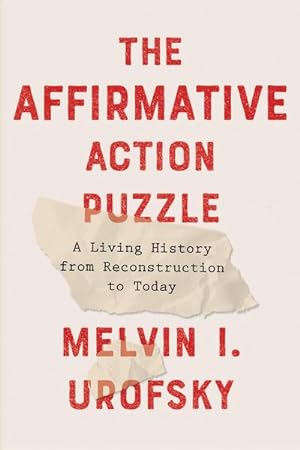
Affirmative Action Puzzle
Melvin I Urofsky
Verkauft von AHA-BUCH GmbH, Einbeck, Deutschland
AbeBooks-Verkäufer seit 14. August 2006
Neu - Hardcover
Zustand: Neu
Versand von Deutschland nach USA
Anzahl: 1 verfügbar
In den Warenkorb legenVerkauft von AHA-BUCH GmbH, Einbeck, Deutschland
AbeBooks-Verkäufer seit 14. August 2006
Zustand: Neu
Anzahl: 1 verfügbar
In den Warenkorb legenNeuware - A rich, multifaceted history of affirmative action from the Civil Rights Act of 1866 through today's tumultuous times From acclaimed legal historian, author of a biography of Louis Brandeis ('Remarkable' -Anthony Lewis, The New York Review of Books, 'Definitive'-Jeffrey Rosen, The New Republic) and Dissent and the Supreme Court ('Riveting'-Dahlia Lithwick, The New York Times Book Review), a history of affirmative action from its beginning with the Civil Rights Act of 1866 to the first use of the term in 1935 with the enactment of the National Labor Relations Act (the Wagner Act) to 1961 and John F. Kennedy's Executive Order 10925, mandating that federal contractors take 'affirmative action' to ensure that there be no discrimination by 'race, creed, color, or national origin' down to today's American society. Melvin Urofsky traces the evolution of affirmative action through labor and the struggle for racial equality, writing of World War I and the exodus that began when some six million African Americans moved northward between 1910 and 1960, one of the greatest internal migrations in the country's history. The author also writes of World War II, when women replaced men in factories and the issue of equal pay arose, and of Franklin Delano Roosevelt signing into law his last great New Deal measure for returning veterans-the Servicemen's Readjustment Act (the GI Bill), the most massive affirmative action program in American history. Urofsky tells the story of the struggles of blacks through the 1930s and 1940s, and how the southern states had to live up to the 'equal' parts of the 'separate but equal' formula. He writes as well about Brown v. Board of Education of Topeka, the passage of the 1964 Civil Rights Act, and the 1965 Voting Rights Act. He describes how Harry Truman, after becoming president in 1945, fought for Roosevelt's Fair Employment Practice Act and, surprising everyone, appointed a distinguished panel to serve as the President's Commission on Civil Rights, as well as appointing the first black judge on a federal appeals court in 1948 and, by executive order later that year, ordering full racial integration in the armed forces. We see Dwight Eisenhower sending in one thousand U.S. Army paratroopers and federalizing ten thousand Arkansas national guardsmen to protect black students trying to go to school; John F. Kennedy establishing the President's Committee on Equal Employment Opportunity and naming Lyndon Johnson as its chair, with Kennedy understanding, as did civil rights leaders, that no matter how the government tried to eradicate racial discrimination, the key to progress involved private sector employment with decent paying jobs, which would pull black America out of poverty. Urofsky explores affirmative action in relation to sex, gender, and education and shows that nearly every public university in the country has at one time or another instituted some form of affirmative action plan-some successful, others not. In this important, ambitious, far-reaching book, Urofsky writes about the affirmative action cases decided by the Supreme Court: cases that either upheld or struck down particular plans that affected both governmental and private entities. We come to fully understand the societal impact of affirmative action: how and why it has helped, and inflamed, people of all walks of life; how it has evolved; and how, and why, it is still needed.
Bestandsnummer des Verkäufers 9781101870877
A rich, multifaceted history of affirmative action from the Civil Rights Act of 1866 through today’s tumultuous times
From acclaimed legal historian, author of a biography of Louis Brandeis (“Remarkable” —Anthony Lewis, The New York Review of Books, “Definitive”—Jeffrey Rosen, The New Republic) and Dissent and the Supreme Court (“Riveting”—Dahlia Lithwick, The New York Times Book Review), a history of affirmative action from its beginning with the Civil Rights Act of 1866 to the first use of the term in 1935 with the enactment of the National Labor Relations Act (the Wagner Act) to 1961 and John F. Kennedy’s Executive Order 10925, mandating that federal contractors take “affirmative action” to ensure that there be no discrimination by “race, creed, color, or national origin” down to today’s American society.
Melvin Urofsky explores affirmative action in relation to sex, gender, and education and shows that nearly every public university in the country has at one time or another instituted some form of affirmative action plan--some successful, others not.
Urofsky traces the evolution of affirmative action through labor and the struggle for racial equality, writing of World War I and the exodus that began when some six million African Americans moved northward between 1910 and 1960, one of the greatest internal migrations in the country’s history.
He describes how Harry Truman, after becoming president in 1945, fought for Roosevelt’s Fair Employment Practice Act and, surprising everyone, appointed a distinguished panel to serve as the President’s Commission on Civil Rights, as well as appointing the first black judge on a federal appeals court in 1948 and, by executive order later that year, ordering full racial integration in the armed forces.
In this important, ambitious, far-reaching book, Urofsky writes about the affirmative action cases decided by the Supreme Court: cases that either upheld or struck down particular plans that affected both governmental and private entities. We come to fully understand the societal impact of affirmative action: how and why it has helped, and inflamed, people of all walks of life; how it has evolved; and how, and why, it is still needed.
„Über diesen Titel“ kann sich auf eine andere Ausgabe dieses Titels beziehen.
Allgemeine Geschäftsbedingungen und Kundeninformationen / Datenschutzerklärung
I. Allgemeine Geschäftsbedingungen
§ 1 Grundlegende Bestimmungen
(1) Die nachstehenden Geschäftsbedingungen gelten für alle Verträge, die Sie mit uns als Anbieter (AHA-BUCH GmbH) über die Internetplattformen AbeBooks und/oder ZVAB schließen. Soweit nicht anders vereinbart, wird der Einbeziehung gegebenenfalls von Ihnen verwendeter eigener Bedingungen widersprochen.
(2) Verbraucher im Sinne der nachstehenden Regelungen...
Wenn Sie Verbraucher sind, können Sie gemäß den folgenden Bestimmungen vom Vertrag zurücktreten. Verbraucher ist jede natürliche Person, die zu Zwecken handelt, die nicht ihrer kaufmännischen, gewerblichen, künstlerischen oder beruflichen Tätigkeit zugerechnet werden können.
Informationen zum Widerrufsrecht
Gesetzliches Widerrufsrecht
Sie haben das Recht, den Vertrag innerhalb von 14 Tagen ohne Angabe von Gründen zu widerrufen.
Die Widerrufsfrist beträgt 14 Tage ab dem Tag, an dem Sie oder ein von Ihnen benannter Dritter, der nicht der Transporteur ist, die letzte Ware oder den letzten Posten oder das letzte Exemplar in Besitz genommen hat.
Um das Widerrufsrecht auszuüben, füllen Sie auf unserer Website unter „Meine Einkäufe" in „Mein Nutzerkonto" eine eindeutige Erklärung elektronisch aus und senden Sie sie ab. Wir werden Ihnen unverzüglich eine Bestätigung über den Eingang eines solchen Widerrufs auf einem dauerhaften Datenträger (z. B. per E-Mail) übermitteln.
Um die Widerrufsfrist einzuhalten, reicht es aus, dass Sie Ihre Mitteilung über die Ausübung des Widerrufsrechts vor Ablauf der Widerrufsfrist absenden.
Auswirkungen des Widerrufs
Wenn Sie diesen Vertrag widerrufen, erstatten wir Ihnen alle Zahlungen, die wir von Ihnen erhalten haben, einschließlich der Lieferkosten (mit Ausnahme der zusätzlichen Kosten, die entstehen, wenn Sie eine andere Art der Lieferung als die von uns angebotene günstigste Standardlieferung gewählt haben).
Wir können einen Abzug von der Rückerstattung für den Wertverlust der gelieferten Waren vornehmen, wenn der Verlust auf eine unnötige Behandlung durch Sie zurückzuführen ist.
Wir werden die Rückerstattung unverzüglich und nicht später als 14 Tage nach dem Tag vornehmen, an dem wir über Ihre Entscheidung, diesen Vertrag zu widerrufen, informiert wurden.
Für die Rückerstattung verwenden wir dasselbe Zahlungsmittel, das Sie für die ursprüngliche Transaktion verwendet haben, es sei denn, Sie haben ausdrücklich etwas anderes vereinbart; in keinem Fall werden Ihnen aufgrund einer solchen Rückerstattung Gebühren berechnet.
Wir können die Rückzahlung verweigern, bis wir die Waren wieder zurückerhalten haben oder Sie den Nachweis erbracht haben, dass Sie die Waren zurückgesandt haben, je nachdem, was eher eintritt.
Sie müssen die Waren unverzüglich und in jedem Fall spätestens 14 Tage ab dem Tag, an dem Sie uns über den Widerruf dieses Vertrags unterrichten, an AHA-BUCH GmbH, Einbeck, Germany, zurücksenden oder übergeben. Die Frist ist eingehalten, wenn Sie die Ware vor Ablauf der Frist von 14 Tagen zurücksenden. Sie müssen die direkten Kosten der Rücksendung der Waren tragen. Sie haften nur für einen etwaigen Wertverlust der Waren, der auf eine Behandlung zurückzuführen ist, die nicht zur Prüfung der Art, Eigenschaften und Funktionsweise der Waren erforderlich ist.
Ausnahmen vom Widerrufsrecht
Das Widerrufsrecht gilt nicht für:
Wir liefern Lagerartikel innerhalb von 24 Stunden nach Erhalt der Bestellung aus.
Barsortimentsartikel, die wir über Nacht geliefert bekommen, am darauffolgenden Werktag.
Unser Ziel ist es Ihnen die Artikel in der ökonomischten und effizientesten Weise zu senden.
| Bestellmenge | 30 bis 40 Werktage | 7 bis 14 Werktage |
|---|---|---|
| Erster Artikel | EUR 64.84 | EUR 74.84 |
Die Versandzeiten werden von den Verkäuferinnen und Verkäufern festgelegt. Sie variieren je nach Versanddienstleister und Standort. Sendungen, die den Zoll passieren, können Verzögerungen unterliegen. Eventuell anfallende Abgaben oder Gebühren sind von der Käuferin bzw. dem Käufer zu tragen. Die Verkäuferin bzw. der Verkäufer kann Sie bezüglich zusätzlicher Versandkosten kontaktieren, um einen möglichen Anstieg der Versandkosten für Ihre Artikel auszugleichen.