
Verwandte Artikel zu Elements of Rhythmology: II. From the Renaissance to...
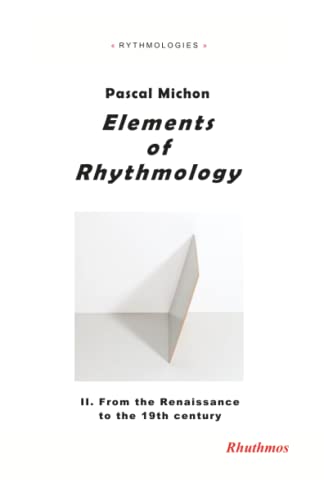
Elements of Rhythmology: II. From the Renaissance to the 19th century (Rhythmologies, Band 7) - Softcover
Inhaltsangabe
The recent transformations of the world—the new cycle in which capitalism has entered, the globalization of trade, production and consumption, the spreading of new communication technologies, the growing urbanization and the fluidization of our societies and lives—have triggered a search for new critical tools. It is no coincidence that rhythm has become, since the 1990s, both a subject of investigation and a methodological instrument in a growing number of disciplines. Its success is so remarkable that it seems now on the verge of becoming a new scientific paradigm, somewhat like system, structure, individual or difference in the second half of the 20th century. But its history and thus the multiple meanings it has been endowed with are still very badly known. Old models of rhythm are still commonly used while more recent and efficient ones are left aside. This book is the second installment of a series that aims at providing some of the elements of rhythmology we need to better assess the significance of the current scientific change, as well as the ethical and political empowerment it may involve.
Die Inhaltsangabe kann sich auf eine andere Ausgabe dieses Titels beziehen.
Über die Autorin bzw. den Autor
PASCAL MICHON is a Professor in Classes Préparatoires aux Grandes Écoles in Paris, a historian as well as a philosopher. He was a member of the Collège International de Philosophie. He has already published several essays on rhythm : Rythme, pouvoir, mondialisation (2005); Les rythmes du politique. Démocratie et capitalisme mondialisé (2007); Marcel Mauss retrouvé. Origines de l’anthropologie du rythme (2010); Rythmologie baroque. Spinoza, Leibniz, Diderot (2015).
„Über diesen Titel“ kann sich auf eine andere Ausgabe dieses Titels beziehen.
Suchergebnisse für Elements of Rhythmology: II. From the Renaissance to...

Beispielbild für diese ISBN
Elements of Rhythmology: II. From the Renaissance to the 19th century (Rhythmologies)
Anbieter: Ria Christie Collections, Uxbridge, Vereinigtes Königreich
Verkäuferbewertung 5 von 5 Sternen

Zustand: New. In English. Artikel-Nr. ria9791095155195_new
Neu kaufen
EUR 32,82
EUR 13,39 Versand
Versand von Vereinigtes Königreich nach USA
Versand von Vereinigtes Königreich nach USA
Anzahl: Mehr als 20 verfügbar
Foto des Verkäufers
Elements of Rhythmology : II. From the Renaissance to the 19th century
Anbieter: AHA-BUCH GmbH, Einbeck, Deutschland
Verkäuferbewertung 5 von 5 Sternen
Taschenbuch. Zustand: Neu. Neuware - The recent transformations of the world-the new cycle in which capitalism has entered, the globalization of trade, production and consumption, the spreading of new communication technologies, the growing urbanization and the fluidization of our societies and lives-have triggered a search for new critical tools. It is no coincidence that rhythm has become, since the 1990s, both a subject of investigation and a methodological instrument in a growing number of disciplines. Its success is so remarkable that it seems now on the verge of becoming a new scientific paradigm, somewhat like system, structure, individual or difference in the second half of the 20th century. But its history and thus the multiple meanings it has been endowed with are still very badly known. Old models of rhythm are still commonly used while more recent and efficient ones are left aside. This book is the second installment of a series that aims at providing some of the elements of rhythmology we need to better assess the significance of the current scientific change, as well as the ethical and political empowerment it may involve. Artikel-Nr. 9791095155195
Neu kaufen
EUR 46,62
EUR 35,00 Versand
Versand von Deutschland nach USA
Versand von Deutschland nach USA
Anzahl: 2 verfügbar
Foto des Verkäufers
Elements of Rhythmology
Anbieter: moluna, Greven, Deutschland
Verkäuferbewertung 5 von 5 Sternen
Zustand: New. Artikel-Nr. 599260644
Neu kaufen
EUR 34,89
EUR 48,99 Versand
Versand von Deutschland nach USA
Versand von Deutschland nach USA
Anzahl: Mehr als 20 verfügbar