
Verwandte Artikel zu Legal Ontology Engineering: Methodologies, Modelling...
Legal Ontology Engineering: Methodologies, Modelling Trends, and the Ontology of Professional Judicial Knowledge (Law, Governance and Technology Series, 3, Band 3) - Hardcover
Buch 16 von 63: Law, Governance and Technology Series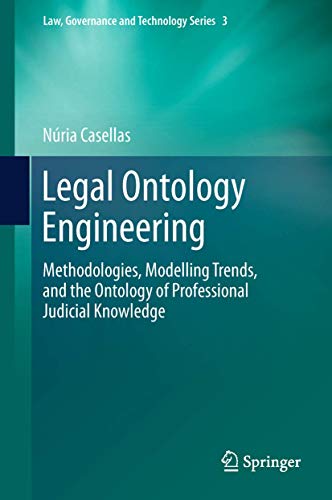
Inhaltsangabe
Enabling information interoperability, fostering legal knowledge usability and reuse, enhancing legal information search, in short, formalizing the complexity of legal knowledge to enhance legal knowledge management are challenging tasks, for which different solutions and lines of research have been proposed.
During the last decade, research and applications based on the use of legal ontologies as a technique to represent legal knowledge has raised a very interesting debate about their capacity and limitations to represent conceptual structures in the legal domain. Making conceptual legal knowledge explicit would support the development of a web of legal knowledge, improve communication, create trust and enable and support open data, e-government and e-democracy activities. Moreover, this explicit knowledge is also relevant to the formalization of software agents and the shaping of virtual institutions and multi-agent systems or environments.
This book explores the use of ontologism in legal knowledge representation for semantically-enhanced legal knowledge systems or web-based applications. In it, current methodologies, tools and languages used for ontology development are revised, and the book includes an exhaustive revision of existing ontologies in the legal domain. The development of the Ontology of Professional Judicial Knowledge (OPJK) is presented as a case study.
Die Inhaltsangabe kann sich auf eine andere Ausgabe dieses Titels beziehen.
Von der hinteren Coverseite
Enabling information interoperability, fostering legal knowledge usability and reuse, enhancing legal information search, in short, formalizing the complexity of legal knowledge to enhance legal knowledge management are challenging tasks, for which different solutions and lines of research have been proposed.
During the last decade, research and applications based on the use of legal ontologies as a technique to represent legal knowledge has raised a very interesting debate about their capacity and limitations to represent conceptual structures in the legal domain. Making conceptual legal knowledge explicit would support the development of a web of legal knowledge, improve communication, create trust and enable and support open data, e-government and e-democracy activities. Moreover, this explicit knowledge is also relevant to the formalization of software agents and the shaping of virtual institutions and multi-agent systems or environments.
This book explores the use of ontologism in legal knowledge representation for semantically-enhanced legal knowledge systems or web-based applications. In it, current methodologies, tools and languages used for ontology development are revised, and the book includes an exhaustive revision of existing ontologies in the legal domain. The development of the Ontology of Professional Judicial Knowledge (OPJK) is presented as a case study.
„Über diesen Titel“ kann sich auf eine andere Ausgabe dieses Titels beziehen.
Suchergebnisse für Legal Ontology Engineering: Methodologies, Modelling...

Beispielbild für diese ISBN
Legal Ontology Engineering: Methodologies, Modelling Trends, and the Ontology of Professional Judicial Knowledge (Law, Governance and Technology Series, 3)
Anbieter: Ria Christie Collections, Uxbridge, Vereinigtes Königreich
Verkäuferbewertung 5 von 5 Sternen

Zustand: New. In English. Artikel-Nr. ria9789400714960_new
Neu kaufen
EUR 214,41
EUR 13,48 Versand
Versand von Vereinigtes Königreich nach USA
Versand von Vereinigtes Königreich nach USA
Anzahl: Mehr als 20 verfügbar
Foto des Verkäufers
Legal Ontology Engineering : Methodologies, Modelling Trends, and the Ontology of Professional Judicial Knowledge
Anbieter: AHA-BUCH GmbH, Einbeck, Deutschland
Verkäuferbewertung 5 von 5 Sternen
Buch. Zustand: Neu. Druck auf Anfrage Neuware - Printed after ordering - Enabling information interoperability, fostering legal knowledge usability and reuse, enhancing legal information search, in short, formalizing the complexity of legal knowledge to enhance legal knowledge management are challenging tasks, for which different solutions and lines of research have been proposed. During the last decade, research and applications based on the use of legal ontologies as a technique to represent legal knowledge has raised a very interesting debate about their capacity and limitations to represent conceptual structures in the legal domain. Making conceptual legal knowledge explicit would support the development of a web of legal knowledge, improve communication, create trust and enable and support open data, e-government and e-democracy activities. Moreover, this explicit knowledge is also relevant to the formalization of software agents and the shaping of virtual institutions and multi-agent systems or environments. This book explores the use of ontologism in legal knowledge representation for semantically-enhanced legal knowledge systems or web-based applications. In it, current methodologies, tools and languages used for ontology development are revised, and the book includes an exhaustive revision of existing ontologies in the legal domain. The development of the Ontology of Professional Judicial Knowledge (OPJK) is presented as a case study. Artikel-Nr. 9789400714960
Neu kaufen
EUR 206,69
EUR 35,00 Versand
Versand von Deutschland nach USA
Versand von Deutschland nach USA
Anzahl: 2 verfügbar