
Verwandte Artikel zu Political Change And the Rise of Labour in Comparative...
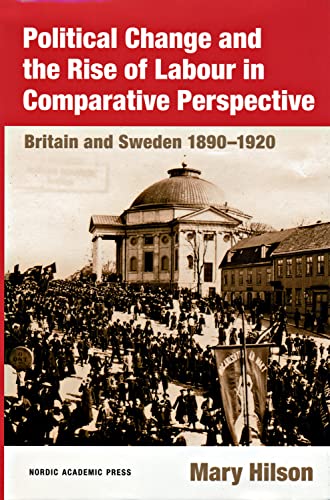
Political Change And the Rise of Labour in Comparative Perspective: Britain And Sweden, 1890-1930 - Hardcover
Inhaltsangabe
A comparative analysis of social change, democratization, and the development of modern party politics in Britain and Sweden during the period 1880–1930, this book presents the similarities of political changes in these two countries at this time and also in the wider European context, with particular reference to the emergence of social democracy as a political current.
Die Inhaltsangabe kann sich auf eine andere Ausgabe dieses Titels beziehen.
Über die Autorin bzw. den Autor
Mary Hilson has a PhD in economic and social history from the University of Exeter and is a lecturer in contemporary Scandinavian history in the department of Scandinavian studies at University College London.
Auszug. © Genehmigter Nachdruck. Alle Rechte vorbehalten.
Political Change and the Rise of Labour in Comparative Perspective
Britain and Sweden 1890-1920
By Mary HilsonNordic Academic Press
Copyright © 2006 Nordic Academic Press and the Author
All rights reserved.
ISBN: 978-91-89116-71-9All rights reserved.
Contents
Title Page,
Copyright Page,
Acknowledgements,
A Note on the Translation of Swedish Terms,
Part I - Rethinking Comparative Labour History,
CHAPTER 1 - Introduction–Exceptionalism in Comparative Labour History,
CHAPTER 2 - The Rise of Labour in Britain and Sweden,
CHAPTER 3 - Local and National Politics in the Rise of Labour,
Part II - A Local Case Study–Labour and the Two Dockyard Towns,
CHAPTER 4 - The Labour Movement in Plymouth c. 1890–1914,
CHAPTER 5 - Plymouth during World War I and after,
CHAPTER 6 - The Labour Movement in Karlskrona c. 1890–1911,
CHAPTER 7 - Naval Politics in Karlskrona c. 1911–1921,
CHAPTER 8 - Conclusion,
Summary - Political Change and the Rise of Labour in Comparative Perspective. Britain and Sweden c. 1890–1920,
Notes,
Maps,
Tables,
Bibliography,
CHAPTER 1
Introduction — Exceptionalism in Comparative Labour History
This book is a study of political change and the emergence of a working-class political movement in two naval dockyard towns, Plymouth in Britain and Karlskrona in Sweden. Naval dockyard towns, where a large proportion of the adult male population was employed in the direct service of the state, and where the early twentieth century agitation for 'big navy' politics seemed to have a particular resonance, have often been thought of as difficult territory for the labour movement, and for that reason have been largely ignored by labour historians. One of the main concerns of the study, therefore, is to explore the politics of naval defence in the local context, and the particular challenges which this presented to the emergent labour movement. Through a detailed exploration of the conditions of dockyard work, of everyday life and municipal politics at the local level, I hope to show that the politics of the dockyard town in were in fact far more complex and interesting than they are sometimes assumed to be.
The study has a wider ambition though, and that is to investigate a broad comparative question, namely, why did social democratic labour parties emerge in most European countries during the late nineteenth century? A major problem of cross-national comparison is that the historian is usually required to make huge generalisations, thus ignoring the internal variations and complexities of a particular case and presenting it in monolithic, over-simplified terms. The preferred methods of many labour historians–local and microscopic–do not seem to lend themselves readily to international comparisons, especially where such comparisons have a tendency to over-exaggerate the differences between states and nations at the expense of equally important variations at local or regional level. One of the aims of the present study is to demonstrate that cross-national comparisons are indeed compatible with local studies. It is argued that to be successful, cross-national comparisons have to be based on a more pluralist understanding of the complex processes and regional patterns and variations which make up a national case. In recent years there have been a number of calls for international comparative histories which move beyond the nation state, but, as yet, not more than a handful of studies which has actually done this. Moreover, much comparative labour history continues to be informed by the influential thesis of exceptionalism, in particular the assumption that Britain was fundamentally different to the 'continental' labour parties. The difficulties with this approach are explored in the first two chapters of the book, comparing the British case with Sweden. One of the advantages of a cross-national comparative study is that it requires the historian to develop a familiarity with two separate historiographical traditions, thus exposing sometimes long-held assumptions to new questions and approaches.
I
The British labour movement has been described as "the most anomalous left in Europe". Scholars have consistently regarded the British left as fundamentally different from its continental counterparts, exceptional in its historical development. The thesis of British exceptionalism has deep historical roots. Egon Wertheimer, observing the British labour movement at first hand during the 1920s, noted the 'wide difference' between the Labour Party and the socialist movement in his native Germany. Continental socialist parties were dogmatic and disciplined, homogenous and uniform in spirit, structure, organisation, vocabulary and leadership. In contrast,
How different is the Labour Party! Without a past that sets it in opposition to State and society, it reflects the national characteristics of the English people, undeterred and untroubled by the other Labour parties of the world. It is more British than German social democracy is German, Polish Socialism Polish.
Two characteristics in particular seemed to set the British Labour Party apart from the rest of Europe: the limited influence of socialism and the party's organisational structure, especially its relationship with the trade unions. Following the defeat of Chartism in the mid-nineteenth century, so the argument went, the British working class had turned its back on revolutionary politics, embracing instead 'purely economic' trade union action to defend their interests. Rather than being united by class consciousness, British working-class politics was fragmented and sectional, steered by the pragmatism of the trade unions, and the alliance between labour interests and radical Liberalism. The failure of Marxism to make more of an impact on the British working class could be explained by a number of anomalies within British social and political development: the social and geographical fragmentation of the working class; the apolitical nature of working-class associational culture in Britain; the extent to which the working class was integrated into existing political arrangements; and the lack of intellectual ideological leaders in the British labour movement. For these reasons, class loyalty and cohesiveness, not socialist doctrine, became the unifying principle of the Labour Party. As one influential historian of the party suggested,
One of the most highly class-conscious working-classes in the world produced a Party whose appeal was specifically intended to be classless. Accepting the Labour Party meant accepting not socialism but an intricate network of loyalties ... This was a trade-union code of behaviour; so were the political aims of the Labour Party essentially trade-union ones.
The exceptionalism of the British labour movement has to be seen within a wider tradition of historical writing which has set Britain's historical development apart from that of the rest of Europe, especially in its constitutional development. This tradition pervades even the most critical accounts of national history. For Perry Anderson and Tom Nairn, the failure of the English working class to develop a revolutionary consciousness was attributed not so much to the specific conditions generated by late nineteenth century political and social developments, but to the 'cumulative fundamental moments of modern English history.' The 'least pure' bourgeois revolution in Europe resulted in the emergence of a...
„Über diesen Titel“ kann sich auf eine andere Ausgabe dieses Titels beziehen.
Suchergebnisse für Political Change And the Rise of Labour in Comparative...

Foto des Verkäufers
Political Change and the Rise of Labour in Comparative Perspective : Britain and Sweden, 1890-1920
Verlag:
Nordic Academic Press, Lund, SE, 2006
ISBN 10: 9189116712
ISBN 13: 9789189116719
Gebraucht
Hardcover
Erstausgabe
Anbieter: BookAddiction (IOBA, IBooknet), Canterbury, Vereinigtes Königreich
Verkäuferbewertung 5 von 5 Sternen

Hardcover. Zustand: Near Fine. Zustand des Schutzumschlags: Near Fine. 1st Edition. 352pp. Black cloth-covered boards, silver titles on spine. Lightly bumped bottom corners. Light grey endpapers. Internally neat, clean, bright and tight. Dust jacket has some shelf wear, light chipping to edges, mirrors book damage. 8vo. Presents a comparative analysis of social change, democratisation and the development of modern party politics in Britain and Sweden during the period 1890-1920. Includes a case study of two naval dockyard towns, Plymouth and Karlskrona and the response of labour organisations to the politics of nationalism and naval defence in the early twentieth century. Artikel-Nr. 006568
Gebraucht kaufen
EUR 21,87
EUR 8,26 Versand
Versand von Vereinigtes Königreich nach USA
Versand von Vereinigtes Königreich nach USA
Anzahl: 1 verfügbar
Beispielbild für diese ISBN
Political Change & the Rise of Labour in Comparative Perspective: Britain & Sweden, 1890-1920 [Hardcover] Hilson, Mary
Anbieter: Hay-on-Wye Booksellers, Hay-on-Wye, HEREF, Vereinigtes Königreich
Verkäuferbewertung 4 von 5 Sternen

Zustand: Good. Some wear, crumpling, marks, scratches and fading to dust jacket. Bumps/wear at edges/corners of hard board. Marks/scratches to hard board/text blocks. Date inscription at 1st page. Text very good/clean. Artikel-Nr. 128238-3
Gebraucht kaufen
EUR 22,10
EUR 29,49 Versand
Versand von Vereinigtes Königreich nach USA
Versand von Vereinigtes Königreich nach USA
Anzahl: 1 verfügbar
Beispielbild für diese ISBN
Political Change And the Rise of Labour in Comparative Perspective: Britain And Sweden, 1890-1930
Anbieter: Revaluation Books, Exeter, Vereinigtes Königreich
Verkäuferbewertung 5 von 5 Sternen
Hardcover. Zustand: Brand New. illustrated edition. 352 pages. 8.75x6.00x1.00 inches. In Stock. Artikel-Nr. __9189116712
Neu kaufen
EUR 94,19
EUR 14,75 Versand
Versand von Vereinigtes Königreich nach USA
Versand von Vereinigtes Königreich nach USA
Anzahl: 2 verfügbar