
Verwandte Artikel zu Reaching a State of Hope: Refugees, Immigrants and...
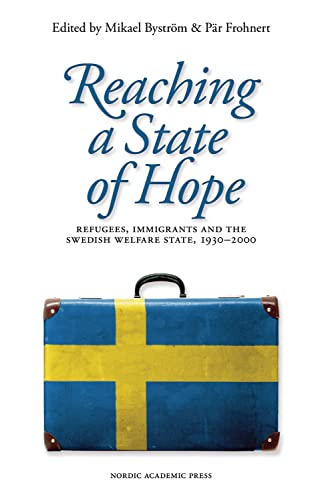
Inhaltsangabe
Shedding new light on the issues concerning refugees and immigration in 20th-century Sweden, this analysis examines the implications of its immigration policies. On what grounds were refugees admitted? Where did they come from? How did the Swedish state aid its new citizens? What differences were there between refugees and the “imported labor” that was essential to Swedish industry? A group of established Swedish and international historians answer these questions against the background of the eras passed: the Second World War, the Cold War, and the labor movement that shaped the national characteristic of Sweden so deeply. Reaching a State of Hope contributes to the wider field of research on political and administrative practices around refugees historically and places the Swedish refugee and immigration experience in a European perspective.Die Inhaltsangabe kann sich auf eine andere Ausgabe dieses Titels beziehen.
Über die Autorin bzw. den Autor
Mikael Byström is an associate professor of history at Uppsala University in Sweden. He has published extensively on the subject of the debate regarding refugees and migration during World War II. Pär Frohnert is an associate professor of history at Stockholm University in Sweden. He has published extensively on the impact of the Holocaust in European culture and the aid to refugees during the 1930s and the Second World War.
Auszug. © Genehmigter Nachdruck. Alle Rechte vorbehalten.
Reaching a State of Hope
Refugees, Immigrants and the Swedish Welfare State, 1930–2000
By Mikael Byström, Pär FrohnertNordic Academic Press
Copyright © 2013 Nordic Academic Press, Mikael Byström and Pär Frohnert
All rights reserved.
ISBN: 978-91-87351-23-5All rights reserved.
Contents
Acknowledgements and general background Mikael Byström & Pär Frohnert,
I PERSPECTIVES ON SWEDISH REFUGEE POLICY, 1933–45,
Introduction I Mikael Byström & Pär Frohnert,
1. Sweden and the refugees, 1933–45 Klas Åmark,
2. A foreign element within the nation Karin Kvist Geverts,
II THE AGENTS OF REFUGEE POLICY AND RECEPTION, 1933–50,
Introduction II Mikael Byström & Pär Frohnert,
3. The politics of Jewish refugee aid and relief work in Sweden Pontus Rudberg,
4. Social-democratic solidarity Pär Frohnert,
5. The last bastion of Swedish refugee policy Mikael Byström,
6. Raoul Wallenberg and Swedish humanitarian policy in Budapest Paul A. Levine,
7. Swedish Jews and the Jewish survivors Malin Thor Tureby,
III REFUGEE POLICY IN THE SHADOW OF THE COLD WAR AND SWEDEN'S LABOUR SHORTAGE,
Introduction III Mikael Byström & Pär Frohnert,
8. From contract workers to political refugees Attila Lajos,
9. Ethnic encounters, narratives, and counter-narratives Johan Svanberg,
10. Controlling the untrustworthy Cecilia Notini Burch,
IV DISCOURSES AND PRACTICE, 1960–2000,
Introduction IV Mikael Byström & Pär Frohnert,
11. Union solidarity in exchange for adaptation Jesper Johansson,
12. LO and refugee immigration, 1973–82 Zeki Yalcin,
13. Beyond Swedish self-image Christina Johansson,
V NTERNATIONAL PERSPECTIVES AND CONCLUSION,
Introduction V Mikael Byström & Pär Frohnert,
14. The agenda of British refugee policy, 1933–48 Louise London,
15. Pre-1945 refugee policy as a reference point for post-1945 policy Georg Kreis,
16. Sweden's exceptional ability to organize its immigration Frank Caestecker,
Abbreviations,
About the authors,
CHAPTER 1
Sweden and the refugees, 1933–45
Klas Åmark
Swedish refugee policy and refugee reception changed dramatically between 1933 and 1945. In the course of the 1930s, refugee policy became more and more restrictive. In early 1939, a heated debate took place about a proposal that Sweden should accept ten German Jewish doctors. Yet in the first half of 1945, there were more than 210,000 refugees and evacuees staying in Sweden, without any major debate about the size of the Swedish refugee reception. The expansion came late. It was not until 1942 and 1943 that the number of refugees in Sweden grew rapidly. The largest groups of refugees arrived between the summer of 1944 and the summer of 1945. What had happened, in what respects did the Swedish refugee policy change, and why?
The question of numbers
There are no reliable statistics on how many refugees came to Sweden during the period 1933 to 1945. Swedish authorities regularly counted the number of foreigners with the right to stay in the country, but in the 1930s they did not differentiate between refugees and other foreigners. The situation altered in the last year of the war, probably due to a change in the administrative structure of the authorities, with the establishment of a new National Alien Commission in July 1944. Another problem for the historian is that a number of refugees were only in Sweden for a limited time and then moved on, but the authorities only counted the number of foreigners and refugees who were in the country at a certain date: we still do not know how many refugees only passed through Sweden.
The best available statistics on refugees and foreigners in Sweden were worked out by an official commission of inquiry, in an unpublished study of Swedes living in foreign countries and refugees in Sweden in 1948. Its estimates are presented in Table 1 (p. 51). The largest group of refugees in Sweden were the Norwegians, who started to arrive after the German occupation of Norway in April 1940. In the autumn of 1943, as the occupation became more oppressive, more Norwegians fled to Sweden. Similarly, in the first year of the German occupation of Denmark refugees were relatively few. Approximately 8,000 persons arrived from Denmark in the autumn of 1943, of whom 7,000 were Danish Jews. Baltic refugees came in large numbers in the autumn of 1944, after the Soviet occupation of the Baltic countries. Sweden also took in a great number of Finnish children during the Winter War and the Continuation War with the Soviet Union; in all, 72,000. They are usually not classified as refugees, sometimes even not as foreigners, in Sweden, since they were not adults. After the peace between Finland and Soviet Union in September 1944, the Finns were forced to throw out the German troops who had been stationed in Northern Finland since 1941. The Germans responded with a scorched earth policy, and to escape the fighting tens of thousands of Finns were evacuated to Sweden together with their cattle. These Finns, at least 45,000 in number, were also usually not called refugees, but evacuees, and they are not included in the number of refugees in Table 1. From the late autumn of 1944, at least 210,000 refugees and evacuees were in Sweden for shorter or longer periods of time.
For this essay, neither the difficulty of finding exact figures, nor the problems with the categorization of different groups of refugees, are of real importance. My focus is instead the change in scale in the refugee reception in Sweden. During the 1930s, a couple of thousand refugees came to Sweden, most of them from Germany and usually German-speaking (German being the second language of choice in Sweden at the time). They were typically either Jews or social democrats. In the last year of the war, tens of thousands of refugees arrived from a great number of nations. There were Norwegian resistance fighters, quislings who saw the end of the war drawing closer, Allied bomber pilots, Soviets and Yugoslavians fleeing from slave labour under Organisation Todt in Norway, Baltic and Soviet soldiers who had been fighting in the German army, Spaniards, Swiss and Argentinean citizens who had been prisoners in the German concentrations camps, and even two Chinese women, also camp prisoners. It was not only the sheer numbers of refugees that created problems to be solved by Swedish authorities, also all the different cultures, languages, and religions that had to be handled in some way.
Responsibility
Who was responsible for the decisions about which people should be allowed to come to Sweden in what numbers, and who was financially responsible for their support once there? Ultimately, of course, the state was directly responsible for the decision to accept a person as a legal refugee. Swedish refugee policies in the 1930s had their roots in the First World War and its aftermath, when a rather narrow definition of the concept of 'political refugee' had been established. The right of asylum was interpreted not as a right for the individual refugee, but as a right for the state to give asylum to political refugees, as a protection against criticism from the state from which the refugees came.
In Sweden, a system of refugee quotas was established during the 1930s. The quotas, decided on after negotiations between...
„Über diesen Titel“ kann sich auf eine andere Ausgabe dieses Titels beziehen.
Suchergebnisse für Reaching a State of Hope: Refugees, Immigrants and...

Foto des Verkäufers
Reaching a State of Hope: Refugees, Immigrants & the Swedish Welfare State 1930â"2000
Anbieter: WeBuyBooks, Rossendale, LANCS, Vereinigtes Königreich
Verkäuferbewertung 5 von 5 Sternen

hardcover. Zustand: Like New. Most items will be dispatched the same or the next working day. An apparently unread copy in perfect condition. Dust cover is intact with no nicks or tears. Spine has no signs of creasing. Pages are clean and not marred by notes or folds of any kind. Artikel-Nr. rev5558291523
Gebraucht kaufen
EUR 21,48
EUR 9,66 Versand
Versand von Vereinigtes Königreich nach USA
Versand von Vereinigtes Königreich nach USA
Anzahl: 2 verfügbar
Beispielbild für diese ISBN
Reaching a State of Hope: Refugees, Immigrants & the Swedish Welfare State 1930â"2000
Anbieter: Sell Books, Elland, YORKS, Vereinigtes Königreich
Verkäuferbewertung 5 von 5 Sternen
hardcover. Zustand: Good. Our good condition books are generally good for reading but not for gifting or collecting. They could have imperfections such as creasing, fanning, inscriptions, margin notes, yellowing, staining on edge or cover or pages, bumps, scuffs, etc etc (sometimes multiple of these). It's a wide category that encompasses anything that isn't almost-new down to anything that is slightly better than poor. We would NOT recommend gifting Good books - these should be considered reading copies. Our books are dispatched from a Yorkshire former cotton mill. We list via barcode/ISBN so please note that the images are stock images and may not be the exact copy you receive, furthermore the details about edition and year might not be accurate as many publishers reuse the same ISBN for multiple editions and as we simply scan a barcode or enter an ISBN we do not check the validity of the edition data when listing. If you're looking for an exact edition please don't order (at least not without checking with us first, although we don't always have time to check). We aim to dispatch prompty, the service used will depend on order value and book size. We can ship to most countries, see our shipping policies. Payment is via Abe only. Artikel-Nr. SBAB-mon0000158748
Gebraucht kaufen
EUR 22,19
EUR 13,55 Versand
Versand von Vereinigtes Königreich nach USA
Versand von Vereinigtes Königreich nach USA
Anzahl: 1 verfügbar
Beispielbild für diese ISBN
Reaching a State of Hope: Refugees, Immigrants and the Swedish Welfare State, 1930-2000
Anbieter: Revaluation Books, Exeter, Vereinigtes Königreich
Verkäuferbewertung 5 von 5 Sternen
Hardcover. Zustand: Brand New. 368 pages. 8.75x6.00x1.25 inches. In Stock. Artikel-Nr. __9187351234
Neu kaufen
EUR 81,17
EUR 14,85 Versand
Versand von Vereinigtes Königreich nach USA
Versand von Vereinigtes Königreich nach USA
Anzahl: 2 verfügbar
Beispielbild für diese ISBN
Reaching a State of Hope : Refugges, Immigrants and the Swedish Welfare State, 1930 - 2000 Mikael Byström & Pär Frohnert (eds.)
Anbieter: BUCHSERVICE / ANTIQUARIAT Lars Lutzer, Wahlstedt, Deutschland
Verkäuferbewertung 5 von 5 Sternen
Hardcover. Zustand: gut. 2013. Reaching a State of Hope : Refugges, Immigrants and the Swedish Welfare State, 1930 - 2000 In deutscher Sprache. pages. Artikel-Nr. BN587145
Gebraucht kaufen
EUR 189,00
EUR 39,95 Versand
Versand von Deutschland nach USA
Versand von Deutschland nach USA
Anzahl: 1 verfügbar