
Verwandte Artikel zu Sales & Marketing: Learn What You Need in 2 Hours...
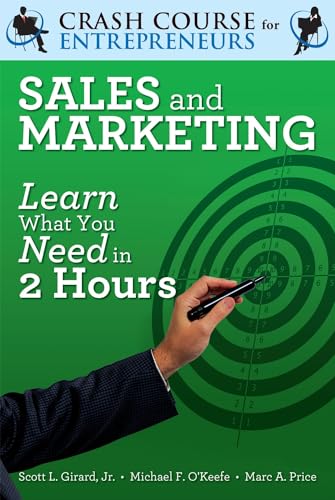
Sales & Marketing: Learn What You Need in 2 Hours (Crash Course for Entrepreneurs, Band 2) - Softcover
Inhaltsangabe
You have a brilliant idea and are ready to invest all your time and hard-earned cash. But what if you aren't really sure how to market or sell that stunning service or perfect product? What if you are a bit of an introvert and aren't even sure that you can sell it at all? In this essential guide, you'll learn how to:
Train and coordinate a sales and marketing team.
Establish prices and profit projections.
Get and keep customers.
Each of the books in the Crash Course for Entrepreneurs series offers a high-level overview of the critical things you need to know and do if you want to survive and thrive in our super-competitive world. Of course, there's much more to learn about each topic, but what you'll read here will give you the framework for learning the rest.
Between them, Marc A. Price, Michael F. O'Keefe, and Scott L. Girard, Jr. have successfully started 17 companies in a wide variety of fields. Scott was formerly executive vice president of Pinpoint Holdings Group, Inc. Mike founded O'Keefe Motor Sports in 2004 and grew it into the largest database of aftermarket automotive components in the world. Marc has launched seven companies of his own and collaborated with the Federal government, U.S. military, and major nonprofits and corporations.
Each of the books in the Crash Course for Entrepreneurs series offers a high-level overview of the critical things you need to know and do if you want to survive and thrive in our super-competitive world. Of course, there's much more to learn about each topic, but what you'll read here will give you the framework for learning the rest.
Between them, Marc A. Price, Michael F. O'Keefe, and Scott L. Girard, Jr. have successfully started 17 companies in a wide variety of fields. Scott was formerly executive vice president of Pinpoint Holdings Group, Inc. Mike founded O'Keefe Motor Sports in 2004 and grew it into the largest database of aftermarket automotive components in the world. Marc has launched seven companies of his own and collaborated with the Federal government, U.S. military, and major nonprofits and corporations.
Die Inhaltsangabe kann sich auf eine andere Ausgabe dieses Titels beziehen.
Über die Autorinnen und Autoren
Marc Price has collaborated with the federal government, United States military, major nonprofit organizations, and some of the largest corporations in America, developing and implementing new products, services, and educational programs. Equally skilled in business-to-business and business-to-consumer functions, he has facilitated product positioning, branding, and outreach efforts on many different platforms for the organizations with which he has worked. As an entrepreneur, Marc has successfully directed the launch of seven different companies, ranging from traditional brick-and-mortar establishments to innovative dot-com initiatives. As an accomplished public speaker and writer, he has appeared on nationally syndicated television and radio networks, in national print publications, and has been the subject of numerous interviews and special-interest stories. He received his Bachelor of Science in organizational management from Ashford University.
Marc Price has collaborated with the federal government, United States military, major nonprofit organizations, and some of the largest corporations in America, developing and implementing new products, services, and educational programs. Equally skilled in business-to-business and business-to-consumer functions, he has facilitated product positioning, branding, and outreach efforts on many different platforms for the organizations with which he has worked. As an entrepreneur, Marc has successfully directed the launch of seven different companies, ranging from traditional brick-and-mortar establishments to innovative dot-com initiatives. As an accomplished public speaker and writer, he has appeared on nationally syndicated television and radio networks, in national print publications, and has been the subject of numerous interviews and special-interest stories. He received his Bachelor of Science in organizational management from Ashford University.
Auszug. © Genehmigter Nachdruck. Alle Rechte vorbehalten.
Sales And Marketing
Learn What You Need in Two Hours
By Scott L. Girard Jr., Michael F. O'Keefe, Marc A. PriceRed Wheel/Weiser, LLC
Copyright © 2012 Scott L. Girard, Jr., Michael F. O'Keefe, and Marc A. Price
All rights reserved.
ISBN: 978-90-77256-37-4All rights reserved.
Contents
Foreword,
Chapter I: First Things First: Sales and Marketing Basics,
The Relationship Between Sales and Marketing,
Sales and Marketing: The Winning Team,
Creating Marketing Collateral,
16 Marketing Tips That Work,
Chapter II: Creating a Game Plan,
How to Write a Marketing Plan,
The Law of Large Numbers,
The Importance of Business Networking,
Organizing Internal Sales Training Seminars,
Getting Back to Sales Basics,
Pricing Your Products,
The Magic of 99,
Chapter III: How to Win Customers,
How to Sell Business-to-Business,
How to Sell Business-to-Consumers,
How to Get and Keep More Customers,
Five Basic Ways to Advertise Your Business,
Public Relations and Publicity,
Secrets of Sales and Marketing Strategies,
Creating Leads,
Creating a Referral Network,
Asking for Referrals from Current Customers,
Escaping the Fear of Cold-Calling,
Why is Cold-Calling So Difficult?,
The Sales Call Process You Can't Live (or Sell) Without,
Chapter IV: How to Keep Customers,
Perception is Reality,
Understanding and Adjusting to Consumer Behavior Changes,
Keeping Customers for Life,
Customer Loyalty Programs,
How to Communicate Effectively with Customers,
Chapter V: Branding,
Branding Your Business,
Branding and Mnemonics,
Launching and Sustaining Your Brand,
Chapter VI: Tricks of the Trade,
Effective Networking through Social Media Channels,
Avoiding Sales Burnout,
Outsourcing Your Sales and Marketing,
Mobile Device Marketing: Not Just for Whippersnappers Any More,
Mastermind Groups: A Valuable Resource,
Marketing Outside the Box,
Afterword: Where to Go from Here,
Acknowledgements,
Glossary,
Resources,
Index,
About the Authors,
CHAPTER 1
First Things First: Sales and Marketing Basics
The Relationship Between Sales and Marketing
Like two peas in a pod, these two have always been together. Ever wonder why?
MOST ENTREPRENEURS HAVE a common sense idea of what sales and marketing are all about, and what makes selling different from marketing. Marketing opens the gate between customers and the products or services they want; sales ensures that the buying happens. So rather than discuss the obvious differences between sales and marketing, let's focus first on the real question: how sales and marketing are connected and how, without one, the other would probably fail.
Sales and marketing are two segments of business that work hand in hand. Marketers identify customer needs, help open ways for the company to sell something to meet those needs, and try to ensure customers come back for more. If a consumer only hears about a product or service for the first time when someone is trying to sell it, the odds of a purchase go down.
So as an entrepreneur, you most likely will be spending money on marketing before you spend on sales. This is no doubt where the saying, "You have to spend money to make money" comes from.
Organizations of all sizes have to deal with this dilemma every day, because marketing is not only about introducing the product to the consumer. It's also about the prior processes of developing a brand, conducting market research to support product development, alpha and beta testing, and holding trials. The costs for these activities are incurred by all businesses. So remember, when creating your marketing plan, to budget for all appropriate marketing expenses. Then you can think about budgeting for sales.
Sales can be handled in many ways. Some companies choose direct selling. This is when the company sells its products or services directly to customers through salespeople, electronic stores (websites), or storefronts. Other companies partner with intermediaries, both nationally and internationally, who take charge of selling on their behalf. These intermediaries are commonly called distributors, wholesalers, representatives (sales reps) or brokers. Regardless of the way a business decides to sell its product or service, the sales force counts on the marketing of that product to facilitate brand awareness, brand recognition, and trust. If the marketing is executed correctly, a much better sales conversion rate should develop.
As a result, if the sales of a product or a service go well, the business will earn more and be able to fund a larger marketing budget, refueling the next cycle of the entire process.
Some companies see sales as a late stage in the overall marketing process, and the sales team may be part of Marketing. Others see marketing as supporting sales, with the schema inverted. The truth is that both models can generate excellent business, provided the two functions coordinate well. Needless to say, in a small company, sales and marketing may be done by a single person. But it helps a lot to clearly see which function is in play at the moment, so your goals are crystal clear.
Sales and Marketing: The Winning Team
While closely related, they are not the same. Nevertheless, never leave home without both.
SALES AND MARKETING are close to the heart of a business. Through marketing you can get clear indicators of your target market; with these, projections and marketing leads can be established. Through sales you can translate your product or service into income. Sales needs marketing to get customers; marketing needs sales to fund its operations and help move your company to the next level. You need both, functioning smoothly together, to ensure growth.
Marketing activities target many people, whereas selling deals with target buyers — individuals and groups clustered around some common factors. Without effective marketing, nobody will know what you offer. Without effective selling, your business has low prospects of surviving and growing. So the two functions are complementary and have equal, important value.
Marketing means all activities that are undertaken with the aim of reaching out and convincing the prospect to buy. Sales processes often involve activities to ensure that a customer buys a product, signs a contract or an agreement, or exchanges something of value for your offering.
The marketing process can vary a lot. It mainly consists of the following:
• Spotting unmet needs, a gap in the market, a new market sector where some opportunities for new offerings may lie
• Finding out the kind of product or service that will serve the needs of your potential customers
• Developing the product or service
• Ensuring that it has the attributes which meet the need of the customer
• Determining a fair price, effective name, appealing packaging and branding, and compelling proposition for the product or the service
• Making the product known to the customer
• Communicating why the customer ought to buy it (vs. the competition, or to solve a need or problem)
• Ensuring customers remain loyal, often by asking them for new concepts or enhancements on existing products, streamlining processes (think of rental cars), or building a community of users — but also...
„Über diesen Titel“ kann sich auf eine andere Ausgabe dieses Titels beziehen.
Suchergebnisse für Sales & Marketing: Learn What You Need in 2 Hours...

Beispielbild für diese ISBN
Sales and Marketing: Learn What You Need in Two Hours (Crash Course for Entrepreneurs)
Anbieter: World of Books (was SecondSale), Montgomery, IL, USA
Verkäuferbewertung 5 von 5 Sternen

Zustand: Very Good. Item in very good condition! Textbooks may not include supplemental items i.e. CDs, access codes etc. Artikel-Nr. 00098684090
Gebraucht kaufen
EUR 8,77
Versand gratis
Versand innerhalb von USA
Versand innerhalb von USA
Anzahl: 1 verfügbar
Beispielbild für diese ISBN
Sales & Marketing: Learn What You Need in 2 Hours
Anbieter: ThriftBooks-Dallas, Dallas, TX, USA
Verkäuferbewertung 5 von 5 Sternen
Paperback. Zustand: Good. No Jacket. Former library book; Pages can have notes/highlighting. Spine may show signs of wear. ~ ThriftBooks: Read More, Spend Less. Artikel-Nr. G9077256377I3N10
Gebraucht kaufen
EUR 9,14
Versand gratis
Versand innerhalb von USA
Versand innerhalb von USA
Anzahl: 1 verfügbar
Beispielbild für diese ISBN
Sales & Marketing: Learn What You Need in 2 Hours
Anbieter: ThriftBooks-Dallas, Dallas, TX, USA
Verkäuferbewertung 5 von 5 Sternen
Paperback. Zustand: Very Good. No Jacket. May have limited writing in cover pages. Pages are unmarked. ~ ThriftBooks: Read More, Spend Less. Artikel-Nr. G9077256377I4N00
Gebraucht kaufen
EUR 9,14
Versand gratis
Versand innerhalb von USA
Versand innerhalb von USA
Anzahl: 1 verfügbar