
Verwandte Artikel zu Don't Read This Book: Time Management for Creative...
Inhaltsangabe
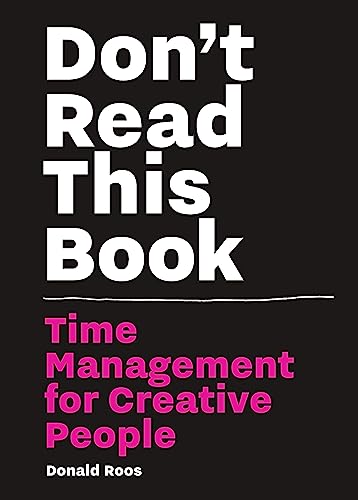
As creative people, we have ideas. Some of us have many ideas, others have really good ones, and most of us have many really good ideas. But most of these never see the light of day. Why? If you ask a creative person, the answer will always revolve around time. We simply need time to execute an idea (and do it well)―more time than we have.
Don’t Read This Book focuses on how to make choices about everything you do in your daily creative practice and life. The book follows the ‘To Don’t List’ method: When you say ‘no’ to one idea, you have more time to execute another one. In short: the more you subtract, the more focus and time you get.
The book is divided into three parts: Life, Workplace, and Projects. It covers everything from defining your life goals, to writing a five sentence-long email, to leaving out as much as possible in a project. Whether you are a student or professional, this book will save you time. (Of course, if you don’t read it, you will save some time directly.)
Die Inhaltsangabe kann sich auf eine andere Ausgabe dieses Titels beziehen.
Über die Autorin bzw. den Autor
Marcus Kraft is an art director, graphic designer, typographer and owner of Studio Marcus Kraft, based in Zurich, Switzerland. From his studio he creates custom-made design solutions for national and international clients. An emphasis is on elaborate design concepts, editorial projects and typographical quality. His work has been awarded international prizes and frequently exhibited and published. In 2012, his international bestseller ‹Don't Eat the Yellow Snow› got published by BIS Publishers. Marcus is also the founder and curator of ‹Tableau Zurich›, a public art space in Zurich.
Von der hinteren Coverseite
As creative people, we have ideas. Some of us have many ideas, others have really good ones, and most of us have many really good ideas. But most of these never see the light of day. Why? If you ask a creative person, the answer will always revolve around time. We simply need time to execute an idea (and do it well)―more time than we have.
Don’t Read This Book focuses on how to make choices about everything you do in your daily creative practice and life. The book follows the ‘To Don’t List’ method: When you say ‘no’ to one idea, you have more time to execute another one. In short: the more you subtract, the more focus and time you get.
The book is divided into three parts: Life, Workplace, and Projects. It covers everything from defining your life goals, to writing a five sentence-long email, to leaving out as much as possible in a project. Whether you are a student or professional, this book will save you time. (Of course, if you don’t read it, you will save some time directly.)
Auszug. © Genehmigter Nachdruck. Alle Rechte vorbehalten.
10 Where Do Ideas Come From?
The evolution of ideas
Everything we see around us — except for nature — was once an idea someone had. Charles and Ray Eames may have designed iconic chairs, but the idea of the chair emerged when a distant ancestor found a rock and sat down on it. Every invention flows from previous ideas. Often ideas seamlessly merge from one into the other, but some feature as milestones in the evolution of ideas, like Henry Ford’s idea to manufacture cars at a large scale. He did not invent the car itself. Nor did he invent the assembly line. But his idea to combine the two became a milestone in production history.
Everything is connected
Google would never have existed if Tim Berners-Lee had not invented the World Wide Web, which became the method for viewing the Internet (which was already in place) through personal computers. The Internet itself emerged from a network of telephone lines between various universities. Telephone lines, in turn, emerged from telegraph machines.
Innovation is serendipity,
so you don’t know what people will make.
— Tim Berners-Lee
From one idea grows another, often without us being able to anticipate it. That’s because ideas don’t function along linear lines, but come together through all sorts of twists and turns: something that philosopher Gilles Deleuze calls a Rhizome. A Rhizome is a root that grows and worms its way into everything. It is symbolic for how connotations and ideas work: You are standing at a crossing with a random number of directions. You turn into the road that feels like it suits you best. Only in retrospect can you see what the choices you’ve made were good for.
Time Management for Creative People is therefore not an hour-by-hour planning method, but a way to help you decide which route you wish to take, even if your goal is not entirely clear yet. In brief: you execute some quick tests to decide which road suits you best. Sounds vague to you? No worries, I will come back to this in a minute.
„Über diesen Titel“ kann sich auf eine andere Ausgabe dieses Titels beziehen.
Suchergebnisse für Don't Read This Book: Time Management for Creative...

Beispielbild für diese ISBN
Don't Read This Book
Anbieter: World of Books (was SecondSale), Montgomery, IL, USA
Verkäuferbewertung 5 von 5 Sternen

Paperback. Zustand: Good. As creative people, we have ideas. Some of us have many ideas, others have really good ones, and most of us have many really good ideas. This book focuses on how to make choices about everything you do in your daily creative practice and life. Artikel-Nr. 00104678683
Gebraucht kaufen
EUR 4,12
Versand gratis
Versand innerhalb von USA
Versand innerhalb von USA
Anzahl: 2 verfügbar
Beispielbild für diese ISBN
Don't Read This Book : Time Management for Creative People
Verlag:
Bis B.V., Uitgeverij (BIS Publishers), 2016
ISBN 10: 9063694237
ISBN 13: 9789063694234
Gebraucht
Softcover
Anbieter: Better World Books, Mishawaka, IN, USA
Verkäuferbewertung 5 von 5 Sternen
Zustand: Very Good. Pages intact with possible writing/highlighting. Binding strong with minor wear. Dust jackets/supplements may not be included. Stock photo provided. Product includes identifying sticker. Better World Books: Buy Books. Do Good. Artikel-Nr. 14803623-6
Gebraucht kaufen
EUR 7,11
Versand gratis
Versand innerhalb von USA
Versand innerhalb von USA
Anzahl: 1 verfügbar
Beispielbild für diese ISBN
Don't Read This Book : Time Management for Creative People
Verlag:
Bis B.V., Uitgeverij (BIS Publishers), 2016
ISBN 10: 9063694237
ISBN 13: 9789063694234
Gebraucht
Softcover
Anbieter: Better World Books: West, Reno, NV, USA
Verkäuferbewertung 5 von 5 Sternen
Zustand: Good. Pages intact with minimal writing/highlighting. The binding may be loose and creased. Dust jackets/supplements are not included. Stock photo provided. Product includes identifying sticker. Better World Books: Buy Books. Do Good. Artikel-Nr. 52056661-20
Gebraucht kaufen
EUR 7,11
Versand gratis
Versand innerhalb von USA
Versand innerhalb von USA
Anzahl: 1 verfügbar
Beispielbild für diese ISBN
Don't Read This Book: Time Management for Creative People
Anbieter: ThriftBooks-Dallas, Dallas, TX, USA
Verkäuferbewertung 5 von 5 Sternen
Paperback. Zustand: Very Good. No Jacket. May have limited writing in cover pages. Pages are unmarked. ~ ThriftBooks: Read More, Spend Less. Artikel-Nr. G9063694237I4N00
Gebraucht kaufen
EUR 7,49
Versand gratis
Versand innerhalb von USA
Versand innerhalb von USA
Anzahl: 1 verfügbar
Beispielbild für diese ISBN
Don't Read This Book: Time Management for Creative People
Anbieter: ThriftBooks-Atlanta, AUSTELL, GA, USA
Verkäuferbewertung 5 von 5 Sternen
Paperback. Zustand: As New. No Jacket. Pages are clean and are not marred by notes or folds of any kind. ~ ThriftBooks: Read More, Spend Less. Artikel-Nr. G9063694237I2N00
Gebraucht kaufen
EUR 7,49
Versand gratis
Versand innerhalb von USA
Versand innerhalb von USA
Anzahl: 1 verfügbar
Beispielbild für diese ISBN
Don't Read this Book: Time Management for Creative People
Anbieter: AwesomeBooks, Wallingford, Vereinigtes Königreich
Verkäuferbewertung 5 von 5 Sternen
Paperback. Zustand: Very Good. Don't Read this Book: Time Management for Creative People This book is in very good condition and will be shipped within 24 hours of ordering. The cover may have some limited signs of wear but the pages are clean, intact and the spine remains undamaged. This book has clearly been well maintained and looked after thus far. Money back guarantee if you are not satisfied. See all our books here, order more than 1 book and get discounted shipping. Artikel-Nr. 7719-9789063694234
Gebraucht kaufen
EUR 3,47
EUR 4,80 Versand
Versand von Vereinigtes Königreich nach USA
Versand von Vereinigtes Königreich nach USA
Anzahl: 1 verfügbar
Beispielbild für diese ISBN
Don't Read this Book: Time Management for Creative People
Anbieter: WorldofBooks, Goring-By-Sea, WS, Vereinigtes Königreich
Verkäuferbewertung 5 von 5 Sternen
Paperback. Zustand: Very Good. The book has been read, but is in excellent condition. Pages are intact and not marred by notes or highlighting. The spine remains undamaged. Artikel-Nr. GOR008693733
Gebraucht kaufen
EUR 4,15
EUR 6,53 Versand
Versand von Vereinigtes Königreich nach USA
Versand von Vereinigtes Königreich nach USA
Anzahl: 13 verfügbar
Beispielbild für diese ISBN
Donât Read this Book: Time Management for Creative People
Anbieter: WorldofBooks, Goring-By-Sea, WS, Vereinigtes Königreich
Verkäuferbewertung 5 von 5 Sternen
Paperback. Zustand: Fair. A readable copy of the book which may include some defects such as highlighting and notes. Cover and pages may be creased and show discolouration. Artikel-Nr. GOR015017299
Gebraucht kaufen
EUR 4,15
EUR 6,53 Versand
Versand von Vereinigtes Königreich nach USA
Versand von Vereinigtes Königreich nach USA
Anzahl: 1 verfügbar
Beispielbild für diese ISBN
Don't Read This Book : Time Management for Creative People
Verlag:
Bis B.V., Uitgeverij (BIS Publishers), 2016
ISBN 10: 9063694237
ISBN 13: 9789063694234
Gebraucht
Softcover
Anbieter: Better World Books Ltd, Dunfermline, Vereinigtes Königreich
Verkäuferbewertung 5 von 5 Sternen
Zustand: Good. Former library copy. Pages intact with minimal writing/highlighting. The binding may be loose and creased. Dust jackets/supplements are not included. Includes library markings. Stock photo provided. Product includes identifying sticker. Better World Books: Buy Books. Do Good. Artikel-Nr. 40587821-75
Gebraucht kaufen
EUR 5,67
EUR 5,83 Versand
Versand von Vereinigtes Königreich nach USA
Versand von Vereinigtes Königreich nach USA
Anzahl: 1 verfügbar
Beispielbild für diese ISBN
Don't Read This Book : Time Management for Creative People
Verlag:
Bis B.V., Uitgeverij (BIS Publishers), 2016
ISBN 10: 9063694237
ISBN 13: 9789063694234
Gebraucht
Softcover
Anbieter: Better World Books Ltd, Dunfermline, Vereinigtes Königreich
Verkäuferbewertung 5 von 5 Sternen
Zustand: Good. Pages intact with minimal writing/highlighting. The binding may be loose and creased. Dust jackets/supplements are not included. Stock photo provided. Product includes identifying sticker. Better World Books: Buy Books. Do Good. Artikel-Nr. 52056661-20
Gebraucht kaufen
EUR 5,67
EUR 5,83 Versand
Versand von Vereinigtes Königreich nach USA
Versand von Vereinigtes Königreich nach USA
Anzahl: 2 verfügbar