
Verwandte Artikel zu How to Think about Meaning (Philosophical Studies Series,...
How to Think about Meaning (Philosophical Studies Series, Band 109) - Softcover
Buch 24 von 134: Philosophical Studies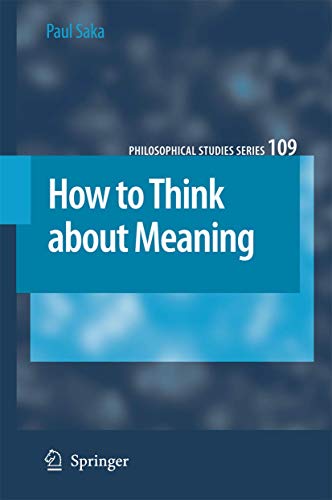
Inhaltsangabe
According to the dominant theory of meaning, truth-conditional semantics, to explain the meaning of a statement is to specify the conditions necessary and sufficient for its truth. Classical truth-conditional semantics is coming under increasing attack, however, from contextualists and inferentialists, who agree that meaning is located in the mind.
How to Think about Meaning develops an even more radical mentalist semantics, which it does by shifting the object of semantic inquiry. Whereas for classical semantics the object of analysis is an abstract sentence or utterance such as “Grass is green”, for attitudinal semantics the object of inquiry is a propositional attitude such as “Speaker so-and-so thinks grass is green”. Explicit relativization to some speaker S allows for semantic theory then to make contact with psychology, sociology, historical linguistics, and other empirical disciplines.
Die Inhaltsangabe kann sich auf eine andere Ausgabe dieses Titels beziehen.
Von der hinteren Coverseite
According to the dominant theory of meaning, truth-conditional semantics, to explain the meaning of a statement is to specify the conditions necessary and sufficient for its truth. Classical truth-conditional semantics is coming under increasing attack, however, from contextualists and inferentialists, who agree that meaning is located in the mind.
How to Think about Meaning develops an even more radical mentalist semantics, which it does by shifting the object of semantic inquiry. Whereas for classical semantics the object of analysis is an abstract sentence or utterance such as "Grass is green," for attitudinal semantics the object of inquiry is a propositional attitude such as "Speaker so-and-so thinks grass is green." Explicit relativization to some speaker S allows for semantic theory then to make contact with psychology, sociology, historical linguistics, and other empirical disciplines.
The attitudinal approach is motivated both by theoretical considerations and by its practical success in dealing with recalcitrant phenomena in the theory of meaning. These include: presuppositions as found in hate speech, and more generally the connotative force of evaluative language; the problem of how to represent ambiguity; quotation and the use-mention distinction; and the liar paradox, which appears to contradict truth-based semantics.
"Technically exact, highly readable, and illustrated with valuable examples, ...here is a book to counterbalance decades of misdirected anti-psychologistic semantic dogma." Prof. Dale Jacquette, Pennsylvania State University, U.S.A.
„Über diesen Titel“ kann sich auf eine andere Ausgabe dieses Titels beziehen.
Suchergebnisse für How to Think about Meaning (Philosophical Studies Series,...

Foto des Verkäufers
How to Think about Meaning
Anbieter: AHA-BUCH GmbH, Einbeck, Deutschland
Verkäuferbewertung 5 von 5 Sternen

Taschenbuch. Zustand: Neu. Druck auf Anfrage Neuware - Printed after ordering - According to the dominant theory of meaning, truth-conditional semantics, to explain the meaning of a statement is to specify the conditions necessary and sufficient for its truth. Classical truth-conditional semantics is coming under increasing attack, however, from contextualists and inferentialists, who agree that meaning is located in the mind.How to Think about Meaning develops an even more radical mentalist semantics, which it does by shifting the object of semantic inquiry. Whereas for classical semantics the object of analysis is an abstract sentence or utterance such as 'Grass is green', for attitudinal semantics the object of inquiry is a propositional attitude such as 'Speaker so-and-so thinks grass is green'. Explicit relativization to some speaker S allows for semantic theory then to make contact with psychology, sociology, historical linguistics, and other empirical disciplines. Artikel-Nr. 9789048174607
Neu kaufen
EUR 174,36
EUR 35,00 Versand
Versand von Deutschland nach USA
Versand von Deutschland nach USA
Anzahl: 1 verfügbar
Foto des Verkäufers
How to Think about Meaning
Anbieter: preigu, Osnabrück, Deutschland
Verkäuferbewertung 5 von 5 Sternen
Taschenbuch. Zustand: Neu. How to Think about Meaning | Paul Saka | Taschenbuch | Philosophical Studies Series | xiii | Englisch | 2010 | Springer | EAN 9789048174607 | Verantwortliche Person für die EU: Springer Verlag GmbH, Tiergartenstr. 17, 69121 Heidelberg, juergen[dot]hartmann[at]springer[dot]com | Anbieter: preigu. Artikel-Nr. 107219185
Neu kaufen
EUR 140,10
EUR 70,00 Versand
Versand von Deutschland nach USA
Versand von Deutschland nach USA
Anzahl: 5 verfügbar
Beispielbild für diese ISBN
How to Think about Meaning (Philosophical Studies Series, 109)
Anbieter: Ria Christie Collections, Uxbridge, Vereinigtes Königreich
Verkäuferbewertung 5 von 5 Sternen
Zustand: New. In English. Artikel-Nr. ria9789048174607_new
Neu kaufen
EUR 210,28
EUR 13,22 Versand
Versand von Vereinigtes Königreich nach USA
Versand von Vereinigtes Königreich nach USA
Anzahl: Mehr als 20 verfügbar
Beispielbild für diese ISBN
How to Think about Meaning (Philosophical Studies Series)
Anbieter: Revaluation Books, Exeter, Vereinigtes Königreich
Verkäuferbewertung 5 von 5 Sternen
Paperback. Zustand: Brand New. 292 pages. 9.00x6.00x0.68 inches. In Stock. Artikel-Nr. x-9048174600
Neu kaufen
EUR 238,41
EUR 11,71 Versand
Versand von Vereinigtes Königreich nach USA
Versand von Vereinigtes Königreich nach USA
Anzahl: 2 verfügbar