
Verwandte Artikel zu Probability and Inference in the Law of Evidence: The...
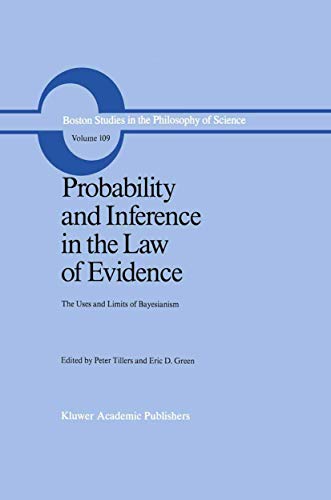
Probability and Inference in the Law of Evidence: The Uses and Limits of Bayesianism (Boston Studies in the Philosophy and History of Science, 109, Band 109) - Hardcover
Inhaltsangabe
This book explores the nature of factual inference in adjudication. The book should be useful to students of law in Continental Europe as well as to students of Anglo-American law. While a good many countries do not use the sorts of rules of evidence found in the Anglo-American legal tradition, their procedural systems nevertheless frequently use a variety of rules and principles to regulate and structure the acquisition, presentation, and evalu ation of evidence. In this sense, almost all legal systems have a law of proof. This book should also be useful to scholars in fields other than law. While the papers focus on inference in adjudication, they deal with a wide variety of issues that are important in disciplines such as the philosophy of science, statistics, and psychology. For example, there is extensive discussion of the role of generalizations and hypotheses in inference and of the significance of the fact that the actors who evaluate data also in some sense constitute the data that they evaluate. Furthermore, explanations of the manner in which some legal systems structure fact-finding processes may highlight features of inferential processes that have yet to be adequately tackled by scholars in fields other than law.
Die Inhaltsangabe kann sich auf eine andere Ausgabe dieses Titels beziehen.
Suchergebnisse für Probability and Inference in the Law of Evidence: The...

Beispielbild für diese ISBN
Probability and Inference in the Law of Evidence. The uses and limits of Bayesianism.
Anbieter: Antiquariat Kai Groß, Gleichen OT Bischhausen, Deutschland
Verkäuferbewertung 5 von 5 Sternen

346 S., Ln. 1-2. Boston Studies in the Philosophy of Science,109). Artikel-Nr. 27102BB
Gebraucht kaufen
EUR 35,00
EUR 20,50 Versand
Versand von Deutschland nach USA
Versand von Deutschland nach USA
Anzahl: 1 verfügbar
Beispielbild für diese ISBN
Probability and Inference in the Law of Evidence: The Uses and Limits of Bayesianism (Boston Studies in the Philosophy and History of Science, 109)
Anbieter: Ria Christie Collections, Uxbridge, Vereinigtes Königreich
Verkäuferbewertung 5 von 5 Sternen
Zustand: New. In English. Artikel-Nr. ria9789027726896_new
Neu kaufen
EUR 254,31
EUR 13,39 Versand
Versand von Vereinigtes Königreich nach USA
Versand von Vereinigtes Königreich nach USA
Anzahl: Mehr als 20 verfügbar
Foto des Verkäufers
Probability and Inference in the Law of Evidence : The Uses and Limits of Bayesianism
Anbieter: AHA-BUCH GmbH, Einbeck, Deutschland
Verkäuferbewertung 5 von 5 Sternen
Buch. Zustand: Neu. Druck auf Anfrage Neuware - Printed after ordering - This book explores the nature of factual inference in adjudication. The book should be useful to students of law in Continental Europe as well as to students of Anglo-American law. While a good many countries do not use the sorts of rules of evidence found in the Anglo-American legal tradition, their procedural systems nevertheless frequently use a variety of rules and principles to regulate and structure the acquisition, presentation, and evalu ation of evidence. In this sense, almost all legal systems have a law of proof. This book should also be useful to scholars in fields other than law. While the papers focus on inference in adjudication, they deal with a wide variety of issues that are important in disciplines such as the philosophy of science, statistics, and psychology. For example, there is extensive discussion of the role of generalizations and hypotheses in inference and of the significance of the fact that the actors who evaluate data also in some sense constitute the data that they evaluate. Furthermore, explanations of the manner in which some legal systems structure fact-finding processes may highlight features of inferential processes that have yet to be adequately tackled by scholars in fields other than law. Artikel-Nr. 9789027726896
Neu kaufen
EUR 241,76
EUR 35,00 Versand
Versand von Deutschland nach USA
Versand von Deutschland nach USA
Anzahl: 1 verfügbar