Inhaltsangabe
In May 1985 the University of Massachusetts held the first conference on the parameter setting model of grammar and acquisition. The conference was conceived in the belief that there is a new possibility of tightly connecting grammatical studies and language acquisition studies, and that this new possibility has grown out of the new generation of ideas about the relation of Universal Grammar to the grammar of particular languages. The papers in this volume are all concerned in one way or another with the ’parametric’ model of grammar, and with its role in explaining the acquisition of language. Before summarizing the accompanying papers, I would like to sketch the intellectual background of these new ideas. It has long been the acknowledged goal of grammatical theorists to explicate the relation between the experience of the child and the knowledge of the adult. Somehow, the child selects a unique grammar (by assumption) compatible with a random partially unreliable sample of some language. In the earliest work in generative grammar, starting with Chomsky’s Aspects, and extending to such works as Jackendoffs Lexicalist Syntax (1977), the model of this account was the formal evaluation metric, accompanied by a general rule writing system. The model of acquisition was the following: the child composed a grammar by writing rules in the rule writing system, under the constraint that the rules must be compatible with the data, and that the grammar must be the one most highly valued by the evaluation metric.
Die Inhaltsangabe kann sich auf eine andere Ausgabe dieses Titels beziehen.
Críticas
`These papers represent the best current thinking by linguists of how contemporary theories of grammar can help to explain real time acquisition. The essays are both theoretically sensitive and empirically reasonable. Roeper and Williams' collection will be useful to psychologists and linguists alike.'
Norbert Hornstein, Associate Professor, University of Maryland
Reseña del editor
In May 1985 the University of Massachusetts held the first conference on the parameter setting model of grammar and acquisition. The conference was conceived in the belief that there is a new possibility of tightly connecting grammatical studies and language acquisition studies, and that this new possibility has grown out of the new generation of ideas about the relation of Universal Grammar to the grammar of particular languages. The papers in this volume are all concerned in one way or another with the 'parametric' model of grammar, and with its role in explaining the acquisition of language. Before summarizing the accompanying papers, I would like to sketch the intellectual background of these new ideas. It has long been the acknowledged goal of grammatical theorists to explicate the relation between the experience of the child and the knowledge of the adult. Somehow, the child selects a unique grammar (by assumption) compatible with a random partially unreliable sample of some language. In the earliest work in generative grammar, starting with Chomsky's Aspects, and extending to such works as Jackendoffs Lexicalist Syntax (1977), the model of this account was the formal evaluation metric, accompanied by a general rule writing system. The model of acquisition was the following: the child composed a grammar by writing rules in the rule writing system, under the constraint that the rules must be compatible with the data, and that the grammar must be the one most highly valued by the evaluation metric.
„Über diesen Titel“ kann sich auf eine andere Ausgabe dieses Titels beziehen.
Weitere beliebte Ausgaben desselben Titels

Suchergebnisse für Parameter Setting: 4 (Studies in Theoretical Psycholinguisti...

Foto des Verkäufers
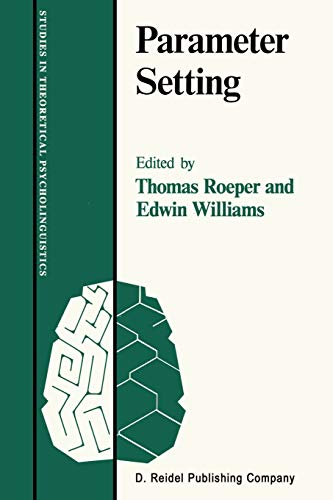
Parameter Setting
Verlag:
Springer Netherlands, Springer Netherlands Aug 1986, 1986
ISBN 10: 9027723168
ISBN 13: 9789027723161
Neu
Taschenbuch
Anbieter: buchversandmimpf2000, Emtmannsberg, BAYE, Deutschland
Verkäuferbewertung 5 von 5 Sternen

Taschenbuch. Zustand: Neu. Neuware -In May 1985 the University of Massachusetts held the first conference on the parameter setting model of grammar and acquisition. The conference was conceived in the belief that there is a new possibility of tightly connecting grammatical studies and language acquisition studies, and that this new possibility has grown out of the new generation of ideas about the relation of Universal Grammar to the grammar of particular languages. The papers in this volume are all concerned in one way or another with the 'parametric' model of grammar, and with its role in explaining the acquisition of language. Before summarizing the accompanying papers, I would like to sketch the intellectual background of these new ideas. It has long been the acknowledged goal of grammatical theorists to explicate the relation between the experience of the child and the knowledge of the adult. Somehow, the child selects a unique grammar (by assumption) compatible with a random partially unreliable sample of some language. In the earliest work in generative grammar, starting with Chomsky's Aspects, and extending to such works as Jackendoffs Lexicalist Syntax (1977), the model of this account was the formal evaluation metric, accompanied by a general rule writing system. The model of acquisition was the following: the child composed a grammar by writing rules in the rule writing system, under the constraint that the rules must be compatible with the data, and that the grammar must be the one most highly valued by the evaluation metric.Springer Verlag GmbH, Tiergartenstr. 17, 69121 Heidelberg 276 pp. Englisch. Artikel-Nr. 9789027723161
Neu kaufen
EUR 160,49
EUR 60,00 shipping
Versand von Deutschland nach USA
Versand von Deutschland nach USA
Anzahl: 2 verfügbar
Foto des Verkäufers
Parameter Setting
Verlag:
Springer Netherlands, Springer Netherlands, 1986
ISBN 10: 9027723168
ISBN 13: 9789027723161
Neu
Taschenbuch
Anbieter: AHA-BUCH GmbH, Einbeck, Deutschland
Verkäuferbewertung 5 von 5 Sternen
Taschenbuch. Zustand: Neu. Druck auf Anfrage Neuware - Printed after ordering - In May 1985 the University of Massachusetts held the first conference on the parameter setting model of grammar and acquisition. The conference was conceived in the belief that there is a new possibility of tightly connecting grammatical studies and language acquisition studies, and that this new possibility has grown out of the new generation of ideas about the relation of Universal Grammar to the grammar of particular languages. The papers in this volume are all concerned in one way or another with the 'parametric' model of grammar, and with its role in explaining the acquisition of language. Before summarizing the accompanying papers, I would like to sketch the intellectual background of these new ideas. It has long been the acknowledged goal of grammatical theorists to explicate the relation between the experience of the child and the knowledge of the adult. Somehow, the child selects a unique grammar (by assumption) compatible with a random partially unreliable sample of some language. In the earliest work in generative grammar, starting with Chomsky's Aspects, and extending to such works as Jackendoffs Lexicalist Syntax (1977), the model of this account was the formal evaluation metric, accompanied by a general rule writing system. The model of acquisition was the following: the child composed a grammar by writing rules in the rule writing system, under the constraint that the rules must be compatible with the data, and that the grammar must be the one most highly valued by the evaluation metric. Artikel-Nr. 9789027723161
Neu kaufen
EUR 167,14
EUR 62,12 shipping
Versand von Deutschland nach USA
Versand von Deutschland nach USA
Anzahl: 1 verfügbar
Beispielbild für diese ISBN
Parameter Setting
Anbieter: Kennys Bookstore, Olney, MD, USA
Verkäuferbewertung 4 von 5 Sternen

Zustand: New. Editor(s): Roeper, Tom; Williams, Edwin. Series: Studies in Theoretical Psycholinguistics. Num Pages: 253 pages, biography. BIC Classification: CFD. Category: (P) Professional & Vocational; (UP) Postgraduate, Research & Scholarly. Dimension: 234 x 156 x 14. Weight in Grams: 860. . 1986. Softcover reprint of the original 1st ed. 1987. Paperback. . . . . Books ship from the US and Ireland. Artikel-Nr. V9789027723161
Neu kaufen
EUR 245,97
EUR 8,92 shipping
Versand innerhalb von USA
Versand innerhalb von USA
Anzahl: 15 verfügbar