
Inhaltsangabe
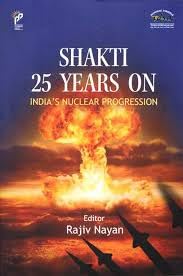
The May 1998 Shakti-series tests marked India`s emergence as a nuclear weapons state. These tests faced initial global resistance, but over time, this opposition gave way to understanding and reconciliation. India actively engaged with the international community to explain the security rationale behind its nuclear weaponization. The existing nuclear world order, anchored in the Nuclear Non-Proliferation Treaty, did not adequately address India’s security concerns. To reinforce its commitment to responsible nuclear behaviour, India undertook measures to demonstrate restraint and reliability.
Die Inhaltsangabe kann sich auf eine andere Ausgabe dieses Titels beziehen.
Über die Autorin bzw. den Autor
Dr Rajiv Nayan is Senior Research Associate at Manohar Parrikar Institute for Defence Studies and Analyses (MP-IDSA), New Delhi. He has been working with the Institute since 1993, where he specialises in international relations, security issues, especially the politics of nuclear disarmament, export control, non-proliferation, and arms control.
„Über diesen Titel“ kann sich auf eine andere Ausgabe dieses Titels beziehen.
Suchergebnisse für Shakti 25 Years on India's Nuclear Progression

Beispielbild für diese ISBN
Shakti 25 Years on Indias Nuclear Progression
Anbieter: Majestic Books, Hounslow, Vereinigtes Königreich
Verkäuferbewertung 4 von 5 Sternen

Zustand: New. Artikel-Nr. 409475810
Neu kaufen
EUR 13,47
EUR 7,63 Versand
Versand von Vereinigtes Königreich nach USA
Versand von Vereinigtes Königreich nach USA
Anzahl: 4 verfügbar
Foto des Verkäufers
Shakti 25 Years on India's Nuclear Progression
Anbieter: Vedams eBooks (P) Ltd, New Delhi, Indien
Verkäuferbewertung 4 von 5 Sternen
Hardcover. Zustand: New. The May 1998 Shakti-series tests marked India`s emergence as a nuclear weapons state. These tests faced initial global resistance, but over time, this opposition gave way to understanding and reconciliation. India actively engaged with the international community to explain the security rationale behind its nuclear weaponization. The existing nuclear world order, anchored in the Nuclear Non-Proliferation Treaty, did not adequately address India's security concerns. To reinforce its commitment to responsible nuclear behaviour, India undertook measures to demonstrate restraint and reliability. This book examines India's nuclear journey over 25 years. It explores the evolution of India's nuclear policy, dispelling myths surrounding its nuclear weapons programmme and highlighting the diplomatic efforts that led to its gradual integration into the global nuclear order. Over time, the international non-proliferation regime has developed a constructive relationship with India, recognizing its nuclear force as a security necessity rather than a tool for power projection or intimidation. The book also delves into India's nuclear doctrine, its confidence-building measures both self-initiated and those proposed by global civil society and its participation in global nuclear governance. Despite its nuclear weapons programme, India has remained committed to the peaceful applications of nuclear science and technology, emerging as a key player in global nuclear research and development. While nuclear disarmament remains a distant goal, it continues to be a fundamental aspiration for nuclear India. Artikel-Nr. 159240
Neu kaufen
EUR 28,45
EUR 17,50 Versand
Versand von Indien nach USA
Versand von Indien nach USA
Anzahl: 5 verfügbar
Beispielbild für diese ISBN
Shakti 25 Years on India's Nuclear Progression
Anbieter: PBShop.store UK, Fairford, GLOS, Vereinigtes Königreich
Verkäuferbewertung 5 von 5 Sternen

HRD. Zustand: New. New Book. Shipped from UK. Established seller since 2000. Artikel-Nr. M0-9788198285706
Neu kaufen
EUR 49,49
EUR 4,88 Versand
Versand von Vereinigtes Königreich nach USA
Versand von Vereinigtes Königreich nach USA
Anzahl: 6 verfügbar
Foto des Verkäufers
Shakti 25 Years on India's Nuclear Progression
Anbieter: AHA-BUCH GmbH, Einbeck, Deutschland
Verkäuferbewertung 5 von 5 Sternen
Buch. Zustand: Neu. Neuware - The May 1998 Shakti-series tests marked India`s emergence as a nuclear weapons state. These tests faced initial global resistance, but over time, this opposition gave way to understanding and reconciliation. India actively engaged with the international community to explain the security rationale behind its nuclear weaponization. The existing nuclear world order, anchored in the Nuclear Non-Proliferation Treaty, did not adequately address India's security concerns. To reinforce its commitment to responsible nuclear behaviour, India undertook measures to demonstrate restraint and reliability. Artikel-Nr. 9788198285706
Neu kaufen
EUR 68,60
EUR 62,36 Versand
Versand von Deutschland nach USA
Versand von Deutschland nach USA
Anzahl: 1 verfügbar