
Verwandte Artikel zu The Unified Modeling Language User Guide
Inhaltsangabe
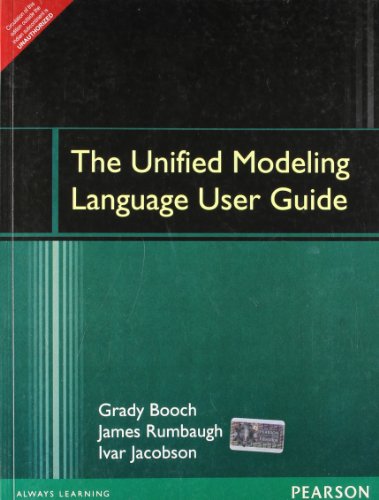
Introduced in 1997, the Unified Modeling Language (UML) has rapidly been accepted throughout the software industry as the standard graphical language for specifying, constructing, visualizing, and documenting software-intensive systems. The UML provides anyone involved in the production, deployment, and maintenance of software with a standard notation for expressing a system's blueprint. The UML covers conceptual things, such as business processes and system functions, as well as concrete things, such as programming-language classes, database schemas, and reusable software components. In The Unified Modeling Language User Guide, the original developers of the UML, Grady Booch, James Rumbaugh, and Ivar Jacobson, provide a tutorial to the core aspects of the language in a two-color format designed to facilitate learning. Starting with a conceptual model of the UML, the book progressively applies the UML to a series of increasingly complex modeling problems across a variety of application domains. This example-driven approach helps readers quickly understand and apply the UML. For more advanced developers, the book includes a learning track focused on applying the UML to advanced modeling problems. Contents same as US/UK editions.
Die Inhaltsangabe kann sich auf eine andere Ausgabe dieses Titels beziehen.
Weitere beliebte Ausgaben desselben Titels

Suchergebnisse für The Unified Modeling Language User Guide

Beispielbild für diese ISBN
The Unified Modeling Language User Guide
Verlag:
Pearson India Education, 1999
ISBN 10: 8177583727
ISBN 13: 9788177583724
Gebraucht
Paperback
Anbieter: ThriftBooks-Atlanta, AUSTELL, GA, USA
Verkäuferbewertung 5 von 5 Sternen

Paperback. Zustand: Fair. No Jacket. Readable copy. Pages may have considerable notes/highlighting. ~ ThriftBooks: Read More, Spend Less. Artikel-Nr. G8177583727I5N00
Gebraucht kaufen
EUR 20,84
Versand gratis
Versand innerhalb von USA
Versand innerhalb von USA
Anzahl: 1 verfügbar
Beispielbild für diese ISBN
The Unified Modeling Language User Guide
Anbieter: Majestic Books, Hounslow, Vereinigtes Königreich
Verkäuferbewertung 4 von 5 Sternen

Zustand: New. Artikel-Nr. 8348460
Neu kaufen
EUR 16,46
EUR 7,61 Versand
Versand von Vereinigtes Königreich nach USA
Versand von Vereinigtes Königreich nach USA
Anzahl: 1 verfügbar