
Verwandte Artikel zu New Education and School Libraries: Experience of Half...
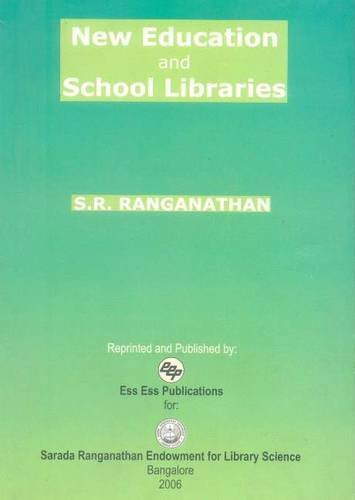
New Education and School Libraries: Experience of Half a Century (Sarada Ranganathan Endowment for Library Science, Band 4) - Hardcover
Inhaltsangabe
Works of Dr. Shiyali Ramamrita Ranganathan (S.R. Ranganathan) need no introduction. They are renowned not because they cover certain facet of library and information science, but because they have been written by the father of library science in india, Dr. Ranganathan. These library science classics have been reprinted to make Dr. Ranganathan's work available to the current generation of librarians and for those to come. This last book by S.R. Ranganathan is a classic on the why, that is, the necessity and role of school library in education for a 'changing world'. About half of the text is devoted to a discussion of educational theory focusing on the centrality of the library in learning and teaching processes (cf. John Dewey, educational philosopher). A thorough analysis of 'what' of the school library.- dealing with each of its constituents: reading materials,, human constituents; location, building and furniture. This is followed by several chapters on the 'how' of the school library - promoting reading habit, inspirational reading, reading for pleasure and recreation, imbibing values, social responsibility, personal development, etc. The techniques of organizing library materials and providing services to meet the information needs of different categories of users of the school library and to support the educational role of the library are elaborated.. Adequate attention is given to important aspects of management, administration and policy issues. All these are implied by the Five Laws of Library Science as the author points out.Ã?Â?Ã?Â?Ã?Â?Ã?Â?
Die Inhaltsangabe kann sich auf eine andere Ausgabe dieses Titels beziehen.
Suchergebnisse für New Education and School Libraries: Experience of Half...

Beispielbild für diese ISBN
New Education and School Library
Anbieter: Majestic Books, Hounslow, Vereinigtes Königreich
Verkäuferbewertung 4 von 5 Sternen

Zustand: New. pp. 510 Figures. Artikel-Nr. 7685643
Neu kaufen
EUR 16,45
EUR 7,57 Versand
Versand von Vereinigtes Königreich nach USA
Versand von Vereinigtes Königreich nach USA
Anzahl: 4 verfügbar
Beispielbild für diese ISBN
New Education and School Library
Anbieter: Vedams eBooks (P) Ltd, New Delhi, Indien
Verkäuferbewertung 4 von 5 Sternen
Hardbound. Zustand: As New. Reprint. Contents I. Preliminaries 1. Conspectus. 2. Foreword to edition 1 (1942) by Sir John Sargent. 3. Pre library days in schools and colleges. 4. Genesis of the book. II. Why of School Library Lines of Approach 1. Answer based on authority. 2. Answer based on tradition. 3. Answer based on imitation. 4. Answer based on a priori method. III. Why of School Library From the Angle of Curriculum 1. Teleology of education. 2. Education for a changing world. 3. Education for an accelerated change in the universe of ideas. 4. Factors leading to overloaded curriculum. 5. A way out of overloaded curriculum. 6. From oral communication to socialisation of books. 7. From camel theory to new education. 8. New education and library scene in elementary school. 9. New education and library scene in high school. IV. Why of School Library From the Angle of Education 1. Humanism and universal education. 2. Arrest of the progress in educational techniques in the early awakened countries of the west. 3. Arrest of progress in educational techniques in India Today. 4. Lines of solution. 5. Problem of lower quartiles in the intellectual scale. 6. Unconscious hit. 7. John Dewey and individual instruction. 8. Emergence of school library and new education. 9. Library hour and new education. V. Why of School Library From the Angle of the Process of Education 1. Inherence and becoming. 2. Education as becoming some case studies. 3. Education as becoming some opinions. 4. Passivity vs activity. 6. Global experience. 7. New education and pedagogical consequences. 8. The look of school library. 9. Sum up inequalities and equalities. VI. What of School Library Constituents of a Library 1. Evolution of the concept of school library. 2. Current definition of the term library. 3. New outlook on school library. VII. What of School Library Bibliographical Factor 1. Range of books in a school library. 2. Range of subjects in a school library. 3. Range of standards of books in a school library. 4. Illustrations in books. 5. Physical make up of books. 6. Fugitive reading materials in a school library. 7. Extension work. VIII. What of School Library Human Constituent 1. Three human constituents of a school library. 2. Human constituent students. 3. Retention of students as customers. 4. Teachers the human constituent of a school library. 5. Library staff the human constituent of a school library. 6. Qualification for a school librarian. 7. Status and scale of salary of school library staff. 8. Grouping of schools for library services both necessary and sufficient. IX. What of School Library Material Constituent 1. General features of school library building. 2. Specification for library building fittings and furniture. X. How of School Library Objectives of School Library Work 1. School library to create library habit in students. 2. School library to create library civics in students. 3. Objectives of school library from the angle of students. XI. How of School Library Means 1. Fallacies. 2. Handicaps. 3. Student's preparatory work in the library. 4. Student's parallel reading. 5. Student's follow up work. 6. Extra mural stimulus. 7. Story hour for the young students. 8. Fact finding. 9. Reading for information and pleasure a sample. 10. Inspirational book. 11. Learning of library habit. XII. How of School Library Student's Work 1. Need for keeping diary. 2. Fact finding dairy. 3. Recreative reading dairy. 4. Inspirational reading diary. 5. Fact finding how to make it pleasurable. 6. Recreational reading how to make it profitable. 7. Inspirational reading how to make it pleasurable. 8. School library the training ground for responsible citizenship. 9. Promotion of public mindedness. 10. Consideration of others. 11. Queue system. 12. Public and private hygiene. 13. Fire prevention. 14. Personal manners. 15. Student's work while attending library lessons. 16. Notes taking work. 17. Bibliography building work. XIII. How of School Library Achievement Test 1. Fact Finding. 2. R. Artikel-Nr. 58847
Gebraucht kaufen
EUR 25,59
EUR 17,50 Versand
Versand von Indien nach USA
Versand von Indien nach USA
Anzahl: 1 verfügbar