
Verwandte Artikel zu Marginalization in Globalizing Delhi: Issues of Land,...
Inhaltsangabe
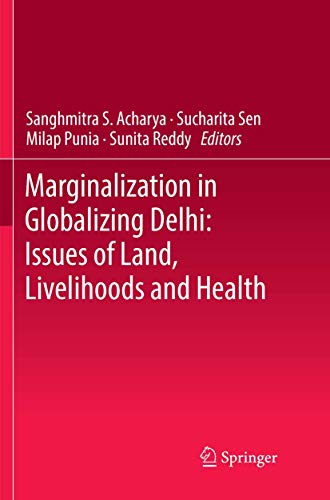
This book analyses how developmental projects in a globalizing Delhi have brought about neglect, exclusion and alienation of certain sections of population, while benefiting others. It discusses the physical, economic and social displacement of people in the city in recent times, which has deprived them of their lands, livelihoods and access to health care. In Delhi and the National Capital Region, beyond the obvious and apparent image of wide roads, flyovers, the metro rail network, high-rises and glittering malls, globalization has brought about skewed and uneven development. A growing middle class and a significant group of an extremely rich section of population steer the ways in which development strategies are planned and implemented. Furthermore, with government control reducing as is inevitable and consistent with a neoliberal policy framework, private players have entered not only the consumer goods sector, but also basic goods and services such as agriculture, health and education. This book explores the effects of such processes, with a specific focus on equity, on the marginalized sections of population in a globalizing megacity. It addresses the themes of land, livelihoods and health as overarching, drawing upon their interlinkages. It traces the changes in the growth of the city in context of these themes and draws inferences from their interconnectedness to examine the current situation of development in Delhi.
Die Inhaltsangabe kann sich auf eine andere Ausgabe dieses Titels beziehen.
Über die Autorin bzw. den Autor
Sanghmitra S. Acharya is a Professor at the Centre of Social Medicine and Community Health, School of Social Sciences JNU and is currently deputed as Director to Indian Institute of Dalit Studies, New Delhi. She has been a Visiting Fellow at CASS, China, Ball State University, USA and UPPI, Manila, East West Center, Honolulu, Hawaii and University of Botswana. She was awarded Asian Scholarship Foundation fellowship in 2005. She has delivered lectures, chaired sessions and contributed in national and international conferences in various Institutions within the country and abroad. Her research includes health and discrimination; vulnerability among youth; gender in urban spaces; and caste gender intersectionality. She has published in national and international journal and has three books to her credit.
Sucharita Sen is a Professor in the Centre for the Study of Regional Development, School of Social Sciences, Jawaharlal Nehru University. She was a Nehru-Fulbright Fellow in 2009-10 and was associated with Ohio State University, Columbus, Ohio, USA during this period. She is an economic geographer and has published in areas of land resources, its acquisition and effect of dispossession on rural livelihoods, rural employment, the impact of watershed development programmes as a means for sustaining rural livelihoods. She is currently working on one major project other than the ‘Gender Atlas’ funded by the Department of Science and Technology (DST), which is the Inter University Consortium on Cryosphere and Climate Change (IUCCCC) project of 'Himalayan Cryosphere: Science and Society', also funded by the DST. She also regularly contributes to the geography curriculum in school (Central Board of Higher Secondary Education) through her association with the National Council of Educational Research and Training, New Delhi.<
Milap Punia is professor of geography in the Centre for the Study of Regional Development, Schoolof Social Sciences, Jawaharlal Nehru University, New Delhi, India. He did his Post Doctoral research work on urban studies from School of Forestry and Environment Studies, Yale University, USA. Served as scientist in Photogrammetry and Remote Sensing Division, Indian Institute of Remote Sensing-ISRO, Dehradun from 2002 to 2006, and adjunct faculty of Centre for Space Science and Technology Education in Asia and the Pacific (Affiliated to the UN). His areas of research include urban studies, spatial data analysis for urban planning and regional development; sustainability, land use change, disaster management, spatial aspects of governance and to bridge research gap between social sciences and remote sensing discipline. He is involved in various research projects of international (Subaltern Urbanization-ANR, remapping of global South-DAAD and of national repute (Snow Spectral Properties and Regional Climate -Hyperspectral Mapping, Geovisualisation of Landscape-DST-GOI) and Spatial aspects of Governance for Decentralised Local Bodies-Indian Council of Social Science and Research (ICSSR).
Sunita Reddy is an Associate Professor at the Center of Social Medicine and Community Health, School of Social Sciences, Jawaharlal Nehru University, New Delhi, India. She is an anthropologist, specialized in medical anthropology. She has researched on various issues of women and child health; breast- feeding practices, tribal women’s health, childbirth and child rearing practices among the tribes. She has researched on disaster issues from social science perspectives and published a book ‘Clash of Waves: Post tsunami Relief and Rehabilitation in Andaman and Nicobar Islands’ (2013) Indos publishers, New Delhi. This book is a based longitudinal study using anthropological research techniques. Her current area of research is ‘Medical Tourism and Reproductive Tourism’, ‘Surrogacy’ issues. She has published articles in peer reviewed journals,contributed papers for edited volumes and disseminated her research work in various universities abroad. She is a founder member of ‘Anthropos India Foundation’ a trust which promotes visual and action anthropology and has a dynamic website www.anthroposindiafoundation.com . She is also an honorary president of an organization called ‘SATAT’ which works for empowering women and children.
Von der hinteren Coverseite
This book analyses how developmental projects in a globalizing Delhi have brought about neglect, exclusion and alienation of certain sections of population, while benefiting others. It discusses the physical, economic and social displacement of people in the city in recent times, which has deprived them of their lands, livelihoods and access to health care. In Delhi and the National Capital Region, beyond the obvious and apparent image of wide roads, flyovers, the metro rail network, high-rises and glittering malls, globalization has brought about skewed and uneven development. A growing middle class and a significant group of an extremely rich section of population steer the ways in which development strategies are planned and implemented. Furthermore, with government control reducing as is inevitable and consistent with a neoliberal policy framework, private players have entered not only the consumer goods sector, but also basic goods and services such as agriculture, health and education. This book explores the effects of such processes, with a specific focus on equity, on the marginalized sections of population in a globalizing megacity. It addresses the themes of land, livelihoods and health as overarching, drawing upon their interlinkages. It traces the changes in the growth of the city in context of these themes and draws inferences from their interconnectedness to examine the current situation of development in Delhi.
„Über diesen Titel“ kann sich auf eine andere Ausgabe dieses Titels beziehen.
Suchergebnisse für Marginalization in Globalizing Delhi: Issues of Land,...

Foto des Verkäufers
Marginalization in Globalizing Delhi: Issues of Land, Livelihoods and Health
Anbieter: AHA-BUCH GmbH, Einbeck, Deutschland
Verkäuferbewertung 5 von 5 Sternen

Taschenbuch. Zustand: Neu. Druck auf Anfrage Neuware - Printed after ordering - This bookanalyses how developmental projectsin a globalizing Delhi have brought about neglect, exclusion and alienation of certain sections of population, while benefitingothers. It discusses the physical, economic and social displacement of people in the city in recent times, which has deprived them of their lands, livelihoods and access to health care. In Delhi and the National Capital Region, beyond the obvious and apparent image of wide roads, flyovers, the metro rail network, high-rises and glittering malls, globalization has brought about skewed and uneven development. A growing middle class and a significant group of an extremely rich section of population steer the ways in which development strategies are planned and implemented. Furthermore, with government control reducing as is inevitable and consistent with a neoliberal policy framework, private players have entered not only the consumer goods sector, but also basic goods and services such as agriculture, health and education. This book explores the effects of such processes, with a specific focus on equity, on the marginalized sections of population in a globalizing megacity. It addresses the themes of land, livelihoods and health as overarching, drawing upon their interlinkages. It traces the changes in the growth of the city in context of these themes and draws inferences from their interconnectedness to examine the current situation of development in Delhi. Artikel-Nr. 9788132238577
Neu kaufen
EUR 124,85
EUR 35,00 Versand
Versand von Deutschland nach USA
Versand von Deutschland nach USA
Anzahl: 1 verfügbar
Foto des Verkäufers
Marginalization in Globalizing Delhi: Issues of Land, Livelihoods and Health
Anbieter: preigu, Osnabrück, Deutschland
Verkäuferbewertung 5 von 5 Sternen
Taschenbuch. Zustand: Neu. Marginalization in Globalizing Delhi: Issues of Land, Livelihoods and Health | Sanghmitra S. Acharya (u. a.) | Taschenbuch | xxxix | Englisch | 2018 | Springer | EAN 9788132238577 | Verantwortliche Person für die EU: Springer Verlag GmbH, Tiergartenstr. 17, 69121 Heidelberg, juergen[dot]hartmann[at]springer[dot]com | Anbieter: preigu. Artikel-Nr. 114123887
Neu kaufen
EUR 95,25
EUR 70,00 Versand
Versand von Deutschland nach USA
Versand von Deutschland nach USA
Anzahl: 5 verfügbar