Inhaltsangabe
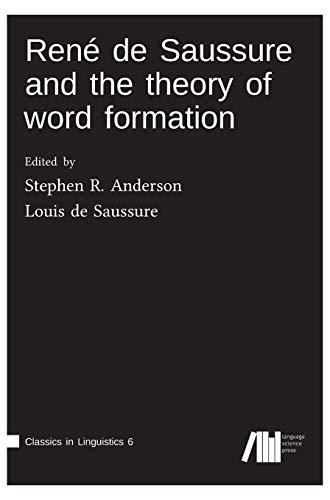
This volume presents two works elaborating a general theory of words and their structure written by René de Saussure, younger brother of Ferdinand de Saussure. Although originating in René de Saussure's concerns for the structure of Esperanto, these essays are clearly intended to articulate a general account of word formation in natural language. They appear here in the French original with facing English translations, accompanied by some remarks on René de Saussure's life and followed by essays on the Esperantist background of his analysis (by Marc van Oostendorp), the contemporary relevance of his morphological theory (by Stephen Anderson), and the semantic theory of words underlying his analysis (by Louis de Saussure). These two works have remained essentially unknown to the community of scholars in general linguistics since their publication in 1911 and 1919, respectively, although Esperantists have been aware of them. They develop in quite explicit form a theory of what would later be called morphemic analysis, based primarily on data from French (with some material from German and English, as well as occasional examples from other Indo-European languages). In its fundamental aspect, René's view of word formation differed significantly from that of his brother, who saw the structure of complex words as revealed not through their decomposition into smaller 'atomic' units but rather in the relations between words, relations which could be presented in analogical form and which anticipate rule-based theories of morphological structure. The contrast between the two brothers' views thus anticipates basic issues in current theorizing about word structure.
Die Inhaltsangabe kann sich auf eine andere Ausgabe dieses Titels beziehen.
Reseña del editor
This volume presents two works elaborating a general theory of words and their structure written by René de Saussure, younger brother of Ferdinand de Saussure. Although originating in René de Saussure's concerns for the structure of Esperanto, these essays are clearly intended to articulate a general account of word formation in natural language. They appear here in the French original with facing English translations, accompanied by some remarks on René de Saussure's life and followed by essays on the Esperantist background of his analysis (by Marc van Oostendorp), the contemporary relevance of his morphological theory (by Stephen Anderson), and the semantic theory of words underlying his analysis (by Louis de Saussure). These two works have remained essentially unknown to the community of scholars in general linguistics since their publication in 1911 and 1919, respectively, although Esperantists have been aware of them. They develop in quite explicit form a theory of what would later be called morphemic analysis, based primarily on data from French (with some material from German and English, as well as occasional examples from other Indo-European languages). In its fundamental aspect, René's view of word formation differed significantly from that of his brother, who saw the structure of complex words as revealed not through their decomposition into smaller 'atomic' units but rather in the relations between words, relations which could be presented in analogical form and which anticipate rule-based theories of morphological structure. The contrast between the two brothers' views thus anticipates basic issues in current theorizing about word structure.
„Über diesen Titel“ kann sich auf eine andere Ausgabe dieses Titels beziehen.
Weitere beliebte Ausgaben desselben Titels

Suchergebnisse für René de Saussure and the theory of word formation

Foto des Verkäufers
René de Saussure and the theory of word formation
Verlag:
Language Science Press, Language Science Press Jul 2018, 2018
ISBN 10: 3961100977
ISBN 13: 9783961100972
Neu
Hardcover
Anbieter: buchversandmimpf2000, Emtmannsberg, BAYE, Deutschland
Verkäuferbewertung 5 von 5 Sternen

Buch. Zustand: Neu. Neuware -This volume presents two works elaborating a general theory of words and their structure written by René de Saussure, younger brother of Ferdinand de Saussure. Although originating in René de Saussure's concerns for the structure of Esperanto, these essays are clearly intended to articulate a general account of word formation in natural language. They appear here in the French original with facing English translations, accompanied by some remarks on René de Saussure's life and followed by essays on the Esperantist background of his analysis (by Marc van Oostendorp), the contemporary relevance of his morphological theory (by Stephen Anderson), and the semantic theory of words underlying his analysis (by Louis de Saussure). These two works have remained essentially unknown to the community of scholars in general linguistics since their publication in 1911 and 1919, respectively, although Esperantists have been aware of them. They develop in quite explicit form a theory of what would later be called morphemic analysis, based primarily on data from French (with some material from German and English, as well as occasional examples from other Indo-European languages). In its fundamental aspect, René's view of word formation differed significantly from that of his brother, who saw the structure of complex words as revealed not through their decomposition into smaller 'atomic' units but rather in the relations between words, relations which could be presented in analogical form and which anticipate rule-based theories of morphological structure. The contrast between the two brothers' views thus anticipates basic issues in current theorizing about word structure.Books on Demand GmbH, Überseering 33, 22297 Hamburg 256 pp. Englisch. Artikel-Nr. 9783961100972
Neu kaufen
EUR 30,00
Versand:
EUR 60,00
Von Deutschland nach USA
Anzahl: 2 verfügbar