
Verwandte Artikel zu Chain Link
Inhaltsangabe
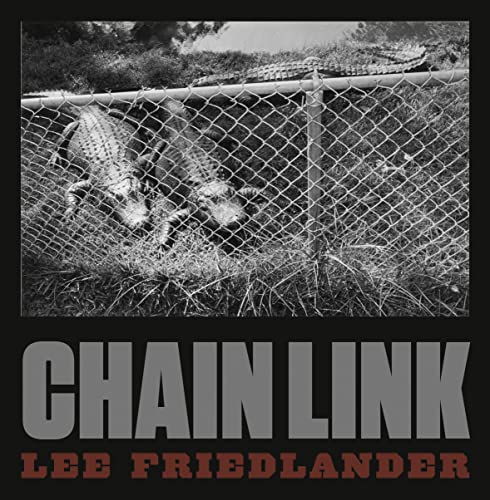
Lee Friedlander is celebrated for his ability to weave disparate elements from ordinary life into uncanny images of great formal complexity and visual wit. And few things have attracted his attention―or been more unpredictable in their effect―than the humble chain link fence.
Erected to delineate space, form protective barriers and bring order to chaos, the fences in Friedlander’s pictures catch filaments of light, throw disconcerting shadows and visually interrupt scenes without fully occluding them. Sometimes the steel mesh seems as delicate as lace; at others it appears as tough as snakeskin. In this book’s 97 pictures, drawn from over four decades of work, it recurs as versatile, utilitarian and ubiquitous―not unlike the photographer himself.
Die Inhaltsangabe kann sich auf eine andere Ausgabe dieses Titels beziehen.
Über die Autorin bzw. den Autor
Lee Friedlander was born in 1934 in Aberdeen, Washington. In 1948 he began to photograph seriously and by the 1960s had become widely recognized for his all-encompassing portrayals of the American social landscape―a term he coined. Friedlander’s influential work has been the subject of many seminal exhibitions, including “New Documents” and “Mirrors and Windows,” both organized by John Szarkowski at the Museum of Modern Art, and more than 50 books, including Self Portrait (1970), The American Monument (1976), Factory Valleys (1982), Sticks and Stones (2004) and America By Car (2010).
Von der hinteren Coverseite
In 2003, Frank Gohlke and Joel Sternfeld were commissioned to photograph one of the densest concentrations of ethnic diversity in the world, the borough of Queens in New York City. After more than a year of photographing everything from corner bodegas to the borough’s boundaries, Gohlke and Sternfeld had not only captured the complicated dynamic that sustains Queens and its myriad communities; they had also evolved a unique theory of landscape photography in which landscape is a visible manifestation of the invisible emotions of its inhabitants. The collection inherits the strength of each photographer’s eye. Gohlke’s Queens consists of streets, houses, fences, gardens, parklands, shorelines, and waste spaces, the terri - tory where human arrangement contends endlessly with the forces that undo it: unruly vegetation, weather, rot, decay, and the “creative destruction” of a voracious commercial culture. Sternfeld focuses on the indigenous shops, restaurants, mosques and temples that make a walk in Queens feel like a walk in Thailand, India or Peru―or all of them at once. Often tucked into homes or converted factories, these places signify a home country, or perhaps a home country that exists more in the mind than in actuality. In conjunction with an essay by the acclaimed writer Suketu Mehta, this book is a powerful instrument for understand - ing a landscape that seems to defy interpretation. Gohlke and Sternfeld successfully make the dizzying patchwork of Queens accessible and visible.
„Über diesen Titel“ kann sich auf eine andere Ausgabe dieses Titels beziehen.
Suchergebnisse für Chain Link

Foto des Verkäufers
Chain Link
Verlag:
Steidl, Gottingen, Germany, 2017
ISBN 10: 3958292593
ISBN 13: 9783958292598
Gebraucht
Hardcover
Erstausgabe
Anbieter: Jeff Hirsch Books, ABAA, Wadsworth, IL, USA
Verkäuferbewertung 5 von 5 Sternen

First Edition. First edition and first printing. Hardcover. A collection of 97 tritone images. A fine copy. No dust jacket as issued. An as new copy and still in the publisher's shrinkwrap. Artikel-Nr. 204465
Gebraucht kaufen
EUR 36,92
EUR 6,27 Versand
Versand innerhalb von USA
Versand innerhalb von USA
Anzahl: 1 verfügbar
Beispielbild für diese ISBN
Lee Friedlander: Chain Link
Anbieter: Phatpocket Limited, Waltham Abbey, HERTS, Vereinigtes Königreich
Verkäuferbewertung 5 von 5 Sternen
Zustand: Good. Your purchase helps support Sri Lankan Children's Charity 'The Rainbow Centre'. Ex-library, so some stamps and wear, but in good overall condition. Our donations to The Rainbow Centre have helped provide an education and a safe haven to hundreds of children who live in appalling conditions. Artikel-Nr. Z1-C-070-02152
Gebraucht kaufen
EUR 48,49
EUR 12,77 Versand
Versand von Vereinigtes Königreich nach USA
Versand von Vereinigtes Königreich nach USA
Anzahl: 1 verfügbar
Beispielbild für diese ISBN
Lee Friedlander: Chain Link
Anbieter: Revaluation Books, Exeter, Vereinigtes Königreich
Verkäuferbewertung 5 von 5 Sternen
Hardcover. Zustand: Brand New. 01 edition. 97 pages. French language. 12.00x12.00x0.25 inches. In Stock. Artikel-Nr. x-3958292593
Neu kaufen
EUR 60,14
EUR 18,00 Versand
Versand von Vereinigtes Königreich nach USA
Versand von Vereinigtes Königreich nach USA
Anzahl: 2 verfügbar
Foto des Verkäufers
Chain Link
Verlag:
Gottingen, Steidl,, Gottingen, 2017
ISBN 10: 3958292593
ISBN 13: 9783958292598
Gebraucht
Hardcover
Anbieter: Studio Bibliografico Marini, ROMA, RM, Italien
Verkäuferbewertung 5 von 5 Sternen
hardcover. Zustand: As New. 97 fotografie in bianco e nero a piena pagina di Lee Friedlander . Cm 31 x 29,3. pp. 102. . Perfetto (Mint). . Prima edizione Steidl (First Steidl Edition). . Lee Friedlander è famoso per la sua capacità di intrecciare elementi disparati della vita ordinaria in immagini inquietanti di grande complessità formale e arguzia visiva. E poche cose hanno attirato la sua attenzione - o sono state più imprevedibili nei loro effetti - dell'umile recinzione di metallo a maglie a catena. Erette per delimitare lo spazio, formare barriere protettive e portare ordine nel caos, le recinzioni nei quadri di Friedlander catturano filamenti di luce, proiettano ombre sconcertanti e interrompono visivamente le scene senza occluderle completamente.A volte la rete d'acciaio sembra delicata come un merletto, altre volte è dura come una pelle di serpente. Prima edizione Steidl (First Steidl Edition). Book. Artikel-Nr. bc_228938
Gebraucht kaufen
EUR 55,00
EUR 35,00 Versand
Versand von Italien nach USA
Versand von Italien nach USA
Anzahl: 1 verfügbar
Foto des Verkäufers
Chain Link
Anbieter: moluna, Greven, Deutschland
Verkäuferbewertung 5 von 5 Sternen
Gebunden. Zustand: New. Lee Friedlander is celebrated for his ability to weave disparate elements from ordinary life into uncanny images of great formal complexity and visual wit. And few things have attracted his attention-or been more unpredictable in their effect-than the humbl. Artikel-Nr. 135219204
Neu kaufen
EUR 46,96
EUR 48,99 Versand
Versand von Deutschland nach USA
Versand von Deutschland nach USA
Anzahl: Mehr als 20 verfügbar
Foto des Verkäufers
Lee Friedlander : Chain Link
Anbieter: GreatBookPricesUK, Woodford Green, Vereinigtes Königreich
Verkäuferbewertung 5 von 5 Sternen
Zustand: As New. Unread book in perfect condition. Artikel-Nr. 28921736
Gebraucht kaufen
EUR 85,13
EUR 18,00 Versand
Versand von Vereinigtes Königreich nach USA
Versand von Vereinigtes Königreich nach USA
Anzahl: 15 verfügbar
Foto des Verkäufers
Lee Friedlander: Chain Link [SIGNED]
Verlag:
Steidl Verlag, Göttingen, Germany, 2017
ISBN 10: 3958292593
ISBN 13: 9783958292598
Neu
Hardcover
Erstausgabe
Signiert
Anbieter: Vincent Borrelli, Bookseller, Albuquerque, NM, USA
Verkäuferbewertung 5 von 5 Sternen
Hardcover. Zustand: New. 1st Edition. Price is net to all; promotional discounts do not apply. First edition, first printing. Signed by Friedlander. Hardcover. Photographs by Lee Friedlander. 140 pp., with 97 tritone plates. 10 x 11 inches. Lee Friedlander's work is widely known for transforming our visual understanding of contemporary American culture. Known for passionately embracing all subject matter, Friedlander photographed nearly every facet of American life from the 1950s to the present. From factories in Pennsylvania, to the jazz scene in New Orleans, to the deserts of the Southwest, Friedlander's complex formal visual strategies continue to influence the way we understand, analyze, and experience modern American experience. Friedlander's work continues to influence photographic practice internationally, in part due to the heightened sense of self-awareness that is a trademark of so many of his photographs and in part because of his ability to embrace wide-ranging subject matter, always interpreting it in an elegance that hadn't existed prior to his work. New (from Friedlander's personal archive). From the publisher: "Lee Friedlander is celebrated for his ability to weave disparate elements from ordinary life into uncanny images of great formal complexity and visual wit. And few things have attracted his attention--or been more unpredictable in their effect--than the humble chain link fence. Erected to delineate space, form protective barriers and bring order to chaos, the fences in Friedlander's pictures catch filaments of light, throw disconcerting shadows and visually interrupt scenes without fully occluding them. Sometimes the steel mesh seems as delicate as lace; at others it appears as tough as snakeskin. In this book's 97 pictures, drawn from over four decades of work, it recurs as versatile, utilitarian and ubiquitous--not unlike the photographer himself." Signed by Author. Signed. Artikel-Nr. 113108
Neu kaufen
EUR 126,93
EUR 8,96 Versand
Versand innerhalb von USA
Versand innerhalb von USA
Anzahl: 7 verfügbar