
Verwandte Artikel zu Almir Mavignier - Additive Plakate: Katalog zur Ausstellung...
Almir Mavignier - Additive Plakate: Katalog zur Ausstellung im Museum für Angewandte Kunst, Frankfurt/Main. Dtsch.-Engl. - Softcover
Inhaltsangabe
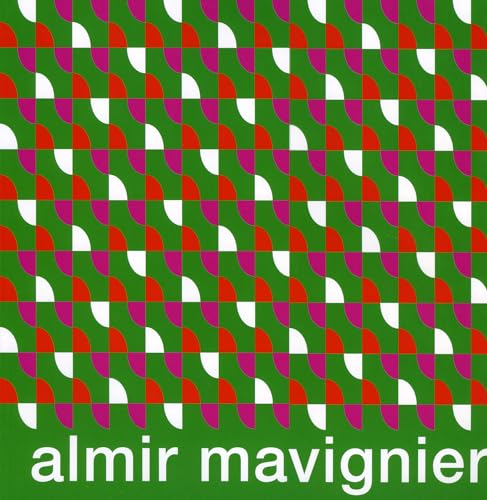
Since the 1960s, the development of poster design in Germany has been determined by the Brazilian-German painter and graphic artist Almir Mavignier. For it is he who, like no other, has learned to apply Op Art's powerful colour effects to the art of the poster.
Mavignier was born on 1 May 1925 in Rio de Janeiro. Initially a student of painting, he was inspired by the work of the Swiss artist Max Bill to go to Europe. In 1953 he arrived at the newly founded Hochschule für Gestaltung in Ulm, where he was to encounter the painter Josef Albers, the art theoretician and philosopher Max Bense, the graphic artist Otl Aicher and many others. Mavignier developed his own approach to the school's ideal of connecting formative and technical skill with political responsibility: "The artist is an official of the unknown." In 1958 he joined the Zero Group, to which he contributed important impulses with his grid-dot paintings. In the decade that followed, the poster began to take its place alongside painting as an essential form of expression for Mavignier, with the "additive posters" playing a special part. They are designed in such a way that they can be joined on all four sides and thus, in the manner of a module, combined to form infinitely large surfaces. Due to the highly charged tension between their space-piercing luminous force and ornamental-geometric abstraction, these posters are capable of casting every passer-by under their spell and advertising for the cause they represent.
The publication on hand elucidates the "additive posters" within the context of Almir Mavignier's influential oeuvre. Special attention is paid to the interfaces between painting, poster design and the artist's other fields of activity such as postage-stamp and tableware design. Light is also shed upon the historical relationship between abstract art and ornament. Of particular relevance in this connection is Mavignier's profound and active interest in the work of the German Romanticist Philipp Otto Runge.
Eva Linhart - head of the department of book art and graphics at the Museum für Angewandte Kunst Frankfurt - devotes her essay to the artist's aesthetic approach, exploring his premise that art and design are one.
Bernd Kracke, once a student of Mavignier at the Hochschule für bildende Künste in Hamburg and now himself a professor at the Hochschule für Gestaltung in Offenbach, takes the reader along on a brief return to his student past. Using his own experience as an example, he provides insight into the significance of the teacher for the budding artist /designer.
Die Inhaltsangabe kann sich auf eine andere Ausgabe dieses Titels beziehen.
Über die Autorin bzw. den Autor
Eva Linhart is head of the department of book art and graphics at the Museum for Applied Arts in Frankfurt. Bernd Kracke, once a student of Mavignier at the Hochschule fur bildende Kunste in Hamburg, is now himself a professor at the Hochschule fur Gestaltung in Offenbach.
„Über diesen Titel“ kann sich auf eine andere Ausgabe dieses Titels beziehen.
Suchergebnisse für Almir Mavignier - Additive Plakate: Katalog zur Ausstellung...

Foto des Verkäufers
Almir Mavignier - Additive Plakate. Additive Posters.
ISBN 10: 393256541X
ISBN 13: 9783932565410
Gebraucht
Softcover
Anbieter: Antiquariat Bernd Preßler, Ahnatal Weimar, Deutschland
Verkäuferbewertung 5 von 5 Sternen

Ohne Stempel, keine An-und Unterstreichungen. Zustand: Einband mit minimalen Gebraucsspuren, gut bis sehr gut. Softcover. Original kartoniert. Kein Versand aufgrund von EPR Regelungen in EU-Länder außerhalb Deutschlands. No shipping to EU countries outside of Germany due to EPR regulations. Artikel-Nr. 247816
Gebraucht kaufen
EUR 24,00
EUR 39,00 Versand
Versand von Deutschland nach USA
Versand von Deutschland nach USA
Anzahl: 1 verfügbar
Beispielbild für diese ISBN
Almir Mavignier: Additive Posters (Additive Plakate) [Paperback] Linhart, Eva; Kracke, Bernd and Mavignier, Almir
Anbieter: Hay-on-Wye Booksellers, Hay-on-Wye, HEREF, Vereinigtes Königreich
Verkäuferbewertung 4 von 5 Sternen

Zustand: As New. Artikel-Nr. HP-59222
Gebraucht kaufen
EUR 35,16
EUR 29,54 Versand
Versand von Vereinigtes Königreich nach USA
Versand von Vereinigtes Königreich nach USA
Anzahl: 1 verfügbar
Foto des Verkäufers
Almir Mavignier - Additive Plakate: Additive Posters (Additive Plakate)
Verlag:
Edition Axel Menges, 2005
ISBN 10: 393256541X
ISBN 13: 9783932565410
Gebraucht
Softcover/Paperback
Anbieter: Roland Antiquariat UG haftungsbeschränkt, Weinheim, Deutschland
Verkäuferbewertung 5 von 5 Sternen
Softcover/Paperback. 95 Seiten Very good condition. Reading pages are very clean and without marks. 9783932565410 Altersfreigabe FSK ab 0 Jahre Sprache: Englisch Gewicht in Gramm: 699. Artikel-Nr. 232743
Gebraucht kaufen
EUR 35,00
EUR 42,00 Versand
Versand von Deutschland nach USA
Versand von Deutschland nach USA
Anzahl: 1 verfügbar
Beispielbild für diese ISBN
Almir Mavignier - Additive Plakate : Katalog zur Ausstellung im Museum für Angewandte Kunst, Frankfurt/Main. Dtsch.-Engl.
Anbieter: AHA-BUCH GmbH, Einbeck, Deutschland
Verkäuferbewertung 5 von 5 Sternen
Taschenbuch. Zustand: Neu. Neuware - Since the 1960s, the development of poster design in Germany has been determined by the Brazilian-German painter and graphic artist Almir Mavignier. For it is he who, like no other, has learned to apply Op Art's powerful colour effects to the art of the poster.Mavignier was born on 1 May 1925 in Rio de Janeiro. Initially a student of painting, he was inspired by the work of the Swiss artist Max Bill to go to Europe. In 1953 he arrived at the newly founded Hochschule für Gestaltung in Ulm, where he was to encounter the painter Josef Albers, the art theoretician and philosopher Max Bense, the graphic artist Otl Aicher and many others. Mavignier developed his own approach to the school's ideal of connecting formative and technical skill with political responsibility: 'The artist is an official of the unknown.' In 1958 he joined the Zero Group, to which he contributed important impulses with his grid-dot paintings. In the decade that followed, the poster began to take its place alongside painting as an essential form of expression for Mavignier, with the 'additive posters' playing a special part. They are designed in such a way that they can be joined on all four sides and thus, in the manner of a module, combined to form infinitely large surfaces. Due to the highly charged tension between their space-piercing luminous force and ornamental-geometric abstraction, these posters are capable of casting every passer-by under their spell and advertising for the cause they represent.The publication on hand elucidates the 'additive posters' within the context of Almir Mavignier's influential oeuvre. Special attention is paid to the interfaces between painting, poster design and the artist's other fields of activity such as postage-stamp and tableware design. Light is also shed upon the historical relationship between abstract art and ornament. Of particular relevance in this connection is Mavignier's profound and active interest in the work of the German Romanticist Philipp Otto Runge.Eva Linhart - head of the department of book art and graphics at the Museum für Angewandte Kunst Frankfurt - devotes her essay to the artist's aesthetic approach, exploring his premise that art and design are one.Bernd Kracke, once a student of Mavignier at the Hochschule für bildende Künste in Hamburg and now himself a professor at the Hochschule für Gestaltung in Offenbach, takes the reader along on a brief return to his student past. Using his own experience as an example, he provides insight into the significance of the teacher for the budding artist /designer. Artikel-Nr. 9783932565410
Neu kaufen
EUR 49,90
EUR 35,00 Versand
Versand von Deutschland nach USA
Versand von Deutschland nach USA
Anzahl: 2 verfügbar
Foto des Verkäufers
Almir Mavignier
Anbieter: moluna, Greven, Deutschland
Verkäuferbewertung 5 von 5 Sternen
Zustand: New. Artikel-Nr. 386537289
Neu kaufen
EUR 49,90
EUR 48,99 Versand
Versand von Deutschland nach USA
Versand von Deutschland nach USA
Anzahl: Mehr als 20 verfügbar