
Verwandte Artikel zu Robert Rauschenberg's »Erased de Kooning Drawing«...
Robert Rauschenberg's »Erased de Kooning Drawing« (1953): Modernism, Literalism, Postmodernism - Softcover
Inhaltsangabe
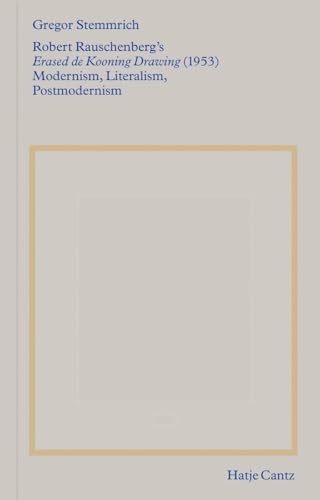
Erased de Kooning Drawing is an artwork that radically challenged the very definition of art and questioned the notion of the artist as creator. Three American artists were involved in its creation: In 1953, Robert Rauschenberg erased a drawing by Willem de Kooning, who had somewhat reluctantly been giving his consent. Jasper Johns created a label for its first public presentation that proved to be key to the psychological framing of the piece. Having been transmuted into something new, the obliterated drawing was soon perceived as a pivotal moment in art history: In the 1950s it was considered Neo-Dada, in the 1960s it was hailed as the beginning of conceptual art, and in the 1980s saw it as a departure into postmodernism. Numerous artists referenced the work and it became a touchstone in Rauschenberg’s oeuvre. Gregor Stemmrich outlines its status as a litmus test for the definitions of modernism, literalism and postmodernism, and demonstrates its continuing relevance for the theory of the image and the question of appropriation.
Die Inhaltsangabe kann sich auf eine andere Ausgabe dieses Titels beziehen.
Über die Autorin bzw. den Autor
GREGOR STEMMRICH (*1953, Soest) is Professor of Art and Art History at NYU Abu Dhabi since 2015. His main focus is on modern and contemporary art. Previously, he was Professor at Freie Universität Berlin and Hochschule für Bildende Künste Dresden. He edited the interviews and writings of Lawrence Weiner as well as Dan Graham, and has published extensively on abstract, conceptual and minimal art.
Von der hinteren Coverseite
Erased de Kooning Drawing is an artwork that radically challenged the very definition of art and questioned the notion of the artist as creator.
Three American artists were involved in its creation: In 1953, Robert Rauschenberg erased a drawing by Willem de Kooning, who had somewhat reluctantly been giving his consent. Jasper Johns created a label for its first public presentation that proved to be key to the psychological framing of the piece. Having been transmuted into something new, the obliterated drawing was soon perceived as a pivotal moment in art history: In the 1950s it was considered Neo-Dada, in the 1960s it was hailed as the beginning of conceptual art, and in the 1980s saw it as a departure into postmodernism.
Numerous artists referenced the work and it became a touchstone in Rauschenberg's oeuvre. Gregor Stemmrich outlines its status as a litmus test for the definitions of modernism, literalism and postmodernism, and demonstrates its continuing relevance for the theory of the image and the question of appropriation.
„Über diesen Titel“ kann sich auf eine andere Ausgabe dieses Titels beziehen.
Suchergebnisse für Robert Rauschenberg's »Erased de Kooning Drawing«...

Beispielbild für diese ISBN
Robert Rauschenberg's Erased de Kooning Drawing (1953)
Anbieter: PBShop.store US, Wood Dale, IL, USA
Verkäuferbewertung 5 von 5 Sternen

PAP. Zustand: New. New Book. Shipped from UK. Established seller since 2000. Artikel-Nr. HU-9783775755030
Beispielbild für diese ISBN
Robert Rauschenberg's Erased de Kooning Drawing (1953)
Anbieter: PBShop.store UK, Fairford, GLOS, Vereinigtes Königreich
Verkäuferbewertung 5 von 5 Sternen
PAP. Zustand: New. New Book. Shipped from UK. Established seller since 2000. Artikel-Nr. HU-9783775755030
Neu kaufen
EUR 50,01
EUR 9,99 Versand
Versand von Vereinigtes Königreich nach USA
Versand von Vereinigtes Königreich nach USA
Anzahl: 15 verfügbar
Beispielbild für diese ISBN
Robert Rauschenberg?s Erased de Kooning Drawing (1953): Modernism, Literalism, Postmodernism
Anbieter: Majestic Books, Hounslow, Vereinigtes Königreich
Verkäuferbewertung 4 von 5 Sternen

Zustand: New. Artikel-Nr. 401145464
Neu kaufen
EUR 56,94
EUR 7,65 Versand
Versand von Vereinigtes Königreich nach USA
Versand von Vereinigtes Königreich nach USA
Anzahl: 3 verfügbar
Beispielbild für diese ISBN
Robert Rauschenberg. Erased de Kooning Drawing (1953). Modernismus, Literalismus, Postmodernismus.
Anbieter: Antiquariat Willi Braunert, München, Deutschland
Verkäuferbewertung 4 von 5 Sternen
8°, paperback. 1028 S. Wie neu. Sprache: Deutsch Gewicht in Gramm: 0. Artikel-Nr. 28474
Gebraucht kaufen
EUR 38,00
EUR 27,00 Versand
Versand von Deutschland nach USA
Versand von Deutschland nach USA
Anzahl: 2 verfügbar
Beispielbild für diese ISBN
Robert Rauschenberg's Erased de Kooning Drawing (1953): Modernism, Literalism, Postmodernism
Anbieter: Ria Christie Collections, Uxbridge, Vereinigtes Königreich
Verkäuferbewertung 5 von 5 Sternen
Zustand: New. In English. Artikel-Nr. ria9783775755030_new
Neu kaufen
EUR 56,08
EUR 17,58 Versand
Versand von Vereinigtes Königreich nach USA
Versand von Vereinigtes Königreich nach USA
Anzahl: 10 verfügbar
Beispielbild für diese ISBN
Robert Rauschenberg's Erased De Kooning Drawing, 1953: Modernism, Literalism, Postmodernism
Verlag:
Hatje Cantz Verlag Gmbh & Co Kg, 2023
ISBN 10: 3775755039
ISBN 13: 9783775755030
Neu
Paperback
Anbieter: Revaluation Books, Exeter, Vereinigtes Königreich
Verkäuferbewertung 5 von 5 Sternen
Paperback. Zustand: Brand New. 1028 pages. 9.50x6.00x2.24 inches. In Stock. Artikel-Nr. __3775755039
Neu kaufen
EUR 69,61
EUR 17,65 Versand
Versand von Vereinigtes Königreich nach USA
Versand von Vereinigtes Königreich nach USA
Anzahl: 1 verfügbar
Beispielbild für diese ISBN
Robert Rauschenbergs Erased De Kooning D
Anbieter: Kennys Bookstore, Olney, MD, USA
Verkäuferbewertung 5 von 5 Sternen
Zustand: New. 2024. 1st Edition. paperback. . . . . . Books ship from the US and Ireland. Artikel-Nr. V9783775755030
Neu kaufen
EUR 83,88
EUR 9,33 Versand
Versand innerhalb von USA
Versand innerhalb von USA
Anzahl: Mehr als 20 verfügbar
Foto des Verkäufers
Robert Rauschenberg's »Erased de Kooning Drawing« (1953): Modernism, Literalism, Postmodernism : Modernism, Literalism, Postmodernism
Anbieter: AHA-BUCH GmbH, Einbeck, Deutschland
Verkäuferbewertung 5 von 5 Sternen
Paperback. Zustand: Sehr gut. Gebraucht - Sehr gut Sg - leichte Beschädigungen oder Verschmutzungen, ungelesenes Mängelexemplar, gestempelt - Erased de Kooning Drawing is an artwork that radically challenged the very definition of art and questioned the notion of the artist as creator. Three American artists were involved in its creation: In 1953, Robert Rauschenberg erased a drawing by Willem de Kooning, who had somewhat reluctantly been giving his consent. Jasper Johns created a label for its first public presentation that proved to be key to the psychological framing of the piece. Having been transmuted into something new, the obliterated drawing was soon perceived as a pivotal moment in art history: In the 1950s it was considered Neo-Dada, in the 1960s it was hailed as the beginning of conceptual art, and in the 1980s saw it as a departure into postmodernism. Numerous artists referenced the work and it became a touchstone in Rauschenberg's oeuvre. Gregor Stemmrich outlines its status as a litmus test for the definitions of modernism, literalism and postmodernism, and demonstrates its continuing relevance for the theory of the image and the question of appropriation.GREGOR STEMMRICH (\*1953, Soest) is Professor of Art and Art History at NYU Abu Dhabi since 2015. His main focus is on modern and contemporary art. Previously, he was Professor at Freie Universität Berlin and Hochschule für Bildende Künste Dresden. He edited the interviews and writings of Lawrence Weiner as well as Dan Graham, and has published extensively on abstract, conceptual and minimal art. Artikel-Nr. INF1000808014
Gebraucht kaufen
EUR 54,64
EUR 45,35 Versand
Versand von Deutschland nach USA
Versand von Deutschland nach USA
Anzahl: 1 verfügbar