
Verwandte Artikel zu Design Science Methodology for Information Systems...
Inhaltsangabe
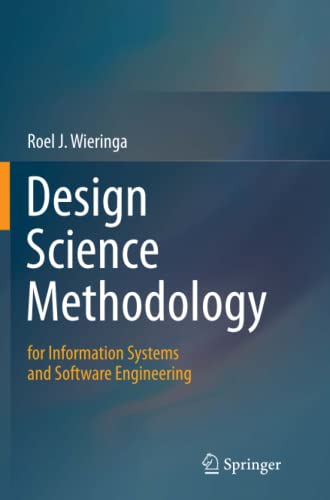
This book provides guidelines for practicing design science in the fields of information systems and software engineering research. A design process usually iterates over two activities: first designing an artifact that improves something for stakeholders and subsequently empirically investigating the performance of that artifact in its context. This “validation in context” is a key feature of the book - since an artifact is designed for a context, it should also be validated in this context.
The book is divided into five parts. Part I discusses the fundamental nature of design science and its artifacts, as well as related design research questions and goals. Part II deals with the design cycle, i.e. the creation, design and validation of artifacts based on requirements and stakeholder goals. To elaborate this further, Part III presents the role of conceptual frameworks and theories in design science. Part IV continues with the empirical cycle to investigate artifacts in context, and presents the different elements of research problem analysis, research setup and data analysis. Finally, Part V deals with the practical application of the empirical cycle by presenting in detail various research methods, including observational case studies, case-based and sample-based experiments and technical action research. These main sections are complemented by two generic checklists, one for the design cycle and one for the empirical cycle.
The book is written for students as well as academic and industrial researchers in software engineering or information systems. It provides guidelines on how to effectively structure research goals, how to analyze research problems concerning design goals and knowledge questions, how to validate artifact designs and how to empirically investigate artifacts in context – and finally how to present the results of the design cycle as a whole.
Die Inhaltsangabe kann sich auf eine andere Ausgabe dieses Titels beziehen.
Über die Autorin bzw. den Autor
Roel Wieringa is Chair of Information Systems at the University of Twente, the Netherlands. His research interests include modelling and design of e-business networks, requirements engineering and research methodology for software engineering and information systems.
Von der hinteren Coverseite
This book provides guidelines for practicing design science in the fields of information systems and software engineering research. A design process usually iterates over two activities: first designing an artifact that improves something for stakeholders, and subsequently empirically investigating the performance of that artifact in its context. This “validation in context” is a key feature of the book - since an artifact is designed for a context, it should also be validated in this context.
The book is divided into five parts. Part I discusses the fundamental nature of design science and its artifacts, as well as related design research questions and goals. Part II deals with the design cycle, i.e. the creation, design and validation of artifacts based on requirements and stakeholder goals. To elaborate this further, Part III presents the role of conceptual frameworks and theories in design science. Part IV continues with the empirical cycle to investigate artifacts in context, and presents the different elements of research problem analysis, research setup, and data analysis. Finally, Part V deals with the practical application of the empirical cycle by presenting in detail various research methods, including observational case studies, case-based and sample-based experiments, and technical action research. These main sections are complemented by two generic checklists, one for the design cycle and one for the empirical cycle.
The book is written for students as well as academic and industrial researchers in software engineering or information systems. It provides guidelines on how to effectively structure research goals, how to analyze research problems concerning design goals and knowledge questions, how to validate artifact designs, and how to empirically investigate artifacts in context – and finally how to present the results of the design cycle as a whole.
„Über diesen Titel“ kann sich auf eine andere Ausgabe dieses Titels beziehen.
Suchergebnisse für Design Science Methodology for Information Systems...

Beispielbild für diese ISBN
Design Science Methodology for Information Systems and Software Engineering
Anbieter: Majestic Books, Hounslow, Vereinigtes Königreich
Verkäuferbewertung 4 von 5 Sternen

Zustand: New. pp. 347. Artikel-Nr. 385805018
Neu kaufen
EUR 56,12
EUR 7,68 Versand
Versand von Vereinigtes Königreich nach USA
Versand von Vereinigtes Königreich nach USA
Anzahl: 1 verfügbar
Beispielbild für diese ISBN
Design Science Methodology for Information Systems and Software Engineering,
Anbieter: Romtrade Corp., STERLING HEIGHTS, MI, USA
Verkäuferbewertung 5 von 5 Sternen

Zustand: New. This is a Brand-new US Edition. This Item may be shipped from US or any other country as we have multiple locations worldwide. Artikel-Nr. ABBB-24820
Beispielbild für diese ISBN
Design Science Methodology for Information Systems and Software Engineering
Anbieter: Ria Christie Collections, Uxbridge, Vereinigtes Königreich
Verkäuferbewertung 5 von 5 Sternen
Zustand: New. In English. Artikel-Nr. ria9783662524466_new
Neu kaufen
EUR 74,95
EUR 13,34 Versand
Versand von Vereinigtes Königreich nach USA
Versand von Vereinigtes Königreich nach USA
Anzahl: Mehr als 20 verfügbar
Foto des Verkäufers
Design Science Methodology for Information Systems and Software Engineering
Anbieter: AHA-BUCH GmbH, Einbeck, Deutschland
Verkäuferbewertung 5 von 5 Sternen
Taschenbuch. Zustand: Neu. Druck auf Anfrage Neuware - Printed after ordering - This book provides guidelines for practicing design science in the fields of information systems and software engineering research. A design process usually iterates over two activities: first designing an artifact that improves something for stakeholders and subsequently empirically investigating the performance of that artifact in its context. This 'validation in context' is a key feature of the book - since an artifact is designed for a context, it should also be validated in this context.The book is divided into five parts. Part I discusses the fundamental nature of design science and its artifacts, as well as related design research questions and goals. Part II deals with the design cycle, i.e. the creation, design and validation of artifacts based on requirements and stakeholder goals. To elaborate this further, Part III presents the role of conceptual frameworks and theories in design science. Part IV continues with the empirical cycle to investigate artifacts in context, and presents the different elements of research problem analysis, research setup and data analysis. Finally, Part V deals with the practical application of the empirical cycle by presenting in detail various research methods, including observational case studies, case-based and sample-based experiments and technical action research. These main sections are complemented by two generic checklists, one for the design cycle and one for the empirical cycle.The book is written for students as well as academic and industrial researchers in software engineering or information systems. It provides guidelines on how to effectively structure research goals, how to analyze research problems concerning design goals and knowledge questions, how to validate artifact designs and how to empirically investigate artifacts in context - and finally how to present the results of the design cycle as a whole. Artikel-Nr. 9783662524466
Neu kaufen
EUR 70,93
EUR 35,00 Versand
Versand von Deutschland nach USA
Versand von Deutschland nach USA
Anzahl: 1 verfügbar
Beispielbild für diese ISBN
Design Science Methodology for Information Systems and Software Engineering
Anbieter: Revaluation Books, Exeter, Vereinigtes Königreich
Verkäuferbewertung 5 von 5 Sternen
Paperback. Zustand: Brand New. reprint edition. 348 pages. 9.25x6.10x0.79 inches. In Stock. Artikel-Nr. x-3662524465
Neu kaufen
EUR 96,29
EUR 14,77 Versand
Versand von Vereinigtes Königreich nach USA
Versand von Vereinigtes Königreich nach USA
Anzahl: 2 verfügbar
Foto des Verkäufers
Design Science Methodology for Information Systems and Software Engineering
Anbieter: preigu, Osnabrück, Deutschland
Verkäuferbewertung 5 von 5 Sternen
Taschenbuch. Zustand: Neu. Design Science Methodology for Information Systems and Software Engineering | Roel J. Wieringa | Taschenbuch | xv | Englisch | 2016 | Springer | EAN 9783662524466 | Verantwortliche Person für die EU: Springer Verlag GmbH, Tiergartenstr. 17, 69121 Heidelberg, juergen[dot]hartmann[at]springer[dot]com | Anbieter: preigu. Artikel-Nr. 103510835
Neu kaufen
EUR 56,70
EUR 70,00 Versand
Versand von Deutschland nach USA
Versand von Deutschland nach USA
Anzahl: 5 verfügbar