
Verwandte Artikel zu The Foundations of Computability Theory
Inhaltsangabe
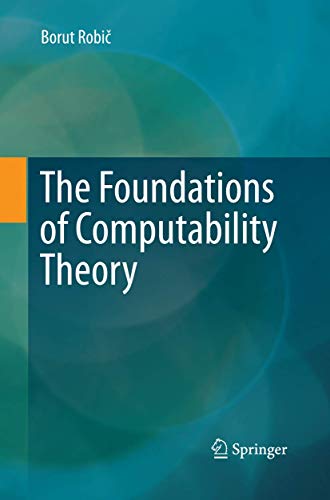
This book offers an original and informative view of the development of fundamental concepts of computability theory. The treatment is put into historical context, emphasizing the motivation for ideas as well as their logical and formal development. In Part I the author introduces computability theory, with chapters on the foundational crisis of mathematics in the early twentieth century, and formalism; in Part II he explains classical computability theory, with chapters on the quest for formalization, the Turing Machine, and early successes such as defining incomputable problems, c.e. (computably enumerable) sets, and developing methods for proving incomputability; in Part III he explains relative computability, with chapters on computation with external help, degrees of unsolvability, the Turing hierarchy of unsolvability, the class of degrees of unsolvability, c.e. degrees and the priority method, and the arithmetical hierarchy.
This is a gentle introduction from the origins of computability theory up to current research, and it will be of value as a textbook and guide for advanced undergraduate and graduate students and researchers in the domains of computability theory and theoretical computer science.
Die Inhaltsangabe kann sich auf eine andere Ausgabe dieses Titels beziehen.
Über die Autorin bzw. den Autor
Prof. Borut Robič received his Ph.D. in Computer Science from the University of Ljubljana in 1993. He is a member of the Faculty of Computer and Information Science of the University of Ljubljana where he leads the Laboratory for Algorithms and Data Structures. He has had guest professorships, fellowships and collaborations with the University of Cambridge, the University of Augsburg, the University of Grenoble, and the Jožef Stefan Institute in Ljubljana. His research interests and teaching experience address algorithms; computability and computational complexity theory; parallel, distributed and grid computing; operating systems; and processor architectures. Prof. Robič coauthored the book "Processor Architecture: From Dataflow to Superscalar and Beyond" (Springer 1999).
Von der hinteren Coverseite
This book offers an original and informative view of the development of fundamental concepts of computability theory. The treatment is put into historical context, emphasizing the motivation for ideas as well as their logical and formal development. In Part I the author introduces computability theory, with chapters on the foundational crisis of mathematics in the early twentieth century, and formalism; in Part II he explains classical computability theory, with chapters on the quest for formalization, the Turing Machine, and early successes such as defining incomputable problems, c.e. (computably enumerable) sets, and developing methods for proving incomputability; in Part III he explains relative computability, with chapters on computation with external help, degrees of unsolvability, the Turing hierarchy of unsolvability, the class of degrees of unsolvability, c.e. degrees and the priority method, and the arithmetical hierarchy.
This is a gentle introduction from the origins of computability theory up to current research, and it will be of value as a textbook and guide for advanced undergraduate and graduate students and researchers in the domains of computability theory and theoretical computer science.
„Über diesen Titel“ kann sich auf eine andere Ausgabe dieses Titels beziehen.
Suchergebnisse für The Foundations of Computability Theory

Foto des Verkäufers
The Foundations of Computability Theory
Anbieter: AHA-BUCH GmbH, Einbeck, Deutschland
Verkäuferbewertung 5 von 5 Sternen

Taschenbuch. Zustand: Neu. Druck auf Anfrage Neuware - Printed after ordering - This book offers an original and informative view of the development of fundamental concepts of computability theory. The treatment is put into historical context, emphasizing the motivation for ideas as well as their logical and formal development. In Part I the author introduces computability theory, with chapters on the foundational crisis of mathematics in the early twentieth century, and formalism; in Part II he explains classical computability theory, with chapters on the quest for formalization, the Turing Machine, and early successes such as defining incomputable problems, c.e. (computably enumerable) sets, and developing methods for proving incomputability; in Part III he explains relative computability, with chapters on computation with external help, degrees of unsolvability, the Turing hierarchy of unsolvability, the class of degrees of unsolvability, c.e. degrees and the priority method, and the arithmetical hierarchy. This is a gentle introduction from the origins of computability theory up to current research, and it will be of value as a textbook and guide for advanced undergraduate and graduate students and researchers in the domains of computability theory and theoretical computer science. Artikel-Nr. 9783662516010
Neu kaufen
EUR 93,36
EUR 30,50 Versand
Versand von Deutschland nach USA
Versand von Deutschland nach USA
Anzahl: 1 verfügbar
Foto des Verkäufers
The Foundations of Computability Theory
Anbieter: preigu, Osnabrück, Deutschland
Verkäuferbewertung 5 von 5 Sternen
Taschenbuch. Zustand: Neu. The Foundations of Computability Theory | Borut Robic | Taschenbuch | xx | Englisch | 2016 | Springer | EAN 9783662516010 | Verantwortliche Person für die EU: Springer Verlag GmbH, Tiergartenstr. 17, 69121 Heidelberg, juergen[dot]hartmann[at]springer[dot]com | Anbieter: preigu. Artikel-Nr. 109582666
Neu kaufen
EUR 59,40
EUR 70,00 Versand
Versand von Deutschland nach USA
Versand von Deutschland nach USA
Anzahl: 5 verfügbar
Beispielbild für diese ISBN
The Foundations of Computability Theory
Anbieter: Revaluation Books, Exeter, Vereinigtes Königreich
Verkäuferbewertung 5 von 5 Sternen
Paperback. Zustand: Brand New. reprint edition. 352 pages. 9.25x6.10x0.80 inches. In Stock. Artikel-Nr. __3662516012
Neu kaufen
EUR 134,35
EUR 40,83 Versand
Versand von Vereinigtes Königreich nach USA
Versand von Vereinigtes Königreich nach USA
Anzahl: 1 verfügbar