
Verwandte Artikel zu Spectra of Random and Almost-Periodic Operators (Grundlehren...
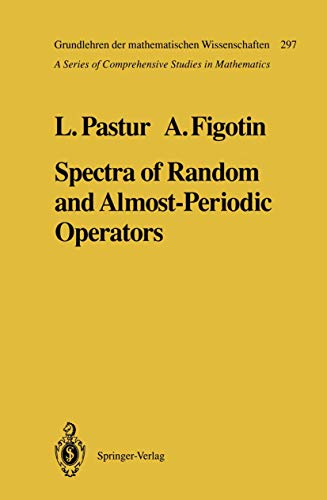
Spectra of Random and Almost-Periodic Operators (Grundlehren der mathematischen Wissenschaften, Band 297) - Softcover
Inhaltsangabe
In the last fifteen years the spectral properties of the Schrodinger equation and of other differential and finite-difference operators with random and almost-periodic coefficients have attracted considerable and ever increasing interest. This is so not only because of the subject's position at the in tersection of operator spectral theory, probability theory and mathematical physics, but also because of its importance to theoretical physics, and par ticularly to the theory of disordered condensed systems. It was the requirements of this theory that motivated the initial study of differential operators with random coefficients in the fifties and sixties, by the physicists Anderson, 1. Lifshitz and Mott; and today the same theory still exerts a strong influence on the discipline into which this study has evolved, and which will occupy us here. The theory of disordered condensed systems tries to describe, in the so-called one-particle approximation, the properties of condensed media whose atomic structure exhibits no long-range order. Examples of such media are crystals with chaotically distributed impurities, amorphous substances, biopolymers, and so on. It is natural to describe the location of atoms and other characteristics of such media probabilistically, in such a way that the characteristics of a region do not depend on the region's position, and the characteristics of regions far apart are correlated only very weakly. An appropriate model for such a medium is a homogeneous and ergodic, that is, metrically transitive, random field.
Die Inhaltsangabe kann sich auf eine andere Ausgabe dieses Titels beziehen.
Von der hinteren Coverseite
In the last fifteen years the spectral properties of the Schrodinger equation and of other differential and finite-difference operators with random and almost-periodic coefficients have attracted considerable and ever increasing interest. This is so not only because of the subject's position at the in tersection of operator spectral theory, probability theory and mathematical physics, but also because of its importance to theoretical physics, and par ticularly to the theory of disordered condensed systems. It was the requirements of this theory that motivated the initial study of differential operators with random coefficients in the fifties and sixties, by the physicists Anderson, 1. Lifshitz and Mott; and today the same theory still exerts a strong influence on the discipline into which this study has evolved, and which will occupy us here. The theory of disordered condensed systems tries to describe, in the so-called one-particle approximation, the properties of condensed media whose atomic structure exhibits no long-range order. Examples of such media are crystals with chaotically distributed impurities, amorphous substances, biopolymers, and so on. It is natural to describe the location of atoms and other characteristics of such media probabilistically, in such a way that the characteristics of a region do not depend on the region's position, and the characteristics of regions far apart are correlated only very weakly. An appropriate model for such a medium is a homogeneous and ergodic, that is, metrically transitive, random field.
„Über diesen Titel“ kann sich auf eine andere Ausgabe dieses Titels beziehen.
Ihre gesetzlichen Garantierechte: Alle Verbraucher:innen in der EU profitieren von mindestens 2 Jahren gesetzlichem Garantieschutz für alle in der EU verkauften Konsumgüter. Mehr erfahren
Suchergebnisse für Spectra of Random and Almost-Periodic Operators (Grundlehren...

Beispielbild für diese ISBN
Spectra of Random and Almost-Periodic Operators (Grundlehren der mathematischen Wissenschaften, 297)
Anbieter: Ria Christie Collections, Uxbridge, Vereinigtes Königreich
Verkäuferbewertung 5 von 5 Sternen

Zustand: New. In English. Artikel-Nr. ria9783642743481_new
Neu kaufen
EUR 131,13
EUR 15,31 Versand
Versand von Vereinigtes Königreich nach USA
Versand von Vereinigtes Königreich nach USA
Anzahl: Mehr als 20 verfügbar
Foto des Verkäufers
Spectra of Random and Almost-Periodic Operators
Anbieter: AHA-BUCH GmbH, Einbeck, Deutschland
Verkäuferbewertung 5 von 5 Sternen
Taschenbuch. Zustand: Neu. Druck auf Anfrage Neuware - Printed after ordering - In the last fifteen years the spectral properties of the Schrodinger equation and of other differential and finite-difference operators with random and almost-periodic coefficients have attracted considerable and ever increasing interest. This is so not only because of the subject's position at the in tersection of operator spectral theory, probability theory and mathematical physics, but also because of its importance to theoretical physics, and par ticularly to the theory of disordered condensed systems. It was the requirements of this theory that motivated the initial study of differential operators with random coefficients in the fifties and sixties, by the physicists Anderson, 1. Lifshitz and Mott; and today the same theory still exerts a strong influence on the discipline into which this study has evolved, and which will occupy us here. The theory of disordered condensed systems tries to describe, in the so-called one-particle approximation, the properties of condensed media whose atomic structure exhibits no long-range order. Examples of such media are crystals with chaotically distributed impurities, amorphous substances, biopolymers, and so on. It is natural to describe the location of atoms and other characteristics of such media probabilistically, in such a way that the characteristics of a region do not depend on the region's position, and the characteristics of regions far apart are correlated only very weakly. An appropriate model for such a medium is a homogeneous and ergodic, that is, metrically transitive, random field. Artikel-Nr. 9783642743481
Neu kaufen
EUR 125,69
EUR 35,00 Versand
Versand von Deutschland nach USA
Versand von Deutschland nach USA
Anzahl: 1 verfügbar
Beispielbild für diese ISBN
Spectra of Random and Almost-Periodic Operators (Grundlehren Der Mathematischen Wissenschaften)
Anbieter: Revaluation Books, Exeter, Vereinigtes Königreich
Verkäuferbewertung 5 von 5 Sternen
Paperback. Zustand: Brand New. reprint edition. 595 pages. 9.00x6.10x1.30 inches. In Stock. Artikel-Nr. x-364274348X
Neu kaufen
EUR 165,93
EUR 14,91 Versand
Versand von Vereinigtes Königreich nach USA
Versand von Vereinigtes Königreich nach USA
Anzahl: 2 verfügbar