
Verwandte Artikel zu Handwriting Recognition: Soft Computing and Probabilistic...
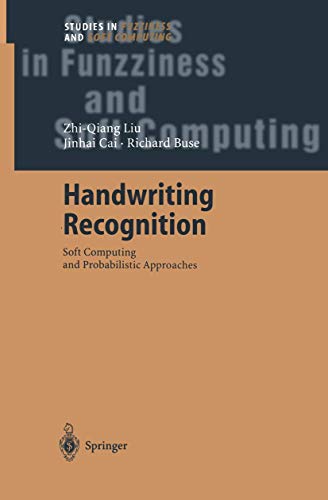
Handwriting Recognition: Soft Computing and Probabilistic Approaches (Studies in Fuzziness and Soft Computing, 133, Band 133) - Softcover
Inhaltsangabe
Over the last few decades, research on handwriting recognition has made impressive progress. The research and development on handwritten word recognition are to a large degree motivated by many application areas, such as automated postal address and code reading, data acquisition in banks, text-voice conversion, security, etc. As the prices of scanners, com puters and handwriting-input devices are falling steadily, we have seen an increased demand for handwriting recognition systems and software pack ages. Some commercial handwriting recognition systems are now available in the market. Current commercial systems have an impressive performance in recognizing machine-printed characters and neatly written texts. For in stance, High-Tech Solutions in Israel has developed several products for container ID recognition, car license plate recognition and package label recognition. Xerox in the U. S. has developed TextBridge for converting hardcopy documents into electronic document files. In spite of the impressive progress, there is still a significant perfor mance gap between the human and the machine in recognizing off-line unconstrained handwritten characters and words. The difficulties encoun tered in recognizing unconstrained handwritings are mainly caused by huge variations in writing styles and the overlapping and the interconnection of neighboring characters. Furthermore, many applications demand very high recognition accuracy and reliability. For example, in the banking sector, although automated teller machines (ATMs) and networked banking sys tems are now widely available, many transactions are still carried out in the form of cheques.
Die Inhaltsangabe kann sich auf eine andere Ausgabe dieses Titels beziehen.
Über die Autorin bzw. den Autor
Prof. Jia ZENG is currently working at the School of Computer Science and Technology, Soochow University, Suzhou 215006, China. Before that, he was a Visiting Research Scholar with the Department of Computer Science, Hong Kong Baptist University from 2009 to 2010 and a Research Fellow in the Department of Electronic Engineering, City University of Hong Kong from 2006 to 2008. He obtained Ph.D. from School of Creative Media, City University of Hong Kong in October 2006, and B.Eng. with excellent academic honors at Wuhan University of Technology, China in 2002. His research interests have been mainly in the areas of type-2 fuzzy systems, probabilistic graphical models, pattern recognition and computational biology. He has authored and co-authored a number of publications appearing in high-profile journals and leading conferences. He won the 2006 Postgraduate Student Paper Contest, Second Prize, IEEE Region 10 and 2005 Postgraduate Student Paper Contest, First Prize, IEEE Region 10, respectively. He has also been invited to serve in a number of journals and conferences as the reviewer. Prof Zhi-Qiang LIU received the M.A.Sc. degree in Aerospace Engineering from the Institute for Aerospace Studies, the University of Toronto, and the Ph.D. degree in Electrical Engineering from The University of Alberta, Canada. He is currently at the School of Creative Media, City University of Hong Kong. He has taught computer architecture, computer networks, artificial intelligence, programming languages, machine learning, pattern recognition, computer graphics, and art & technology. His interests are neural-fuzzy systems, machine learning, media computing and computer vision.
„Über diesen Titel“ kann sich auf eine andere Ausgabe dieses Titels beziehen.
Suchergebnisse für Handwriting Recognition: Soft Computing and Probabilistic...

Beispielbild für diese ISBN
Handwriting Recognition: Soft Computing and Probabilistic Approaches (Studies in Fuzziness and Soft Computing, 133)
Anbieter: Ria Christie Collections, Uxbridge, Vereinigtes Königreich
Verkäuferbewertung 5 von 5 Sternen

Zustand: New. In English. Artikel-Nr. ria9783642072802_new
Neu kaufen
EUR 129,58
EUR 11,05 Versand
Versand von Vereinigtes Königreich nach USA
Versand von Vereinigtes Königreich nach USA
Anzahl: Mehr als 20 verfügbar
Foto des Verkäufers
Handwriting Recognition : Soft Computing and Probabilistic Approaches
Anbieter: AHA-BUCH GmbH, Einbeck, Deutschland
Verkäuferbewertung 5 von 5 Sternen
Taschenbuch. Zustand: Neu. Druck auf Anfrage Neuware - Printed after ordering - Over the last few decades, research on handwriting recognition has made impressive progress. The research and development on handwritten word recognition are to a large degree motivated by many application areas, such as automated postal address and code reading, data acquisition in banks, text-voice conversion, security, etc. As the prices of scanners, com puters and handwriting-input devices are falling steadily, we have seen an increased demand for handwriting recognition systems and software pack ages. Some commercial handwriting recognition systems are now available in the market. Current commercial systems have an impressive performance in recognizing machine-printed characters and neatly written texts. For in stance, High-Tech Solutions in Israel has developed several products for container ID recognition, car license plate recognition and package label recognition. Xerox in the U. S. has developed TextBridge for converting hardcopy documents into electronic document files. In spite of the impressive progress, there is still a significant perfor mance gap between the human and the machine in recognizing off-line unconstrained handwritten characters and words. The difficulties encoun tered in recognizing unconstrained handwritings are mainly caused by huge variations in writing styles and the overlapping and the interconnection of neighboring characters. Furthermore, many applications demand very high recognition accuracy and reliability. For example, in the banking sector, although automated teller machines (ATMs) and networked banking sys tems are now widely available, many transactions are still carried out in the form of cheques. Artikel-Nr. 9783642072802
Neu kaufen
EUR 114,00
EUR 35,00 Versand
Versand von Deutschland nach USA
Versand von Deutschland nach USA
Anzahl: 1 verfügbar
Foto des Verkäufers
Handwriting Recognition | Soft Computing and Probabilistic Approaches
Anbieter: preigu, Osnabrück, Deutschland
Verkäuferbewertung 5 von 5 Sternen
Taschenbuch. Zustand: Neu. Handwriting Recognition | Soft Computing and Probabilistic Approaches | Zhi-Qiang Liu (u. a.) | Taschenbuch | Studies in Fuzziness and Soft Computing | xv | Englisch | 2010 | Springer | EAN 9783642072802 | Verantwortliche Person für die EU: Springer Verlag GmbH, Tiergartenstr. 17, 69121 Heidelberg, juergen[dot]hartmann[at]springer[dot]com | Anbieter: preigu. Artikel-Nr. 107167578
Neu kaufen
EUR 95,25
EUR 70,00 Versand
Versand von Deutschland nach USA
Versand von Deutschland nach USA
Anzahl: 5 verfügbar