
Verwandte Artikel zu Patent Law for Computer Scientists: Steps to Protect...
Inhaltsangabe
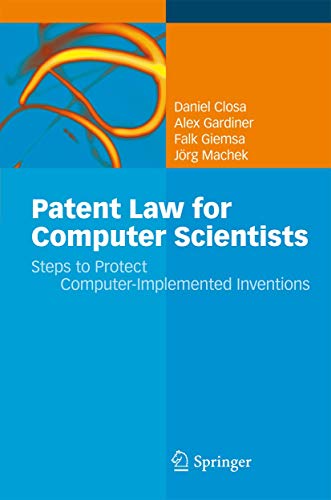
Patent laws are different in many countries, and inventors are sometimes at a loss to understand which basic requirements should be satisfied if an invention is to be granted a patent. This is particularly true for inventions implemented on a computer. While roughly a third of all applications (and granted patents) relate, in one way or another, to a computer, applications where the innovation mainly resides in software or in a business method are treated differently by the major patent offices in the US (USPTO), Japan (JPO), and Europe (EPO).
The authors start with a thorough introduction into patent laws and practices, as well as in related intellectual property rights, which also explains the procedures at the USPTO, JPO and EPO and, in particular, the peculiarities in the treatment of applications centering on software or computers. Based on this theoretical description, next they present in a very structured way a huge set of case studies from different areas like business methods, databases, graphical user interfaces, digital rights management, and many more. Each set starts with a rather short description and claim of the "invention", then explains the arguments a legal examiner will probably have, and eventually refines the description step by step, until all the reservations are resolved. All of these case studies are based on real-world examples, and will thus give an inexperienced developer an idea about the required level of detail and description he will have to provide.
Together, Closa, Gardiner, Giemsa and Machek have more than 70 years experience in the patent business. With their academic background in physics, electronic engineering, and computer science, they know about both the legal and the subject-based subtleties of computer-based inventions. With this book, they provide a guide to a patent examiner’s way of thinking in a clear and systematic manner, helping to prepare the first steps towards a successful patent application.
Die Inhaltsangabe kann sich auf eine andere Ausgabe dieses Titels beziehen.
Über die Autorin bzw. den Autor
Daniel Closa studied in France and worked for Thomson until 1987, when he joined the EPO as an examiner in Berlin. He later transferred to Munich, gaining experience in various technical fields in the electronics area. He specialised in opposition procedures and passed the European Qualifying Examination for patent attorneys in 1998.
Alex Gardiner studied engineering at Aberdeen University in the UK. He joined the EPO in Munich in 1990. In 1997 he moved to the EPO in The Hague and there faced the rapid increase in business method applications. He developed new working practices and procedures at the EPO in related matters and trained examiners at all EPO sites accordingly. He returned to Munich in 2007.
Falk Giemsa studied computer science at LMU in Munich, Germany. He joined the EPO as an examiner in 2002 and works in the fields of business methods and educational and demonstration appliances.
Jörg Machek is a physicist, he received a Diploma from Vienna University of Technology, Austria, and a PhD from Brunel University, UK. After six years in manufacturing and semiconductor devices research, he joined the EPO in 1986. He is a director in charge of searching and examining computer-implemented inventions and methods for doing business.
Von der hinteren Coverseite
Patent laws are different in many countries, and inventors are sometimes at a loss to understand which basic requirements should be satisfied if an invention is to be granted a patent. This is particularly true for inventions implemented on a computer. While roughly a third of all applications (and granted patents) relate, in one way or another, to a computer, applications where the innovation mainly resides in software or in a business method are treated differently by the major patent offices in the US (USPTO), Japan (JPO) and Europe (EPO).
The authors start with a thorough introduction to patent laws and practices, and to related intellectual property rights, also explaining the procedures at the USPTO, JPO and EPO, and, in particular, the peculiarities in the treatment of applications centring on software or computers. Based on this theoretical description they then present, in a very structured way, a comprehensive set of case studies from differing areas including business methods, databases, graphical user interfaces and digital rights management. Each set starts with a short description and claim for the "invention", explains a patent examiner’s likely arguments, then eventually refines step by step to avoid basic reservations against the content. All of these case studies are based on real-world examples, and will thus give an inexperienced developer a strong sense of the level of technical detail and description that should be provided.
Together, Closa, Gardiner, Giemsa and Machek have more than 70 years experience in the patent business. With their academic backgrounds in physics, electronics engineering and computer science, they know both the legal and the technological subtleties of computer-based inventions. With this book, they provide a guide to a patent examiner’s way of thinking in a clear and systematic manner, helping to prepare the first steps towards a successful patent application.
„Über diesen Titel“ kann sich auf eine andere Ausgabe dieses Titels beziehen.
Suchergebnisse für Patent Law for Computer Scientists: Steps to Protect...

Beispielbild für diese ISBN
Patent Law for Computer Scientists: Steps to Protect Computer-Implemented Inventions
Anbieter: Sell Books, Elland, YORKS, Vereinigtes Königreich
Verkäuferbewertung 5 von 5 Sternen

hardcover. Zustand: Good. Our good condition books are generally good for reading but not for gifting or collecting. They could have imperfections such as creasing, fanning, inscriptions, margin notes, yellowing, staining on edge or cover or pages, bumps, scuffs, etc etc (sometimes multiple of these). It's a wide category that encompasses anything that isn't almost-new down to anything that is slightly better than poor. We would NOT recommend gifting Good books - these should be considered reading copies. Our books are dispatched from a Yorkshire former cotton mill. We list via barcode/ISBN so please note that the images are stock images and may not be the exact copy you receive, furthermore the details about edition and year might not be accurate as many publishers reuse the same ISBN for multiple editions and as we simply scan a barcode or enter an ISBN we do not check the validity of the edition data when listing. If you're looking for an exact edition please don't order (at least not without checking with us first, although we don't always have time to check). We aim to dispatch prompty, the service used will depend on order value and book size. We can ship to most countries, see our shipping policies. Payment is via Abe only. Artikel-Nr. L-BJI00294-MIX-20230720-G
Gebraucht kaufen
EUR 41,89
EUR 14,13 Versand
Versand von Vereinigtes Königreich nach USA
Versand von Vereinigtes Königreich nach USA
Anzahl: 1 verfügbar
Beispielbild für diese ISBN
Patent Law for Computer Scientists: Steps to Protect Computer-Implemented Inventions Daniel Closa; Alex Gardiner; Falk Giemsa and Joerg Machek
Anbieter: online-buch-de, Dozwil, Schweiz
Verkäuferbewertung 5 von 5 Sternen
Hardcover Feb 26, 2010. Zustand: gebraucht; wie neu. kleine leere Etikette am Vorsatzblatt, ansonsten ungebraucht. Artikel-Nr. 51-2-1-8
Gebraucht kaufen
EUR 29,00
EUR 36,00 Versand
Versand von Schweiz nach USA
Versand von Schweiz nach USA
Anzahl: 1 verfügbar
Beispielbild für diese ISBN
Patent Law for Computer Scientists: Steps to Protect Computer-Implemented Inventions
Anbieter: Ria Christie Collections, Uxbridge, Vereinigtes Königreich
Verkäuferbewertung 5 von 5 Sternen
Zustand: New. In English. Artikel-Nr. ria9783642050770_new
Neu kaufen
EUR 67,01
EUR 13,13 Versand
Versand von Vereinigtes Königreich nach USA
Versand von Vereinigtes Königreich nach USA
Anzahl: Mehr als 20 verfügbar
Beispielbild für diese ISBN
Patent Law for Computer Scientists: Steps to Protect Computer-implemented Inventions
Anbieter: Revaluation Books, Exeter, Vereinigtes Königreich
Verkäuferbewertung 5 von 5 Sternen
Hardcover. Zustand: Brand New. 1st edition. 194 pages. 9.25x6.25x0.50 inches. In Stock. Artikel-Nr. x-3642050778
Neu kaufen
EUR 80,96
EUR 11,63 Versand
Versand von Vereinigtes Königreich nach USA
Versand von Vereinigtes Königreich nach USA
Anzahl: 2 verfügbar
Foto des Verkäufers
Patent Law for Computer Scientists : Steps to Protect Computer-Implemented Inventions
Anbieter: AHA-BUCH GmbH, Einbeck, Deutschland
Verkäuferbewertung 5 von 5 Sternen
Buch. Zustand: Neu. Druck auf Anfrage Neuware - Printed after ordering - Patent laws are different in many countries, and inventors are sometimes at a loss to understand which basic requirements should be satisfied if an invention is to be granted a patent. This is particularly true for inventions implemented on a computer. While roughly a third of all applications (and granted patents) relate, in one way or another, to a computer, applications where the innovation mainly resides in software or in a business method are treated differently by the major patent offices in the US (USPTO), Japan (JPO), and Europe (EPO). The authors start with a thorough introduction into patent laws and practices, as well as in related intellectual property rights, which also explains the procedures at the USPTO, JPO and EPO and, in particular, the peculiarities in the treatment of applications centering on software or computers. Based on this theoretical description, next they present in a very structured way a huge set of case studies from different areas like business methods, databases, graphical user interfaces, digital rights management, and many more. Each set starts with a rather short description and claim of the 'invention', then explains the arguments a legal examiner will probably have, and eventually refines the description step by step, until all the reservations are resolved. All of these case studies are based on real-world examples, and will thus give an inexperienced developer an idea about the required level of detail and description he will have to provide.Together, Closa, Gardiner, Giemsa and Machek have more than 70 years experience in the patent business. With their academic background in physics, electronic engineering, and computer science, they know about both the legal and the subject-based subtleties of computer-based inventions. With this book, they provide a guide to a patent examiner's way of thinking in a clear and systematic manner, helping to prepare the first steps towards a successful patent application. Artikel-Nr. 9783642050770
Neu kaufen
EUR 61,97
EUR 35,00 Versand
Versand von Deutschland nach USA
Versand von Deutschland nach USA
Anzahl: 2 verfügbar
Foto des Verkäufers
Patent Law for Computer Scientists
Anbieter: moluna, Greven, Deutschland
Verkäuferbewertung 5 von 5 Sternen
Gebunden. Zustand: New. Artikel-Nr. 5044505
Neu kaufen
EUR 48,74
EUR 48,99 Versand
Versand von Deutschland nach USA
Versand von Deutschland nach USA
Anzahl: Mehr als 20 verfügbar