
Verwandte Artikel zu Computational Intelligence: Collaboration, Fusion and...
Computational Intelligence: Collaboration, Fusion and Emergence (Intelligent Systems Reference Library, 1, Band 1) - Hardcover
Buch 1 von 188: Intelligent Systems Reference Library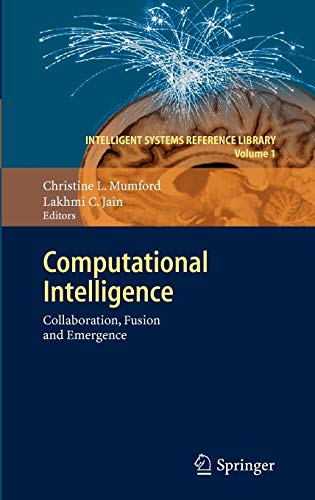
Inhaltsangabe
This book is about synergy in computational intelligence (CI). It is a c- lection of chapters that covers a rich and diverse variety of computer-based techniques, all involving some aspect of computational intelligence, but each one taking a somewhat pragmatic view. Many complex problems in the real world require the application of some form of what we loosely call “intel- gence”fortheirsolution. Fewcanbesolvedbythenaiveapplicationofasingle technique, however good it is. Authors in this collection recognize the li- tations of individual paradigms, and propose some practical and novel ways in which di?erent CI techniques can be combined with each other, or with more traditional computational techniques, to produce powerful probl- solving environments which exhibit synergy, i. e. , systems in which the whole 1 is greater than the sum of the parts . Computational intelligence is a relatively new term, and there is some d- agreement as to its precise de?nition. Some practitioners limit its scope to schemes involving evolutionary algorithms, neural networks, fuzzy logic, or hybrids of these. For others, the de?nition is a little more ?exible, and will include paradigms such as Bayesian belief networks, multi-agent systems, case-based reasoning and so on. Generally, the term has a similar meaning to the well-known phrase “Arti?cial Intelligence” (AI), although CI is p- ceived moreas a “bottom up” approachfrom which intelligent behaviour can emerge,whereasAItendstobestudiedfromthe“topdown”,andderivefrom pondering upon the “meaning of intelligence”. (These and other key issues will be discussed in more detail in Chapter 1.
Die Inhaltsangabe kann sich auf eine andere Ausgabe dieses Titels beziehen.
Von der hinteren Coverseite
This book is the first in a new series entitled "Intelligent Systems Reference Library". It is a collection of chapters written by leading experts, covering a rich and diverse variety of computer-based techniques, all involving some aspect of computational intelligence (CI). Authors in this collection recognize the limitations of individual paradigms, and propose some practical and novel ways in which different CI techniques can be combined with each other, or with more traditional computational techniques, to produce powerful problem-solving environments.
Common themes to be found in the various chapters of this collection include the following:
- Fusion,
- Collaboration, and
- Emergence.
Fusion describes the hybridization of two or more techniques, at least one of which will involve CI. Collaboration ensures that the different techniques work effectively together. Finally, Emergence refers to the phenomenon that complex behaviour can arise as a result of collaboration between simple processing elements.
The book covers a wide range of cutting edge techniques and applications, and is divided into the following parts:
I. Introduction
II. Fusing evolutionary algorithms and fuzzy logic
III. Adaptive solution schemes
IV. Multi-agent systems
V. Computer vision
VI. Communication for CI systems
VII. Artificial immune systems
VIII. Parallel evolutionary algorithms
IX. CI for clustering and classification
„Über diesen Titel“ kann sich auf eine andere Ausgabe dieses Titels beziehen.
Suchergebnisse für Computational Intelligence: Collaboration, Fusion and...

Beispielbild für diese ISBN
Computational Intelligence : Collaboration, Fusion and Emergence
Anbieter: Buchpark, Trebbin, Deutschland
Verkäuferbewertung 5 von 5 Sternen

Zustand: Sehr gut. Zustand: Sehr gut | Seiten: 732 | Sprache: Englisch | Produktart: Bücher | Keine Beschreibung verfügbar. Artikel-Nr. 5495060/12
Gebraucht kaufen
EUR 18,30
EUR 105,00 Versand
Versand von Deutschland nach USA
Versand von Deutschland nach USA
Anzahl: 1 verfügbar
Beispielbild für diese ISBN
Computational Intelligence: Collaboration, Fusion and Emergence (Intelligent Systems Reference Library, 1)
Anbieter: Ria Christie Collections, Uxbridge, Vereinigtes Königreich
Verkäuferbewertung 5 von 5 Sternen
Zustand: New. In English. Artikel-Nr. ria9783642017988_new
Neu kaufen
EUR 353,39
EUR 17,85 Versand
Versand von Vereinigtes Königreich nach USA
Versand von Vereinigtes Königreich nach USA
Anzahl: Mehr als 20 verfügbar
Foto des Verkäufers
Computational Intelligence : Collaboration, Fusion and Emergence
Anbieter: GreatBookPricesUK, Woodford Green, Vereinigtes Königreich
Verkäuferbewertung 5 von 5 Sternen
Zustand: As New. Unread book in perfect condition. Artikel-Nr. 6394861
Gebraucht kaufen
EUR 354,46
EUR 17,92 Versand
Versand von Vereinigtes Königreich nach USA
Versand von Vereinigtes Königreich nach USA
Anzahl: Mehr als 20 verfügbar
Foto des Verkäufers
Computational Intelligence : Collaboration, Fusion and Emergence
Anbieter: AHA-BUCH GmbH, Einbeck, Deutschland
Verkäuferbewertung 5 von 5 Sternen
Buch. Zustand: Neu. Druck auf Anfrage Neuware - Printed after ordering - This book is about synergy in computational intelligence (CI). It is a c- lection of chapters that covers a rich and diverse variety of computer-based techniques, all involving some aspect of computational intelligence, but each one taking a somewhat pragmatic view. Many complex problems in the real world require the application of some form of what we loosely call 'intel- gence'fortheirsolution. Fewcanbesolvedbythenaiveapplicationofasingle technique, however good it is. Authors in this collection recognize the li- tations of individual paradigms, and propose some practical and novel ways in which di erent CI techniques can be combined with each other, or with more traditional computational techniques, to produce powerful probl- solving environments which exhibit synergy, i. e. , systems in which the whole 1 is greater than the sum of the parts . Computational intelligence is a relatively new term, and there is some d- agreement as to its precise de nition. Some practitioners limit its scope to schemes involving evolutionary algorithms, neural networks, fuzzy logic, or hybrids of these. For others, the de nition is a little more exible, and will include paradigms such as Bayesian belief networks, multi-agent systems, case-based reasoning and so on. Generally, the term has a similar meaning to the well-known phrase 'Arti cial Intelligence' (AI), although CI is p- ceived moreas a 'bottom up' approachfrom which intelligent behaviour can emerge,whereasAItendstobestudiedfromthe'topdown',andderivefrom pondering upon the 'meaning of intelligence'. (These and other key issues will be discussed in more detail in Chapter 1. Artikel-Nr. 9783642017988
Neu kaufen
EUR 358,67
EUR 44,19 Versand
Versand von Deutschland nach USA
Versand von Deutschland nach USA
Anzahl: 2 verfügbar