
Verwandte Artikel zu One Law for All?: Western models and local practices...
One Law for All?: Western models and local practices in (post-) imperial contexts (Eigene und Fremde Welten, 25, Band 25) - Softcover
Buch 25 von 42: Eigene und fremde Welten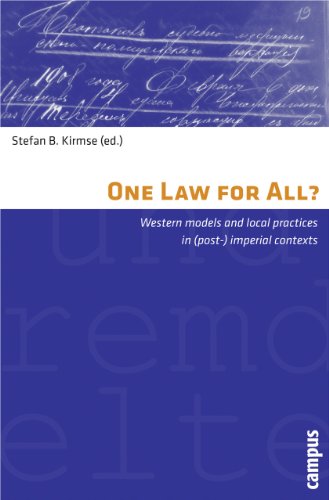
Inhaltsangabe
Im 19. und 20. Jahrhundert traten weltweit Gesetzgeber mit der Absicht auf, lokale Rechtsordnungen nach westlichem Muster umzubilden. Aber welche Modelle sollten als Vorbilder dienen, da doch die rechtliche Realität bereits in Westeuropa uneinheitlich war? Zudem wurde das importierte Recht vor Ort unterschiedlich aufgenommen, umformuliert und interpretiert. Der Band untersucht das Spannungsfeld zwischen den universellen Ansprüchen verschiedener imperialer und post-imperialer Gesetzgeber und der lokalen Umsetzung und Anwendung neuer Rechtsformen, von Lateinamerika und Afrika über Russland bis nach Ostasien.
Die Inhaltsangabe kann sich auf eine andere Ausgabe dieses Titels beziehen.
Über die Autorin bzw. den Autor
Stefan B. Kirmse, Ph.D., ist wissenschaftlicher Mitarbeiter am Sonderforschungsbereich 640 »Repräsentationen sozialer Ordnungen im Wandel« an der Humboldt Universität zu Berlin.
Auszug. © Genehmigter Nachdruck. Alle Rechte vorbehalten.
Introduction
Stefan B. Kirmse
To avoid potential misunderstandings: "one law for all?" is not used as
a political slogan in this book. Admittedly, along with related concepts
in other languages, such as idem ius omnibus or gleiches Recht für alle, the
phrase has been used to further a wide range of political agendas. Feminist,
civil liberties and gay rights groups have utilized the slogan to call
for greater equality; racist groups in North America have exploited it as a
means to denounce the allegedly preferential treatment of minorities; and
most recently, a secularist movement in the United Kingdom has adopted
it as the title for its campaign against shari'a law, which it views as gaining
influence among British Muslims.
In this book, the phrase is neither employed to advocate a political
cause nor used to refer solely to legal equality (or the lack of it). Offering
a point of entry into the study of legal debate and practice in imperial
and post-imperial contexts, it served as a guiding research question for a
conference hosted by the Department of East European History (which
explains the strong representation of historians of Russia in this volume)
at Humboldt University in the fall of 2010. It struck the organizers of
the conference, on which this volume is based, as a useful tool to capture
different aspects of legal reform in the nineteenth and early twentieth
centuries: the drive for "modernization" and the importance of legal borrowing
in various parts of the globe; claims to legal integration and greater
equality; and the continuing specificity of legal practice and interpretation.
That said, to a degree "one law for all" is a rhetorical question. Neither
has legal homogenization ever materialized on a global scale, nor have
most polities ever put "equal justice for all" into practice. Some forms of
inequality persist even in today's liberal democracies. What is more, if the
question is used to investigate the worldwide diffusion of "Western" law,
as in the sociological "world polity"¨ approach (see, in particular, Boyle
and Meyer 2002), it faces a twofold problem: analyses of diffusion tend
to claim either the obvious or the impossible. If diffusion is taken to refer
"only" to the imitation of Western law in different parts of the world,
it is a commonplace. Mimesis is part of most legal reform processes. On
the other hand, the spread and use of European legal norms and institutions
is best not discussed in terms of a transfer of laws from one country
to another. As critics of Watson's concept of "legal transplants" (1974)
have argued, such transfer is impossible since the law consists not only of
words but also of the culturally specific meanings attached to these words
(Legrand 2001). As a result, any analysis of legal borrowing must not only
take local adaptations and reinterpretations into account but also acknowledge
the complete novelty of the resulting laws.
Regardless of these caveats, "one law for all" remains valid not only as
an ideal for lawmakers. Thanks to its multi-dimensionality, it can also be
a useful guide for inquiry. It directs our attention to the dynamic relationship
between two competing, but often overlapping, trends that characterize
most imperial and post-imperial spaces: legal integration, on the
one hand, and the recognition and promotion of difference, on the other.
The latter, at times, even included forms of legal segregation. Framing
the inquiry in such terms allows an analysis of different steps towards, or
away from, legal equality while revealing an array of local interactions with
Western law(s).
The role of "Western" law must indeed be given careful consideration.
A focus on East-West or North-South interaction admittedly runs the
danger of being charged with "Eurocentrism"; and past inquiries into the
role of Western legal blueprints and institutions in the South, such as the
Yale Law and Modernization project in the early 1970s, have been rightly
criticized for their developmental assumptions, that is, the idea that the
adoption of "one type of law-that found in the West-[was] essential for
economic, political and social development in the Third World" (Trubek
1972, 2; see also Trubek and Galanter 1974). This volume, by contrast,
has no interest in extolling or denouncing any particular normative order.
Yet, it suggests that a close consideration of interactions with Western
laws is helpful-in fact, it is necessary-for a cross-cultural discussion of
legal debate and practice in the nineteenth and early twentieth centuries.
In many parts of the globe, European legal reforms and institutions were
among the most common points of reference at this time, as efforts to
rationalize local judicial systems and make them more efficient gained momentum.
Policies of centralization and the standardization of legal practice
were meant to create both stability and a minimum of legal certainty. This
frequently involved an overhaul of laws and legal institutions in accordance
with European models, or at least a partial appropriation of such
models. Legal reforms were usually designed and presented as part of the
wider project of "modernization" and linked to related efforts in the political,
economic and cultural spheres. Subscribing to the idea of universal,
mono-linear progress and Europe's advanced position on this developmental
path, many elites were convinced that non-European regions could
learn from the experience of European nations-usually by following their
lead, but sometimes also by avoiding previous mistakes.
To be fair, there was no such thing as a singular "Western model".
The legal reality in Europe was a multitude of different and differently
interpreted models. Thus, it is worth exploring which of these (and why!)
Russian, Latin American, Afghan and other reformers decided to draw
upon. What is more: how did local actors re-interpret and adapt these models
to local circumstances? For reform movements throughout the South
and East, "modernization" often consisted of a selective re-combination of
European and local ideas and practices (in which the former were discussed
less in terms of their "superiority" than in terms of their compatibility
with the latter). The resulting, new legal systems could then be promoted
as regional models. The new Turkish legal system of the mid-1920s, for
example, though based on a mixture of Swiss, Italian, German and French
influences (Orucu 1992), soon became a reference point in neighboring
Muslim majority states. The question of borrowings and references in legal
debate and practice, then, forms one key set of questions addressed in
the chapters that follow.
This volume is also designed to examine the discrepancy between the
claims of reformers, on the one hand, and the implementation and reception
of legal change, on the other. It highlights the simultaneous development
of growing uniformity in some areas of law, both within and
between countries, and diversity in others. The promotion of universal legal
norms in reform debates and the resulting legal institutions often bore
striking similarities whereas legal practice often remained idiosyncratic,
not least because local actors behaved pragmatically. All cases discussed in
this volume were legally "plural" in one way or another. Local administrators,
judges and...
„Über diesen Titel“ kann sich auf eine andere Ausgabe dieses Titels beziehen.
Suchergebnisse für One Law for All?: Western models and local practices...

Beispielbild für diese ISBN
One Law for All?: Western Models and Local Practices in (Post-) Imperial Contexts (Representations of Patterns of Social Order)
Anbieter: BuchZeichen-Versandhandel, Freiburg, Deutschland
Verkäuferbewertung 5 von 5 Sternen

Zustand: Gebraucht - Sehr gut. Campus-Verlag, broschiert, sehr guter und gepflegter Zustand, h4. Artikel-Nr. L6-TZ5V-YROC
Gebraucht kaufen
EUR 19,03
EUR 9,95 Versand
Versand von Deutschland nach USA
Versand von Deutschland nach USA
Anzahl: 1 verfügbar
Foto des Verkäufers
One Law for All?: Western models and local practices in (post-) imperial contexts (Eigene und Fremde Welten, 25, Band 25)
Anbieter: Book Broker, Berlin, Deutschland
Verkäuferbewertung 5 von 5 Sternen
Zustand: Wie neu. 1. 297 S. Alle Bücher & Medienartikel von Book Broker sind stets in gutem & sehr gutem gebrauchsfähigen Zustand. Dieser Artikel weist folgende Merkmale auf: Helle/saubere Seiten in fester Bindung. Leichte Gebrauchsspuren. Mit Mängelexemplarkennzeichnung am unteren Buchschnitt. Altersfreigabe FSK ab 0 Jahre Sprache: Englisch Gewicht in Gramm: 397 Taschenbuch, Maße: 13.97 cm x 3.05 cm x 21.27 cm. Artikel-Nr. 661003188
Gebraucht kaufen
EUR 22,00
EUR 34,34 Versand
Versand von Deutschland nach USA
Versand von Deutschland nach USA
Anzahl: 1 verfügbar
Foto des Verkäufers
One law for all? Western models and local practices in (post-) imperial contexts.
Verlag:
Frankfurt, M. : Campus-Verl., 2012
ISBN 10: 3593394936
ISBN 13: 9783593394930
Gebraucht
Paperback.
Anbieter: Borkert, Schwarz und Zerfaß GbR, Berlin, Deutschland
Verkäuferbewertung 5 von 5 Sternen
Paperback. Zustand: Sehr gut. 297 S.; 22 cm Das Exemplar ist in einem sehr guten und sauberen Zustand ohne Anstreichungen. / The copy is in a very good and clean condition without markings. -- Contents -- Acknowledgements. -- Introduction -- Stefan B. Kirmse -- DISCUSSING LEGAL REFORM -- A Step for the "Whole Civilized World"? -- The Debate over the Death Penalty in Russia, 1905-1917 -- Benjamin Beuerle -- A New Legal Order under Discussion: -- Legal Reform and the Loya Jirga in Afghanistan in the 1920s -- Benjamin Buchholz -- Agents of Knowledge Transfer: -- Western Debates and Psychiatric Experts in Late Imperial Russia -- Lena Gautam -- GATEKEEPERS TO THE LEGAL SYSTEM: -- THE ROLE OF Legal INTERMEDIARIES -- Tinterillos, Indians, and the State: -- Towards a History of Legal Intermediaries in Post-Independence Peru -- Carlos Aguirre -- The Ties that Bind: -- Sovereignty and Law in the Late Russian Empire. -- Jane Burbank -- WHEN PEOPLE GO TO COURT -- Law and Courts as Negotiating Tools: -- Marriage and Divorce in Republican China, 1912-1949 -- Xiaoqun Xu -- Dealing with Crime in Late Tsarist Russia: -- Muslim Tatars and the Imperial Legal System -- Stefan B. Kirmse -- Entanglements and Interactions within a Plural Legal Order: -- The Case of the German Colony Cameroon, 1884-1916 -- Ulrike Schaper -- De jure and de facto: -- The Penal Code of 1871 and Juridical Culture in Mexico City -- Manuel de los Reyes García Márkina -- Notes on Contributors -- Index of Names and Places. ISBN 9783593394930 Sprache: Englisch Gewicht in Gramm: 394. Artikel-Nr. 1278042
Gebraucht kaufen
EUR 25,00
EUR 40,00 Versand
Versand von Deutschland nach USA
Versand von Deutschland nach USA
Anzahl: 1 verfügbar
Foto des Verkäufers
One Law for All? : Western models and local practices in (post-) imperial contexts
Verlag:
Campus Verlag, University Of Chicago Press, 2012
ISBN 10: 3593394936
ISBN 13: 9783593394930
Neu
Taschenbuch
Anbieter: AHA-BUCH GmbH, Einbeck, Deutschland
Verkäuferbewertung 5 von 5 Sternen
Taschenbuch. Zustand: Neu. Neuware - Im 19. und 20. Jahrhundert traten weltweit Gesetzgeber mit der Absicht auf, lokale Rechtsordnungen nach westlichem Muster umzubilden. Aber welche Modelle sollten als Vorbilder dienen, da doch die rechtliche Realität bereits in Westeuropa uneinheitlich war Zudem wurde das importierte Recht vor Ort unterschiedlich aufgenommen, umformuliert und interpretiert. Der Band untersucht das Spannungsfeld zwischen den universellen Ansprüchen verschiedener imperialer und post-imperialer Gesetzgeber und der lokalen Umsetzung und Anwendung neuer Rechtsformen, von Lateinamerika und Afrika über Russland bis nach Ostasien. Artikel-Nr. 9783593394930
Neu kaufen
EUR 42,00
EUR 35,00 Versand
Versand von Deutschland nach USA
Versand von Deutschland nach USA
Anzahl: 2 verfügbar
Foto des Verkäufers
One Law for All?
Verlag:
Campus Verlag|University of Chicago Press, 2012
ISBN 10: 3593394936
ISBN 13: 9783593394930
Neu
Kartoniert / Broschiert
Anbieter: moluna, Greven, Deutschland
Verkäuferbewertung 5 von 5 Sternen
Kartoniert / Broschiert. Zustand: New. discusses legal transfer and practice in imperial and post-imperial societies, including Russia, Latin America, Africa, and East Asia. This title features essays that analyze the legal sphere as a site of struggle, both in debate and in everyday life, from . Artikel-Nr. 128347480
Neu kaufen
EUR 42,00
EUR 48,99 Versand
Versand von Deutschland nach USA
Versand von Deutschland nach USA
Anzahl: Mehr als 20 verfügbar
Foto des Verkäufers
One Law for All? | Western models and local practices in (post-) imperial contexts
Anbieter: preigu, Osnabrück, Deutschland
Verkäuferbewertung 5 von 5 Sternen
Taschenbuch. Zustand: Neu. One Law for All? | Western models and local practices in (post-) imperial contexts | Stefan B. Kirmse | Taschenbuch | Großformatiges Paperback. Klappenbroschur | 297 S. | Englisch | 2012 | Campus Verlag | EAN 9783593394930 | Verantwortliche Person für die EU: Beltz Verlagsgruppe GmbH & Co. KG, Werderstr. 10, 69469 Weinheim, info[at]campus[dot]de | Anbieter: preigu. Artikel-Nr. 107009086
Neu kaufen
EUR 42,00
EUR 70,00 Versand
Versand von Deutschland nach USA
Versand von Deutschland nach USA
Anzahl: 1 verfügbar