
Verwandte Artikel zu Territorial Cohesion (German Annual of Spatial Research...
Inhaltsangabe
Preface–Introduction 1 Dietmar Scholich The various regions within the European Union are marked by a high degree of disparity with regard to economic performance and productivity, and with respect to their labour markets. The intention underlying the EU’s concept of ‘territorial cohesion’ is to reduce these differences and imbalances and, at the same time, to ensure more balanced spatial development throughout the EU. Territorial cohesion – for which the German language uses two slightly different terms, “territoriale Kohäsion” and “territorialer Zusammenhalt” – has to be seen as a general term encompassing a number of different components. In addition to redressing disparities and spatial imbalances, this concept aims to improve territorial integration and to promote co-operation among EU regions. In striving to bring about territorial cohesion, due account must be taken of the diversity of the European continent, and consideration should be given to the advantages and disadvantages each area exhibits. Among the special challenges to be faced are the concentration of population and economic activity in what has come to be known as the Pentagon, the process of EU enlargement, and the severe imbalances which exist between the major centres of population and other parts of the EU territory. Against this background, it was only right and proper that territorial cohesion should be included in the draft of the Treaty establishing a Constitution for Europe (Article I-3), which lists economic, social, and territorial cohesion as being among the Union’s objectives.
Die Inhaltsangabe kann sich auf eine andere Ausgabe dieses Titels beziehen.
Von der hinteren Coverseite
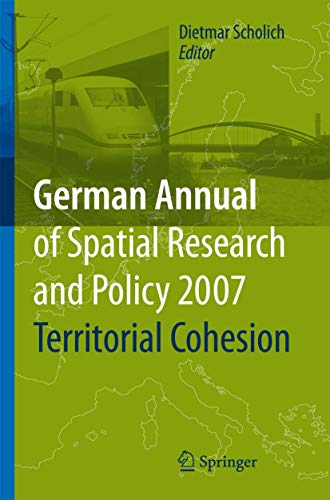
The various regions within the EU are marked by a high degree of disparity with regard to their economic performance and productivity, and as regards their labour markets. Facing these regional differences, the task of regional and spatial sciences is to develop concepts and strategies to reduce and prevent territorial imbalances. Thus "territorial cohesion" stands for a more balanced spatial development, and aims to improve integration throughout the EU. Although the term is used in many EU documents and strategies, its meaning remains vague and unclear. The scientific articles in this annual deal with the interpretations of this term, the challenges of European spatial development policy, and the problems and concepts involved in achieving territorial cohesion. Furthermore two short reports illustrate the implementation of territorial cohesion on the basis of two research projects.
„Über diesen Titel“ kann sich auf eine andere Ausgabe dieses Titels beziehen.
Suchergebnisse für Territorial Cohesion (German Annual of Spatial Research...

Beispielbild für diese ISBN
Territorial Cohesion
Anbieter: Romtrade Corp., STERLING HEIGHTS, MI, USA
Verkäuferbewertung 5 von 5 Sternen

Zustand: New. This is a Brand-new US Edition. This Item may be shipped from US or any other country as we have multiple locations worldwide. Artikel-Nr. ABBB-161320
Beispielbild für diese ISBN
Territorial Cohesion
Anbieter: Majestic Books, Hounslow, Vereinigtes Königreich
Verkäuferbewertung 4 von 5 Sternen

Zustand: Used. pp. x + 173. Artikel-Nr. 7546248
Gebraucht kaufen
EUR 97,90
EUR 7,65 Versand
Versand von Vereinigtes Königreich nach USA
Versand von Vereinigtes Königreich nach USA
Anzahl: 1 verfügbar
Beispielbild für diese ISBN
Territorial Cohesion
Anbieter: Biblios, Frankfurt am main, HESSE, Deutschland
Verkäuferbewertung 4 von 5 Sternen
Zustand: Used. pp. x + 173. Artikel-Nr. 18301661
Gebraucht kaufen
EUR 97,22
EUR 9,95 Versand
Versand von Deutschland nach USA
Versand von Deutschland nach USA
Anzahl: 1 verfügbar
Beispielbild für diese ISBN
Territorial Cohesion (German Annual of Spatial Research and Policy)
Anbieter: Ria Christie Collections, Uxbridge, Vereinigtes Königreich
Verkäuferbewertung 5 von 5 Sternen
Zustand: New. In English. Artikel-Nr. ria9783540717454_new
Neu kaufen
EUR 129,33
EUR 13,28 Versand
Versand von Vereinigtes Königreich nach USA
Versand von Vereinigtes Königreich nach USA
Anzahl: Mehr als 20 verfügbar
Foto des Verkäufers
Territorial Cohesion
Anbieter: AHA-BUCH GmbH, Einbeck, Deutschland
Verkäuferbewertung 5 von 5 Sternen
Buch. Zustand: Neu. Druck auf Anfrage Neuware - Printed after ordering - Preface-Introduction 1 Dietmar Scholich The various regions within the European Union are marked by a high degree of disparity with regard to economic performance and productivity, and with respect to their labour markets. The intention underlying the EU's concept of 'territorial cohesion' is to reduce these differences and imbalances and, at the same time, to ensure more balanced spatial development throughout the EU. Territorial cohesion - for which the German language uses two slightly different terms, 'territoriale Kohäsion' and 'territorialer Zusammenhalt' - has to be seen as a general term encompassing a number of different components. In addition to redressing disparities and spatial imbalances, this concept aims to improve territorial integration and to promote co-operation among EU regions. In striving to bring about territorial cohesion, due account must be taken of the diversity of the European continent, and consideration should be given to the advantages and disadvantages each area exhibits. Among the special challenges to be faced are the concentration of population and economic activity in what has come to be known as the Pentagon, the process of EU enlargement, and the severe imbalances which exist between the major centres of population and other parts of the EU territory. Against this background, it was only right and proper that territorial cohesion should be included in the draft of the Treaty establishing a Constitution for Europe (Article I-3), which lists economic, social, and territorial cohesion as being among the Union's objectives. Artikel-Nr. 9783540717454
Neu kaufen
EUR 114,00
EUR 35,00 Versand
Versand von Deutschland nach USA
Versand von Deutschland nach USA
Anzahl: 1 verfügbar
Beispielbild für diese ISBN
Territorial Cohesion
Anbieter: Buchpark, Trebbin, Deutschland
Verkäuferbewertung 5 von 5 Sternen
Zustand: Sehr gut. Zustand: Sehr gut | Sprache: Englisch | Produktart: Bücher | Preface¿Introduction 1 Dietmar Scholich The various regions within the European Union are marked by a high degree of disparity with regard to economic performance and productivity, and with respect to their labour markets. The intention underlying the EU¿s concept of ¿territorial cohesion¿ is to reduce these differences and imbalances and, at the same time, to ensure more balanced spatial development throughout the EU. Territorial cohesion ¿ for which the German language uses two slightly different terms, ¿territoriale Kohäsion¿ and ¿territorialer Zusammenhalt¿ ¿ has to be seen as a general term encompassing a number of different components. In addition to redressing disparities and spatial imbalances, this concept aims to improve territorial integration and to promote co-operation among EU regions. In striving to bring about territorial cohesion, due account must be taken of the diversity of the European continent, and consideration should be given to the advantages and disadvantages each area exhibits. Among the special challenges to be faced are the concentration of population and economic activity in what has come to be known as the Pentagon, the process of EU enlargement, and the severe imbalances which exist between the major centres of population and other parts of the EU territory. Against this background, it was only right and proper that territorial cohesion should be included in the draft of the Treaty establishing a Constitution for Europe (Article I-3), which lists economic, social, and territorial cohesion as being among the Union¿s objectives. Artikel-Nr. 3926223/12
Gebraucht kaufen
EUR 76,71
EUR 105,00 Versand
Versand von Deutschland nach USA
Versand von Deutschland nach USA
Anzahl: 1 verfügbar