
Verwandte Artikel zu Geometric Discrepancy: An Illustrated Guide (Algorithms...
Inhaltsangabe
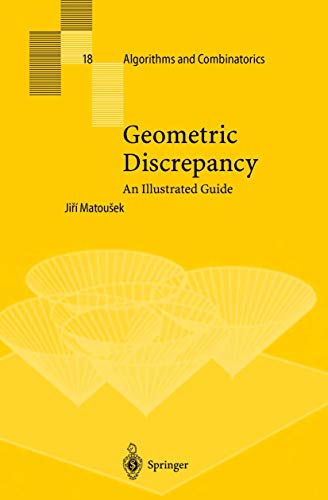
Discrepancy theory is also called the theory of irregularities of distribution. Here are some typical questions: What is the "most uniform" way of dis tributing n points in the unit square? How big is the "irregularity" necessarily present in any such distribution? For a precise formulation of these questions, we must quantify the irregularity of a given distribution, and discrepancy is a numerical parameter of a point set serving this purpose. Such questions were first tackled in the thirties, with a motivation com ing from number theory. A more or less satisfactory solution of the basic discrepancy problem in the plane was completed in the late sixties, and the analogous higher-dimensional problem is far from solved even today. In the meantime, discrepancy theory blossomed into a field of remarkable breadth and diversity. There are subfields closely connected to the original number theoretic roots of discrepancy theory, areas related to Ramsey theory and to hypergraphs, and also results supporting eminently practical methods and algorithms for numerical integration and similar tasks. The applications in clude financial calculations, computer graphics, and computational physics, just to name a few. This book is an introductory textbook on discrepancy theory. It should be accessible to early graduate students of mathematics or theoretical computer science. At the same time, about half of the book consists of material that up until now was only available in original research papers or in various surveys.
Die Inhaltsangabe kann sich auf eine andere Ausgabe dieses Titels beziehen.
Von der hinteren Coverseite
What is the "most uniform" way of distributing n points in the unit square? How big is the "irregularity" necessarily present in any such distribution? Such questions are treated in geometric discrepancy theory. The book is an accessible and lively introduction to this area, with numerous exercises and illustrations. In separate, more specialized parts, it also provides a comprehensive guide to recent research. Including a wide variety of mathematical techniques (from harmonic analysis, combinatorics, algebra etc.) in action on non-trivial examples, the book is suitable for a "special topic" course for early graduates in mathematics and computer science. Besides professional mathematicians, it will be of interest to specialists in fields where a large collection of objects should be "uniformly" represented by a smaller sample (such as high-dimensional numerical integration in computational physics or financial mathematics, efficient divide-and-conquer algorithms in computer science, etc.).
From the reviews: "...The numerous illustrations are well placed and instructive. The clear and elegant exposition conveys a wealth of intuitive insights into the techniques utilized. Each section usually consists of text, historical remarks and references for the specialist, and exercises. Hints are provided for the more difficult exercises, with the exercise-hint format permitting inclusion of more results than otherwise would be possible in a book of this size..."
Allen D. Rogers, Mathematical Reviews Clippings (2001)
„Über diesen Titel“ kann sich auf eine andere Ausgabe dieses Titels beziehen.
Suchergebnisse für Geometric Discrepancy: An Illustrated Guide (Algorithms...

Beispielbild für diese ISBN
Geometric Discrepancy - An Illustrated Guide
Anbieter: Romtrade Corp., STERLING HEIGHTS, MI, USA
Verkäuferbewertung 5 von 5 Sternen

Zustand: New. This is a Brand-new US Edition. This Item may be shipped from US or any other country as we have multiple locations worldwide. Artikel-Nr. ABBB-156283
Foto des Verkäufers
Geometric discrepancy. An illustrated guide Ji?í Matouek. Algorithms and combinatorics 18.
Verlag:
Berlin, Springer [1999]., 1999
ISBN 10: 354065528X
ISBN 13: 9783540655282
Gebraucht
Hardcover
Anbieter: Antiquariat Bookfarm, Löbnitz, Deutschland
Verkäuferbewertung 5 von 5 Sternen
Hardcover. Zustand: Gut. Ex-library with stamp and library-signature. GOOD condition, some traces of use. Ancien Exemplaire de bibliothèque avec signature et cachet. BON état, quelques traces d'usure. Ehem. Bibliotheksexemplar mit Signatur und Stempel. GUTER Zustand, ein paar Gebrauchsspuren. 11 MAT 9783540655282 Sprache: Englisch Gewicht in Gramm: 550. Artikel-Nr. 2502011
Gebraucht kaufen
EUR 99,59
EUR 40,00 Versand
Versand von Deutschland nach USA
Versand von Deutschland nach USA
Anzahl: 1 verfügbar
Foto des Verkäufers
Geometric discrepancy an illustrated guide Ji?í Matouek. Algorithms and combinatorics 18.
Verlag:
Berlin, Springer [1999]., 1999
ISBN 10: 354065528X
ISBN 13: 9783540655282
Gebraucht
Hardcover
Anbieter: Antiquariat Bookfarm, Löbnitz, Deutschland
Verkäuferbewertung 5 von 5 Sternen
Hardcover. Zustand: Gut. Ex-library with stamp and library-signature. GOOD condition, some traces of use. Ancien Exemplaire de bibliothèque avec signature et cachet. BON état, quelques traces d'usure. Ehem. Bibliotheksexemplar mit Signatur und Stempel. GUTER Zustand, ein paar Gebrauchsspuren. 11 MAT 9783540655282 Sprache: Englisch Gewicht in Gramm: 1150. Artikel-Nr. 2505767
Gebraucht kaufen
EUR 99,59
EUR 40,00 Versand
Versand von Deutschland nach USA
Versand von Deutschland nach USA
Anzahl: 1 verfügbar
Beispielbild für diese ISBN
Geometric Discrepancy
Anbieter: Majestic Books, Hounslow, Vereinigtes Königreich
Verkäuferbewertung 4 von 5 Sternen

Zustand: Used. pp. 306 52:B&W 6.14 x 9.21in or 234 x 156mm (Royal 8vo) Case Laminate on White w/Gloss Lam. Artikel-Nr. 7528926
Gebraucht kaufen
EUR 144,38
EUR 7,56 Versand
Versand von Vereinigtes Königreich nach USA
Versand von Vereinigtes Königreich nach USA
Anzahl: 1 verfügbar
Beispielbild für diese ISBN
Geometric Discrepancy
Anbieter: Biblios, Frankfurt am main, HESSE, Deutschland
Verkäuferbewertung 4 von 5 Sternen
Zustand: Used. pp. 306. Artikel-Nr. 18351755
Gebraucht kaufen
EUR 144,84
EUR 9,95 Versand
Versand von Deutschland nach USA
Versand von Deutschland nach USA
Anzahl: 1 verfügbar
Beispielbild für diese ISBN
Geometric Discrepancy: An Illustrated Guide (Algorithms and Combinatorics, 18)
Anbieter: Ria Christie Collections, Uxbridge, Vereinigtes Königreich
Verkäuferbewertung 5 von 5 Sternen
Zustand: New. In English. Artikel-Nr. ria9783540655282_new
Neu kaufen
EUR 181,89
EUR 13,13 Versand
Versand von Vereinigtes Königreich nach USA
Versand von Vereinigtes Königreich nach USA
Anzahl: Mehr als 20 verfügbar
Foto des Verkäufers
Geometric Discrepancy : An Illustrated Guide
Anbieter: AHA-BUCH GmbH, Einbeck, Deutschland
Verkäuferbewertung 5 von 5 Sternen
Buch. Zustand: Neu. Druck auf Anfrage Neuware - Printed after ordering - Discrepancy theory is also called the theory of irregularities of distribution. Here are some typical questions: What is the 'most uniform' way of dis tributing n points in the unit square How big is the 'irregularity' necessarily present in any such distribution For a precise formulation of these questions, we must quantify the irregularity of a given distribution, and discrepancy is a numerical parameter of a point set serving this purpose. Such questions were first tackled in the thirties, with a motivation com ing from number theory. A more or less satisfactory solution of the basic discrepancy problem in the plane was completed in the late sixties, and the analogous higher-dimensional problem is far from solved even today. In the meantime, discrepancy theory blossomed into a field of remarkable breadth and diversity. There are subfields closely connected to the original number theoretic roots of discrepancy theory, areas related to Ramsey theory and to hypergraphs, and also results supporting eminently practical methods and algorithms for numerical integration and similar tasks. The applications in clude financial calculations, computer graphics, and computational physics, just to name a few. This book is an introductory textbook on discrepancy theory. It should be accessible to early graduate students of mathematics or theoretical computer science. At the same time, about half of the book consists of material that up until now was only available in original research papers or in various surveys. Artikel-Nr. 9783540655282
Neu kaufen
EUR 160,49
EUR 63,15 Versand
Versand von Deutschland nach USA
Versand von Deutschland nach USA
Anzahl: 1 verfügbar