
Verwandte Artikel zu Deductive Program Design (NATO ASI Subseries F:, Band...
Inhaltsangabe
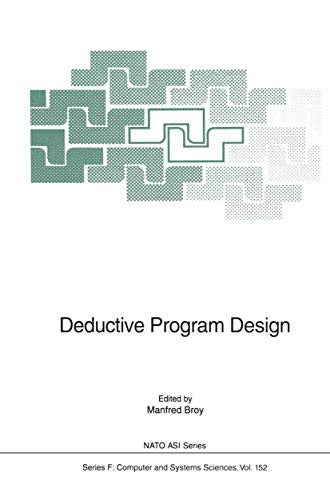
Deductive program design aims at methods that guide and support the development of programs by techniques of deduction. Deduction is a well-known subject of study in logical theories. However, the application of deductive techniques in program design needs methods, heuristics, and understanding of the required forms and formats of the development result that go far beyond those found in logical theories. The summer school presents a very broad spectrum of approaches to these issues. Edsger W. Dijkstra gives a number of beautiful examples that show how to design proofs. Samson Abramsky, Simon Gay, and Rajagopal Nagarajan contribute a fundamental study founding concurrent programming on interaction categories and foundations of type theory. Tony Hoare presents unifying views on mathematical models for computing science. Unifying theories are especially important if the whole development process of programs is to be supported by deductive techniques. The rest of the contributions address applications of deductive program design methods. They are directed to different areas of application; for example Richard Bird's and Oege de Moor's algebra of programming is mainly intended for classical functional programming, and the contribution on data refinement and their transformation by David Gries considers sequential procedural programs.
Die Inhaltsangabe kann sich auf eine andere Ausgabe dieses Titels beziehen.
Über die Autorinnen und Autoren
Manfred Broy leitete an der Technischen Universität München den Lehrstuhl Software & Systems Engineering. Er gründete 2009 das Forschungsinstitut für angewandte Forschungstechnik fortiss. Seit 2016 ist er Gründungspräsident des Zentrums Digitalisierung. Bayern. Seine wissenschaftlichen Arbeiten, die diesem Buch zugrunde liegen, zielen auf die formale Fundierung der Konzepte und Methoden des Softwareengineerings als Basis für eine fundierte Entwicklung von Programmsystemen.Alexander Malkis ist ein internationaler Forscher im Bereich "formale Methoden" mit Fokus auf Verifikation, Programmanalyse und Nebenläufigkeit. Sein Forschungsziel besteht darin, Methoden zur Steigerung von Sicherheit, Zuverlässigkeit und Vertrauenswürdigkeit nebenläufiger Programme, Architekturen und Systeme zu entwickeln.
Dr. rer. nat. Manfred Broy studierte Mathematik und Informatik 1971-76 an der Technischen Universität München. Dort 1976-80 wissenschaftlicher Mitarbeiter im Sonderforschungsbereich 49 'Programmiertechnik' der DFG. 1980 Promotion, ab 1980 wisschenschaftlicher Assistent und 1982 Habilitation in Informatik an der TU München. 1983 ordentlicher Professor für Informatik und Gründungsdekan an der Fakultät für Mathematik und Informatik der Universität Passau. Seit 1989 ordentlicher Professor für Informatik an der TU München. 1994 Leibniz-Preis der DFG.
Von der hinteren Coverseite
Deductive program design aims at methods that guide and support the development of programs by techniques of deduction. Deduction is a well-known subject of study in logical theories. However, the application of deductive techniques in program design needs methods, heuristics, and understanding of the required forms and formats of the development result that go far beyond those found in logical theories. The summer school presents a very broad spectrum of approaches to these issues. Edsger W. Dijkstra gives a number of beautiful examples that show how to design proofs. Samson Abramsky, Simon Gay, and Rajagopal Nagarajan contribute a fundamental study founding concurrent programming on interaction categories and foundations of type theory. Tony Hoare presents unifying views on mathematical models for computing science. Unifying theories are especially important if the whole development process of programs is to be supported by deductive techniques. The rest of the contributions address applications of deductive program design methods. They are directed to different areas of application; for example Richard Bird's and Oege de Moor's algebra of programming is mainly intended for classical functional programming, and the contribution on data refinement and their transformation by David Gries considers sequential procedural programs.
„Über diesen Titel“ kann sich auf eine andere Ausgabe dieses Titels beziehen.
Suchergebnisse für Deductive Program Design (NATO ASI Subseries F:, Band...

Foto des Verkäufers
Deductive Program Design
Anbieter: GreatBookPricesUK, Woodford Green, Vereinigtes Königreich
Verkäuferbewertung 5 von 5 Sternen

Zustand: New. Artikel-Nr. 5905695-n
Neu kaufen
EUR 216,76
EUR 18,02 Versand
Versand von Vereinigtes Königreich nach USA
Versand von Vereinigtes Königreich nach USA
Anzahl: Mehr als 20 verfügbar
Beispielbild für diese ISBN
Deductive Program Design (NATO ASI Subseries F:, 152)
Anbieter: California Books, Miami, FL, USA
Verkäuferbewertung 5 von 5 Sternen
Zustand: New. Artikel-Nr. I-9783540609476
Neu kaufen
EUR 243,61
EUR 2,73 Versand
Versand innerhalb von USA
Versand innerhalb von USA
Anzahl: Mehr als 20 verfügbar
Beispielbild für diese ISBN
Deductive Program Design (NATO ASI Subseries F:, 152)
Anbieter: Ria Christie Collections, Uxbridge, Vereinigtes Königreich
Verkäuferbewertung 5 von 5 Sternen
Zustand: New. In English. Artikel-Nr. ria9783540609476_new
Neu kaufen
EUR 257,63
EUR 15,41 Versand
Versand von Vereinigtes Königreich nach USA
Versand von Vereinigtes Königreich nach USA
Anzahl: Mehr als 20 verfügbar
Foto des Verkäufers
Deductive Program Design
Anbieter: AHA-BUCH GmbH, Einbeck, Deutschland
Verkäuferbewertung 5 von 5 Sternen
Buch. Zustand: Neu. Druck auf Anfrage Neuware - Printed after ordering - Deductive program design aims at methods that guide and support the development of programs by techniques of deduction. Deduction is a well-known subject of study in logical theories. However, the application of deductive techniques in program design needs methods, heuristics, and understanding of the required forms and formats of the development result that go far beyond those found in logical theories. The summer school presents a very broad spectrum of approaches to these issues. Edsger W. Dijkstra gives a number of beautiful examples that show how to design proofs. Samson Abramsky, Simon Gay, and Rajagopal Nagarajan contribute a fundamental study founding concurrent programming on interaction categories and foundations of type theory. Tony Hoare presents unifying views on mathematical models for computing science. Unifying theories are especially important if the whole development process of programs is to be supported by deductive techniques. The rest of the contributions address applications of deductive program design methods. They are directed to different areas of application; for example Richard Bird's and Oege de Moor's algebra of programming is mainly intended for classical functional programming, and the contribution on data refinement and their transformation by David Gries considers sequential procedural programs. Artikel-Nr. 9783540609476
Neu kaufen
EUR 242,59
EUR 35,00 Versand
Versand von Deutschland nach USA
Versand von Deutschland nach USA
Anzahl: 1 verfügbar
Foto des Verkäufers
Deductive Program Design
Anbieter: GreatBookPricesUK, Woodford Green, Vereinigtes Königreich
Verkäuferbewertung 5 von 5 Sternen
Zustand: As New. Unread book in perfect condition. Artikel-Nr. 5905695
Gebraucht kaufen
EUR 494,88
EUR 18,02 Versand
Versand von Vereinigtes Königreich nach USA
Versand von Vereinigtes Königreich nach USA
Anzahl: Mehr als 20 verfügbar