
Verwandte Artikel zu Basic Principles and Applications of Probability Theory
Inhaltsangabe
Probability theory arose originally in connection with games of chance and then for a long time it was used primarily to investigate the credibility of testimony of witnesses in the “ethical” sciences. Nevertheless, probability has become a very powerful mathematical tool in understanding those aspects of the world that cannot be described by deterministic laws. Probability has succeeded in ?nding strict determinate relationships where chance seemed to reign and so terming them “laws of chance” combining such contrasting - tions in the nomenclature appears to be quite justi?ed. This introductory chapter discusses such notions as determinism, chaos and randomness, p- dictibility and unpredictibility, some initial approaches to formalizing r- domness and it surveys certain problems that can be solved by probability theory. This will perhaps give one an idea to what extent the theory can - swer questions arising in speci?c random occurrences and the character of the answers provided by the theory. 1. 1 The Nature of Randomness The phrase “by chance” has no single meaning in ordinary language. For instance, it may mean unpremeditated, nonobligatory, unexpected, and so on. Its opposite sense is simpler: “not by chance” signi?es obliged to or bound to (happen). In philosophy, necessity counteracts randomness. Necessity signi?es conforming to law – it can be expressed by an exact law. The basic laws of mechanics, physics and astronomy can be formulated in terms of precise quantitativerelationswhichmustholdwithironcladnecessity.
Die Inhaltsangabe kann sich auf eine andere Ausgabe dieses Titels beziehen.
Suchergebnisse für Basic Principles and Applications of Probability Theory

Foto des Verkäufers
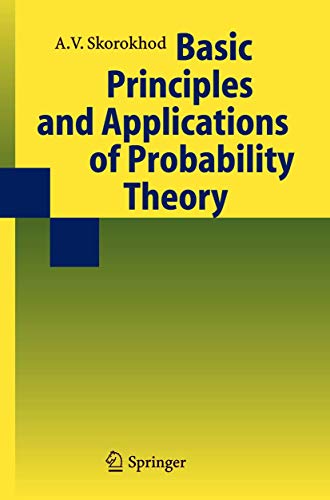
Basic Principles and Applications of Probability Theory
Verlag:
Berlin, Heidelberg: Springer-Verlag, 2005
ISBN 10: 3540546863
ISBN 13: 9783540546863
Gebraucht
Karton Karton
Anbieter: Antiquariat Bernhardt, Kassel, Deutschland
Verkäuferbewertung 5 von 5 Sternen

Karton Karton. Zustand: Sehr gut. 282 Seiten, Zust: Gutes Exemplar. Schneller Versand und persönlicher Service - jedes Buch händisch geprüft und beschrieben - aus unserem Familienbetrieb seit über 25 Jahren. Eine Rechnung mit ausgewiesener Mehrwertsteuer liegt jeder unserer Lieferungen bei. Wir versenden mit der deutschen Post. Sprache: Deutsch Gewicht in Gramm: 530. Artikel-Nr. 493572
Gebraucht kaufen
EUR 68,00
EUR 49,90 Versand
Versand von Deutschland nach USA
Versand von Deutschland nach USA
Anzahl: 1 verfügbar
Beispielbild für diese ISBN
Basic Principles and Applications of Probability Theory
Anbieter: Ria Christie Collections, Uxbridge, Vereinigtes Königreich
Verkäuferbewertung 5 von 5 Sternen
Zustand: New. In English. Artikel-Nr. ria9783540546863_new
Neu kaufen
EUR 127,84
EUR 13,13 Versand
Versand von Vereinigtes Königreich nach USA
Versand von Vereinigtes Königreich nach USA
Anzahl: Mehr als 20 verfügbar
Foto des Verkäufers
Basic Principles and Applications of Probability Theory
Anbieter: AHA-BUCH GmbH, Einbeck, Deutschland
Verkäuferbewertung 5 von 5 Sternen
Buch. Zustand: Neu. Druck auf Anfrage Neuware - Printed after ordering - Probability theory arose originally in connection with games of chance and then for a long time it was used primarily to investigate the credibility of testimony of witnesses in the 'ethical' sciences. Nevertheless, probability has become a very powerful mathematical tool in understanding those aspects of the world that cannot be described by deterministic laws. Probability has succeeded in nding strict determinate relationships where chance seemed to reign and so terming them 'laws of chance' combining such contrasting - tions in the nomenclature appears to be quite justi ed. This introductory chapter discusses such notions as determinism, chaos and randomness, p- dictibility and unpredictibility, some initial approaches to formalizing r- domness and it surveys certain problems that can be solved by probability theory. This will perhaps give one an idea to what extent the theory can - swer questions arising in speci c random occurrences and the character of the answers provided by the theory. 1. 1 The Nature of Randomness The phrase 'by chance' has no single meaning in ordinary language. For instance, it may mean unpremeditated, nonobligatory, unexpected, and so on. Its opposite sense is simpler: 'not by chance' signi es obliged to or bound to (happen). In philosophy, necessity counteracts randomness. Necessity signi es conforming to law - it can be expressed by an exact law. The basic laws of mechanics, physics and astronomy can be formulated in terms of precise quantitativerelationswhichmustholdwithironcladnecessity. Artikel-Nr. 9783540546863
Neu kaufen
EUR 106,99
EUR 63,00 Versand
Versand von Deutschland nach USA
Versand von Deutschland nach USA
Anzahl: 1 verfügbar
Beispielbild für diese ISBN
Basic Principles and Applications of Probability Theory
Anbieter: Revaluation Books, Exeter, Vereinigtes Königreich
Verkäuferbewertung 5 von 5 Sternen
Hardcover. Zustand: Brand New. 1st edition. 282 pages. German language. 9.25x6.25x0.50 inches. In Stock. Artikel-Nr. x-3540546863
Neu kaufen
EUR 156,37
EUR 14,54 Versand
Versand von Vereinigtes Königreich nach USA
Versand von Vereinigtes Königreich nach USA
Anzahl: 2 verfügbar
Beispielbild für diese ISBN
Basic Principles and Applications of Probability Theory Skorokhod, A. V.
Verlag:
Berlin, Heidelberg: Springer-Verlag, 2005
ISBN 10: 3540546863
ISBN 13: 9783540546863
Gebraucht
Hardcover
Anbieter: BUCHSERVICE / ANTIQUARIAT Lars Lutzer, Wahlstedt, Deutschland
Verkäuferbewertung 5 von 5 Sternen
Zustand: gut. 2005. Basic Principles and Applications of Probability Theory In deutscher Sprache. pages. Artikel-Nr. BN485721
Gebraucht kaufen
EUR 179,99
EUR 39,95 Versand
Versand von Deutschland nach USA
Versand von Deutschland nach USA
Anzahl: 1 verfügbar