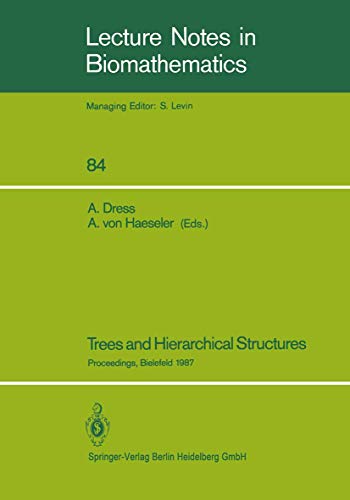
Trees and Hierarchical Structures: Proceedings of a Conference held at Bielefeld, FRG, Oct. 5–9th, 1987: 84 (Lecture Notes in Biomathematics) - Softcover
Inhaltsangabe
The "raison d’etre" of hierarchical dustering theory stems from one basic phe nomenon: This is the notorious non-transitivity of similarity relations. In spite of the fact that very often two objects may be quite similar to a third without being that similar to each other, one still wants to dassify objects according to their similarity. This should be achieved by grouping them into a hierarchy of non-overlapping dusters such that any two objects in ~ne duster appear to be more related to each other than they are to objects outside this duster. In everyday life, as well as in essentially every field of scientific investigation, there is an urge to reduce complexity by recognizing and establishing reasonable das sification schemes. Unfortunately, this is counterbalanced by the experience of seemingly unavoidable deadlocks caused by the existence of sequences of objects, each comparatively similar to the next, but the last rather different from the first.
Die Inhaltsangabe kann sich auf eine andere Ausgabe dieses Titels beziehen.
Reseña del editor
The "raison d'etre" of hierarchical dustering theory stems from one basic phe nomenon: This is the notorious non-transitivity of similarity relations. In spite of the fact that very often two objects may be quite similar to a third without being that similar to each other, one still wants to dassify objects according to their similarity. This should be achieved by grouping them into a hierarchy of non-overlapping dusters such that any two objects in ~ne duster appear to be more related to each other than they are to objects outside this duster. In everyday life, as well as in essentially every field of scientific investigation, there is an urge to reduce complexity by recognizing and establishing reasonable das sification schemes. Unfortunately, this is counterbalanced by the experience of seemingly unavoidable deadlocks caused by the existence of sequences of objects, each comparatively similar to the next, but the last rather different from the first.
Reseña del editor
The non-transitivity of similarity relations is the main problem encountered when - as in taxonomic studies in biology - one wants to base classification schemes on observed similarities and dissimilarities. While recent advances in molecular biology give rise to new and rather abstract data structures which can easily be used as input for automatic classification procedures we are still very much in need of a better and deeper understanding of the many delicate points which need consideration once (semi-)automatic classification procedures are applied to biological or other data. The papers collected in this volume are devoted to precisely this problem. They study various theoretical aspects of three reconstruction methods in biology, and psychology, discuss their value in specific biological contexts, apply tree-like recursion networks in chess programming and indicate a conceptual framework for studying cluster analysis from a purely mathematical point of view.
„Über diesen Titel“ kann sich auf eine andere Ausgabe dieses Titels beziehen.
Weitere beliebte Ausgaben desselben Titels

Suchergebnisse für Trees and Hierarchical Structures: Proceedings of a...

Foto des Verkäufers
Trees and hierarchical structures. Proceedings of a conference held at Bielefeld, FRG, Oct. 5 - 9th, 1987.
Anbieter: Antiquariat Bookfarm, Löbnitz, Deutschland
Verkäuferbewertung 5 von 5 Sternen

Softcover. 137 S. Ehem. Bibliotheksexemplar mit Signatur und Stempel. GUTER Zustand, ein paar Gebrauchsspuren. Ex-library with stamp and library-signature. GOOD condition, some traces of use. C-01189 3540524533 Sprache: Englisch Gewicht in Gramm: 550. Artikel-Nr. 2485044
Gebraucht kaufen
EUR 29,20
EUR 16,00 shipping
Versand von Deutschland nach USA
Versand von Deutschland nach USA
Anzahl: 1 verfügbar
Foto des Verkäufers
Trees and Hierarchical Structures: Proceedings of a Conference held at Bielefeld, FRG, Oct. 5-9th, 1987 (Lecture Notes in Biomathematics (84)).
Anbieter: Wissenschaftl. Antiquariat Th. Haker e.K, Klettgau, Deutschland
Verkäuferbewertung 5 von 5 Sternen
Zustand: Sehr gut. 143 p. In very good condition. ISBN: 9783540524533 Sprache: Englisch Gewicht in Gramm: 266 17,0 x 0,8 x 24,4 cm, softcover. Artikel-Nr. 59309
Gebraucht kaufen
EUR 26,90
EUR 22,13 shipping
Versand von Deutschland nach USA
Versand von Deutschland nach USA
Anzahl: 1 verfügbar
Beispielbild für diese ISBN
Trees and Hierarchical Structures: Proceedings of a Conference held at Bielefeld, FRG, Oct. 5-9th, 1987 (Lecture Notes in Biomathematics)
Anbieter: Revaluation Books, Exeter, Vereinigtes Königreich
Verkäuferbewertung 5 von 5 Sternen
Paperback. Zustand: Brand New. 1990 edition. 148 pages. 9.53x6.69x0.32 inches. In Stock. Artikel-Nr. x-3540524533
Neu kaufen
EUR 75,84
EUR 11,42 shipping
Versand von Vereinigtes Königreich nach USA
Versand von Vereinigtes Königreich nach USA
Anzahl: 2 verfügbar
Foto des Verkäufers
Trees and Hierarchical Structures
Anbieter: moluna, Greven, Deutschland
Verkäuferbewertung 4 von 5 Sternen

Zustand: New. Artikel-Nr. 4892396
Neu kaufen
EUR 48,37
EUR 48,99 shipping
Versand von Deutschland nach USA
Versand von Deutschland nach USA
Anzahl: Mehr als 20 verfügbar
Foto des Verkäufers
Trees and Hierarchical Structures : Proceedings of a Conference held at Bielefeld, FRG, Oct. 5-9th, 1987
Verlag:
Springer Berlin Heidelberg, Springer Berlin Heidelberg, 1990
ISBN 10: 3540524533
ISBN 13: 9783540524533
Neu
Taschenbuch
Anbieter: AHA-BUCH GmbH, Einbeck, Deutschland
Verkäuferbewertung 5 von 5 Sternen
Taschenbuch. Zustand: Neu. Druck auf Anfrage Neuware - Printed after ordering - The 'raison d'etre' of hierarchical dustering theory stems from one basic phe nomenon: This is the notorious non-transitivity of similarity relations. In spite of the fact that very often two objects may be quite similar to a third without being that similar to each other, one still wants to dassify objects according to their similarity. This should be achieved by grouping them into a hierarchy of non-overlapping dusters such that any two objects in ~ne duster appear to be more related to each other than they are to objects outside this duster. In everyday life, as well as in essentially every field of scientific investigation, there is an urge to reduce complexity by recognizing and establishing reasonable das sification schemes. Unfortunately, this is counterbalanced by the experience of seemingly unavoidable deadlocks caused by the existence of sequences of objects, each comparatively similar to the next, but the last rather different from the first. Artikel-Nr. 9783540524533
Neu kaufen
EUR 53,49
EUR 61,34 shipping
Versand von Deutschland nach USA
Versand von Deutschland nach USA
Anzahl: 1 verfügbar
Beispielbild für diese ISBN
Trees and Hierarchical Structures : Proceedings of a Conference held at Bielefeld, FRG, Oct. 5-9th, 1987
Anbieter: Buchpark, Trebbin, Deutschland
Verkäuferbewertung 5 von 5 Sternen
Zustand: Sehr gut. Zustand: Sehr gut | Sprache: Englisch | Produktart: Bücher | The "raison d'etre" of hierarchical dustering theory stems from one basic phe nomenon: This is the notorious non-transitivity of similarity relations. In spite of the fact that very often two objects may be quite similar to a third without being that similar to each other, one still wants to dassify objects according to their similarity. This should be achieved by grouping them into a hierarchy of non-overlapping dusters such that any two objects in ~ne duster appear to be more related to each other than they are to objects outside this duster. In everyday life, as well as in essentially every field of scientific investigation, there is an urge to reduce complexity by recognizing and establishing reasonable das sification schemes. Unfortunately, this is counterbalanced by the experience of seemingly unavoidable deadlocks caused by the existence of sequences of objects, each comparatively similar to the next, but the last rather different from the first. Artikel-Nr. 24765289/202
Gebraucht kaufen
EUR 26,45
EUR 105,00 shipping
Versand von Deutschland nach USA
Versand von Deutschland nach USA
Anzahl: 1 verfügbar