
Verwandte Artikel zu Economic Efficiency of the Organizational Decisions...
Inhaltsangabe
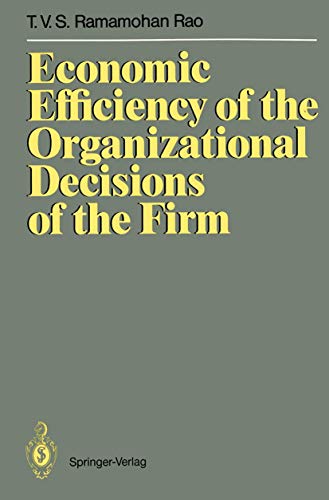
Over the past several years there has been an awareness that mar kets, contractual arrangements, and hierarchical organizations can be uti lized as alternative modes of coordinating resource utilization in the con text of the firm. In most practical situations mixed forms of organization are more frequent. That is, non-market coordination mechanisms are being utilized even in predominantly market oriented economies. The reasons for the use of one of these organizational modes over the others are still being examined extensively. Very often, asset specificity and bilateral monopoly, risk sharing under uncertainty, transaction cost considerations, and/or technological externalities (economies of scope) have been considered as the major reasons for preferring one of these modes over the others. However, the ultimate effect on the performance of the firm, of any of these aspects which result in the adoption of any specific organizational pattern, has to be through the cost curve and/or the demand curve. The neoclassical welfare concepts, which have been developed to examine the efficiency in the functioning of markets, are well known. The sources of inefficiency in the performance of the firm under different mar ket structures are also well documented. However, there is as yet no well established set of concepts to examine the economic efficiency of the other organizational forms. It is not clear that the neoclassical welfare concepts are not relevant even under the new organizational setting. Studies of this nature are a relatively new area of economic research.
Die Inhaltsangabe kann sich auf eine andere Ausgabe dieses Titels beziehen.
Suchergebnisse für Economic Efficiency of the Organizational Decisions...

Beispielbild für diese ISBN
Economic Efficiency of the Organizational Decisions of the Firm
Anbieter: Ria Christie Collections, Uxbridge, Vereinigtes Königreich
Verkäuferbewertung 5 von 5 Sternen

Zustand: New. In English. Artikel-Nr. ria9783540515708_new
Neu kaufen
EUR 67,01
EUR 13,13 Versand
Versand von Vereinigtes Königreich nach USA
Versand von Vereinigtes Königreich nach USA
Anzahl: Mehr als 20 verfügbar
Beispielbild für diese ISBN
Economic Efficiency of the Organizational Decisions of the Firm
Anbieter: Revaluation Books, Exeter, Vereinigtes Königreich
Verkäuferbewertung 5 von 5 Sternen
Paperback. Zustand: Brand New. 1st edition. 238 pages. 9.53x6.69x0.55 inches. In Stock. Artikel-Nr. x-3540515704
Neu kaufen
EUR 79,99
EUR 11,63 Versand
Versand von Vereinigtes Königreich nach USA
Versand von Vereinigtes Königreich nach USA
Anzahl: 2 verfügbar
Foto des Verkäufers
Economic Efficiency of the Organizational Decisions of the Firm
Anbieter: AHA-BUCH GmbH, Einbeck, Deutschland
Verkäuferbewertung 5 von 5 Sternen
Taschenbuch. Zustand: Neu. Druck auf Anfrage Neuware - Printed after ordering - Over the past several years there has been an awareness that mar kets, contractual arrangements, and hierarchical organizations can be uti lized as alternative modes of coordinating resource utilization in the con text of the firm. In most practical situations mixed forms of organization are more frequent. That is, non-market coordination mechanisms are being utilized even in predominantly market oriented economies. The reasons for the use of one of these organizational modes over the others are still being examined extensively. Very often, asset specificity and bilateral monopoly, risk sharing under uncertainty, transaction cost considerations, and/or technological externalities (economies of scope) have been considered as the major reasons for preferring one of these modes over the others. However, the ultimate effect on the performance of the firm, of any of these aspects which result in the adoption of any specific organizational pattern, has to be through the cost curve and/or the demand curve. The neoclassical welfare concepts, which have been developed to examine the efficiency in the functioning of markets, are well known. The sources of inefficiency in the performance of the firm under different mar ket structures are also well documented. However, there is as yet no well established set of concepts to examine the economic efficiency of the other organizational forms. It is not clear that the neoclassical welfare concepts are not relevant even under the new organizational setting. Studies of this nature are a relatively new area of economic research. Artikel-Nr. 9783540515708
Neu kaufen
EUR 61,09
EUR 35,00 Versand
Versand von Deutschland nach USA
Versand von Deutschland nach USA
Anzahl: 1 verfügbar
Foto des Verkäufers
Economic Efficiency of the Organizational Decisions of the Firm
Anbieter: moluna, Greven, Deutschland
Verkäuferbewertung 5 von 5 Sternen
Zustand: New. Artikel-Nr. 4892033
Neu kaufen
EUR 48,37
EUR 48,99 Versand
Versand von Deutschland nach USA
Versand von Deutschland nach USA
Anzahl: Mehr als 20 verfügbar