
Verwandte Artikel zu The Real and Virtual Worlds of Spatial Planning
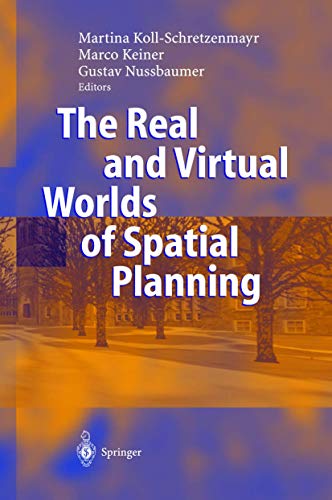
Inhaltsangabe
Experiencing the world of daily life means to observe and perceive the natural, the man-made, the socio-spatial, and the politico-economic elements of the en vironment we live in. But, have you ever tried to explain the phenomena of daily life such as a traffic jam or mass transit to a child? It will take you quite a while to find suitable images to make invisible forces perceivable and con cepts like timetables, bus routes, or capacity constraints comprehensible. This exercise alone will convince you that we need imagery or virtual worlds to cope with the complexity of the real world. The task of spatial planning is to design, implement and manage alternative futures for a complex, dynamic socio-spatial environment that emerges from a wide range of intertwined social, political, economic and environmental processes. In order to learn about these processes and gain knowledge that en ables spatial planners to better understand and manage socio-spatial reality, they need to think in and work with virtual worlds.
Die Inhaltsangabe kann sich auf eine andere Ausgabe dieses Titels beziehen.
Von der hinteren Coverseite
The Real and Virtual Worlds of Spatial Planning brings together contributions from leaders in landscape, transportation, and urban planning today. The authors present an international range of case studies - from Europe, Australia, North America, Asia and Africa - that ground the exploration of ideas in the realities of sustainable urban and regional planning, landscape planning and present the prospects for using virtual worlds for modeling spatial environments and their application in planning. The first part of this volume explores the challenges for planning in the real world that are caused by the dynamics of socio-spatial systems as well as by the contradictions of their evolutionary trends related to their spatial layout. Case studies from developed as well as developing countries are presented. The second part presents diverse concepts to model, analyze, visualize, monitor and control socio-spatial systems by using virtual worlds. Theoretical topics include modeling spatial systems as Petri nets, cellular automata as well as dynamical systems.
„Über diesen Titel“ kann sich auf eine andere Ausgabe dieses Titels beziehen.
Suchergebnisse für The Real and Virtual Worlds of Spatial Planning

Foto des Verkäufers
The Real and Virtual Worlds of Spatial Planning
Anbieter: buecheria, Einzelunternehmen, Heinsberg, NRW, Deutschland
Verkäuferbewertung 5 von 5 Sternen

Gebundene Ausgabe. Zustand: Gut. 305 Seiten Wie abgebildet, gebundene Ausgabe, Springer 2004, sauber, Name auf Vorsatz, geringfügige Lagerspuren, gutes, textsauberes Exemplar, zügiger, versicherter Versand aus Deutschland, Sie erhalten eine ordentliche Rechnung mit ausgewiesener Mwst. Ab dem 12. August 2026 stellen wir unseren Versand in EU-Länder, EWR-Länder (Island, Liechtenstein, Norwegen), ein. Grund dafür sind die strengen Vorgaben der neuen europäischen Verpackungsverordnung (PPWR). Die dadurch entstehenden Auflagen und Kosten sind für uns wirtschaftlich und aus Gründen nicht umsetzbar. Vielen Dank für Ihr Verständnis. BESTELLUNGEN MIT EINER DEUTSCHEN VERSANDANSCHRIFT WERDEN WEITERHIN AUSGEFÜHRT. Sprache: Deutsch Gewicht in Gramm: 402. Artikel-Nr. 15146
Gebraucht kaufen
EUR 79,95
EUR 11,99 Versand
Versand von Deutschland nach USA
Versand von Deutschland nach USA
Anzahl: 1 verfügbar
Foto des Verkäufers
The Real and Virtual Worlds of Spatial Planning
Verlag:
Springer, Berlin, Germany, 2003
ISBN 10: 3540407480
ISBN 13: 9783540407485
Gebraucht
Hardcover
Erstausgabe
Anbieter: Crossroads Books, Reno, NV, USA
Verkäuferbewertung 5 von 5 Sternen
Hardcover. Zustand: Very Good with no dust jacket. First Edition (?). Unmarked. ; Book Description; Spine has no signs of creasing. Pages are clean and not marred by notes or folds. Covers are square with minor wear. Ships Safe and Fast. Published without Dust Jacket. The Real and Virtual Worlds of Spatial Planning brings together contributions from leaders in landscape, transportation, and urban planning. They present case studies - from North America, Europe, Australia, Asia and Africa - that ground the exploration of ideas in the realities of sustainable urban and regional planning, landscape planning and present the prospects for using virtual worlds for modeling spatial environments and their application in planning. The first part explores the challenges for planning in the real world that are caused by the dynamics of socio-spatial systems as well as by the contradictions of their evolutionary trends related to their spatial layout. The second part presents diverse concepts to model, analyze, visualize, monitor and control socio-spatial systems by using virtual worlds. ; B&W Illustrations; 8vo 8" - 9" tall; 306 pages DD5. Artikel-Nr. 29719
Gebraucht kaufen
EUR 113,39
EUR 4,34 Versand
Versand innerhalb von USA
Versand innerhalb von USA
Anzahl: 1 verfügbar
Beispielbild für diese ISBN
The Real and Virtual Worlds of Spatial Planning
Anbieter: Anybook.com, Lincoln, Vereinigtes Königreich
Verkäuferbewertung 5 von 5 Sternen
Zustand: Good. This is an ex-library book and may have the usual library/used-book markings inside.This book has hardback covers. In good all round condition. Please note the Image in this listing is a stock photo and may not match the covers of the actual item,800grams, ISBN:9783540407485. Artikel-Nr. 5967968
Gebraucht kaufen
EUR 85,18
EUR 36,57 Versand
Versand von Vereinigtes Königreich nach USA
Versand von Vereinigtes Königreich nach USA
Anzahl: 1 verfügbar
Beispielbild für diese ISBN
The Real and Virtual Worlds of Spatial Planning
Anbieter: Ria Christie Collections, Uxbridge, Vereinigtes Königreich
Verkäuferbewertung 5 von 5 Sternen
Zustand: New. In. Artikel-Nr. ria9783540407485_new
Neu kaufen
EUR 165,37
EUR 13,95 Versand
Versand von Vereinigtes Königreich nach USA
Versand von Vereinigtes Königreich nach USA
Anzahl: Mehr als 20 verfügbar
Foto des Verkäufers
The Real and Virtual Worlds of Spatial Planning
Verlag:
Springer Berlin Heidelberg, Springer Berlin Heidelberg, 2003
ISBN 10: 3540407480
ISBN 13: 9783540407485
Neu
Hardcover
Anbieter: AHA-BUCH GmbH, Einbeck, Deutschland
Verkäuferbewertung 5 von 5 Sternen
Buch. Zustand: Neu. Druck auf Anfrage Neuware - Printed after ordering - Experiencing the world of daily life means to observe and perceive the natural, the man-made, the socio-spatial, and the politico-economic elements of the en vironment we live in. But, have you ever tried to explain the phenomena of daily life such as a traffic jam or mass transit to a child It will take you quite a while to find suitable images to make invisible forces perceivable and con cepts like timetables, bus routes, or capacity constraints comprehensible. This exercise alone will convince you that we need imagery or virtual worlds to cope with the complexity of the real world. The task of spatial planning is to design, implement and manage alternative futures for a complex, dynamic socio-spatial environment that emerges from a wide range of intertwined social, political, economic and environmental processes. In order to learn about these processes and gain knowledge that en ables spatial planners to better understand and manage socio-spatial reality, they need to think in and work with virtual worlds. Artikel-Nr. 9783540407485
Neu kaufen
EUR 160,49
EUR 63,27 Versand
Versand von Deutschland nach USA
Versand von Deutschland nach USA
Anzahl: 1 verfügbar