
Verwandte Artikel zu Advances in Biometric Person Authentication: 5th Chinese...
Advances in Biometric Person Authentication: 5th Chinese Conference on Biometric Recognition, SINOBIOMETRICS 2004, Guangzhou, China, December 13-14, ... Notes in Computer Science, 3338, Band 3338) - Softcover
Inhaltsangabe
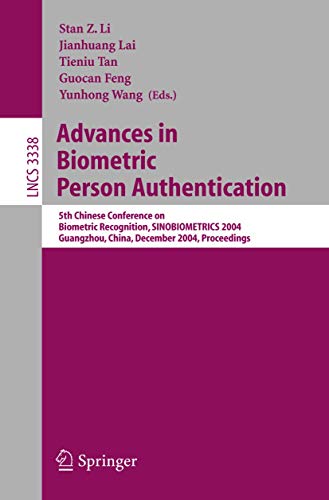
Following the previous four annual conferences, the 5th Chinese Conference on Biometrics Recognition (Sinobiometrics 2004) was held in Guangzhou, China in December 2004. The conference this year was aimed at promoting the international exchange of ideas and providing an opportunity for keeping abreast of the latest developments in biometric algorithms, systems, and applications. The 1st Biometrics Verification Competition (BVC) on face, iris, and fingerprint recognition was also conducted in conjunction with the conference. This book is composed of 74 papers presented at Sinobiometrics 2004, contributed by researchers and industrial practitioners from Korea, Japan, Singapore, Hong Kong, France, UK, US, as well as China. Of these, 60 papers were selected from 140 submissions and 14 were invited. The papers not only presented recent technical advances, but also addressed issues in biometric system design, standardization, and applications. Included among the invited were four feature papers on the ideas and algorithms of the best-performing biometric engines, which were either competition winners at the Face Authentication Test (FAT) 2004 or the Fingerprint Verification Competition (FVC) 2004, or they were the best-performing iris and palmprint recognition algorithms. The papers were complemented by five keynote lectures on biometrics, and face, fingerprint, and iris authentication and multimodal fusion by Arun Ross (West Virginia University) and Anil K. Jain (Michigan State University), Josef Kittler (University of Surrey), John Daugman (University of Cambridge), Raffaele Cappelli (University of Bologna), and Stan Z. Li (Chinese Academy of Sciences).
Die Inhaltsangabe kann sich auf eine andere Ausgabe dieses Titels beziehen.
Über die Autorin bzw. den Autor
Jun Wan received a B.S. degree from the China University of Geosciences, Beijing, China, in 2008, and a Ph.D. degree from the Institute of Information Science, Beijing Jiaotong University, Beijing, China, in 2015. Since January 2015, he has been a Faculty Member with the National Laboratory of Pattern Recognition (NLPR), Institute of Automation, Chinese Academy of Science (CASIA), China, where he currently serves as an Associate Professor. He is an IEEE Senior Member and a director of Chalearn Challenges. He has published more than 50 research papers and has been guest editor at TPAMI, MVA, and Entropy. His main research interests include computer vision, machine learning, especially for face and pedestrian analysis (such as attribute analysis, face anti-spoofing detection), gesture and sign language recognition. He has published papers in top journals and conferences, such as JMLR, T-PAMI, T-IP, T-MM, T-CYB, TOMM, PR, CVIU, CVPR, AAAI, and IJCAI. He has served as the reviewer on several journals and conferences, such as JMLR, T-PAMI, T-IP, T-MM, T-SMC, PR, CVPR, ICCV, ECCV, AAAI, and ICRA.Guodong Guo received a B.E. degree in automation from Tsinghua University, Beijing, China, and a Ph.D. degree in computer science from University of Wisconsin, Madison, WI. He is currently the Deputy Head of the Institute of Deep Learning, Baidu Research, and also an Associate Professor with the Department of Computer Science and Electrical Engineering, West Virginia University (WVU). In the past, he visited and worked in several places, including INRIA, Sophia Antipolis, France; Ritsumeikan University, Kyoto, Japan; and Microsoft Research, Beijing, China; He authored a book, Face, Expression, and Iris Recognition Using Learning-based Approaches (2008), co-edited two books, Support Vector Machines Applications (2014) and Mobile Biometrics (2017), and published over 100 technical papers. He is an Associate Editor of IEEE Transactions on Affective Computing, Journal of Visual Communication and Image Representation, and serves on the editorial board of IET Biometrics. His research interests include computer vision, biometrics, machine learning, and multimedia. He received the North Carolina State Award for Excellence in Innovation in 2008, Outstanding Researcher (2017-2018, 2013-2014) at CEMR, WVU, and New Researcher of the Year (2010-2011) at CEMR, WVU. He was selected the "People's Hero of the Week" by BSJB under Minority Media and Telecommunications Council (MMTC) in 2013. Two of his papers were selected as "The Best of FG'13" and "The Best of FG'15", respectively.Sergio Escalera (www.sergioescalera.com) obtained a P.h.D. degree on multi-class visual categorization systems at Computer Vision Center, UAB. He obtained the 2008 best Thesis award on Computer Science at Universitat Autonoma de Barcelona. He is ICREA Academia. He leads the Human Pose Recovery and Behavior Analysis Group at UB, CVC, and the Barcelona Graduate School of Mathematics. Heis Full Professor at the Department of Mathematics and Informatics, Universitat de Barcelona. He is an adjunct professor at Universitat Oberta de Catalunya, Aalborg University, and Dalhousie University. He has been visiting professor at TU Delft and Aalborg Universities. He is also a member of the Computer Vision Center at UAB. He is series editor of The Springer Series on Challenges in Machine Learning. He is a member and fellow of the European Laboratory of Intelligent Systems ELLIS. He is vice-president of ChaLearn Challenges in Machine Learning, leading ChaLearn Looking at People events. He is a co-creator of Codalab open source platform for challenges organization. He is Chair of IAPR TC-12: Multimedia and visual information systems. His research interests include: statistical pattern recognition, affective computing, and human pose recovery and behavior understanding, including multi-modal data analysis, with special interest in characterizing people: personality and psychological Yi Li received her B.E. degree in Electronic and Information Engineering from Dalian University of Technology in 2014, and her M.E. degree in Information and Communication Engineering from the same university in 2017. She is currently a Ph.D. student at the Center for Research on Intelligent Perception and Computing (CRIPAC), National Laboratory of Pattern Recognition (NLPR), CASIA, Beijing, China. Her research interests include computer vision and pattern recognition. Huaibo Huang received his B.E. degree in Measurement and Control Technology and Instruments from Xi'an Jiaotong University in 2012, and his M.E. degree in Optical Engineering from Beihang University in 2016. He is currently a Ph.D. student at the Center for Research on Intelligent Perception and Computing (CRIPAC), National Laboratory of Pattern Recognition (NLPR), CASIA, Beijing, China. His research interests include computer vision and pattern recognition. Ran He received his B.E. degree in Computer Science and his M.S. degree in Computer Science from Dalian University of Technology, and his Ph.D. degree in Pattern Recognition and Intelligent Systems from the Institute of Automation, Chinese Academy of Sciences in 2001, 2004 and 2009, respectively. In September 2010, Dr. He joined the NLPR, where he is currently a Professor. He is a member of the IEEE (Institute of Electrical and Electronics Engineers) and serves as an Associate Editor of the journal Neurocomputing (Elsevier), and on the program committees of several conferences. His research interests chiefly focus on information theoretic learning, pattern recognition, and computer vision. He has published over 140 conference papers and journal articles in highly ranked international journals, such as IEEE Transactions on Pattern Analysis and Machine Intelligence (TPAMI), IEEE Transactions on Image Processing (TIP), and Neural Computation (NECO). Tieniu Tan received his B.Sc. degree in Electronic Engineering from Xi'an Jiaotong University, China, in 1984, and his M.Sc. and Ph.D. degrees in Electronic Engineering from the Imperial College London, UK, in 1986 and 1989, respectively. In October 1989, he joined the Computational Vision Group in the Department of Computer Science, University of Reading, UK, where he worked as a Research Fellow, Senior Research Fellow and Lecturer. In January 1998, he returned to China to join the National Laboratory of Pattern Recognition (NLPR), where he is currently a Professor. He is the former director (1998-2013) of the NLPR and Center for Research on Intelligent Perception and Computing (CRIPAC), and was Director General of the Institute (2000-2007). He has also served as Vice President of the Chinese Academy of Sciences (2015-2016). His current research interests include biometrics, image and video understanding, and information content security. Dr. Tan is a Fellow of the CAS, TWAS (The World Academy of Sciences for the advancement of science in developing countries), IEEE and IAPR, and an International Fellow of the UK Royal Academy of Engineering. He has served as an Associate Editor or member of the editorial board of several leading international journals, including IEEE Transactions on Pattern Analysis and Machine Intelligence (PAMI), IEEE Transactions on Automation Science and Engineering, Pattern Recognition Letters, and Image and Vision Computing. Dr. Yunhong Wang is a translation scholar and practitioner, and holds a Ph.D. from the Department of Chinese and Bilingual Studies, Hong Kong Polytechnic University. She currently teaches graduate and undergraduate courses on translation as an associate professor affiliated with Jinan University, Guangzhou, Guangdong Province, China. Dr. Wang has published more than twenty research articles in journals such as Chinese Translators Journal, Journal of Foreign Languages,Babel, Neohelicon and Perspectives. Her main research areas include translation studies, cultural studies and sociology of translation.
Von der hinteren Coverseite
Following the previous four annual conferences, the 5th Chinese Conference on Biometrics Recognition (Sinobiometrics 2004) was held in Guangzhou, China in December 2004. The conference this year was aimed at promoting the international exchange of ideas and providing an opportunity for keeping abreast of the latest developments in biometric algorithms, systems, and applications. The 1st Biometrics Verification Competition (BVC) on face, iris, and fingerprint recognition was also conducted in conjunction with the conference. This book is composed of 74 papers presented at Sinobiometrics 2004, contributed by researchers and industrial practitioners from Korea, Japan, Singapore, Hong Kong, France, UK, US, as well as China. Of these, 60 papers were selected from 140 submissions and 14 were invited. The papers not only presented recent technical advances, but also addressed issues in biometric system design, standardization, and applications. Included among the invited were four feature papers on the ideas and algorithms of the best-performing biometric engines, which were either competition winners at the Face Authentication Test (FAT) 2004 or the Fingerprint Verification Competition (FVC) 2004, or they were the best-performing iris and palmprint recognition algorithms. The papers were complemented by five keynote lectures on biometrics, and face, fingerprint, and iris authentication and multimodal fusion by Arun Ross (West Virginia University) and Anil K. Jain (Michigan State University), Josef Kittler (University of Surrey), John Daugman (University of Cambridge), Raffaele Cappelli (University of Bologna), and Stan Z. Li (Chinese Academy of Sciences).
„Über diesen Titel“ kann sich auf eine andere Ausgabe dieses Titels beziehen.
Suchergebnisse für Advances in Biometric Person Authentication: 5th Chinese...

Beispielbild für diese ISBN
Advances In Biometric Person Authentications 2004, Guangzhou, China, December 13-14, 2004, . (lecture Notes In Computer Science)
Anbieter: Romtrade Corp., STERLING HEIGHTS, MI, USA
Verkäuferbewertung 5 von 5 Sternen

Zustand: New. This is a Brand-new US Edition. This Item may be shipped from US or any other country as we have multiple locations worldwide. Artikel-Nr. ABBB-255309
Beispielbild für diese ISBN
Advances in Biometric Person Authentication
Anbieter: Majestic Books, Hounslow, Vereinigtes Königreich
Verkäuferbewertung 4 von 5 Sternen

Zustand: Used. pp. 724 Illus. Artikel-Nr. 5814504
Gebraucht kaufen
EUR 107,05
EUR 7,79 Versand
Versand von Vereinigtes Königreich nach USA
Versand von Vereinigtes Königreich nach USA
Anzahl: 1 verfügbar
Beispielbild für diese ISBN
Advances in Biometric Person Authentication
Anbieter: Biblios, Frankfurt am main, HESSE, Deutschland
Verkäuferbewertung 4 von 5 Sternen
Zustand: Used. pp. 724. Artikel-Nr. 183082045
Gebraucht kaufen
EUR 110,45
EUR 9,95 Versand
Versand von Deutschland nach USA
Versand von Deutschland nach USA
Anzahl: 1 verfügbar
Foto des Verkäufers
Advances in Biometric Person Authentication : 5th Chinese Conference on Biometric Recognition, SINOBIOMETRICS 2004, Guangzhou, China, December 13-14, 2004, Proceedings
Anbieter: AHA-BUCH GmbH, Einbeck, Deutschland
Verkäuferbewertung 5 von 5 Sternen
Taschenbuch. Zustand: Neu. Druck auf Anfrage Neuware - Printed after ordering - Following the previous four annual conferences, the 5th Chinese Conference on Biometrics Recognition (Sinobiometrics 2004) was held in Guangzhou, China in December 2004. The conference this year was aimed at promoting the international exchange of ideas and providing an opportunity for keeping abreast of the latest developments in biometric algorithms, systems, and applications. The 1st Biometrics Verification Competition (BVC) on face, iris, and fingerprint recognition was also conducted in conjunction with the conference. This book is composed of 74 papers presented at Sinobiometrics 2004, contributed by researchers and industrial practitioners from Korea, Japan, Singapore, Hong Kong, France, UK, US, as well as China. Of these, 60 papers were selected from 140 submissions and 14 were invited. The papers not only presented recent technical advances, but also addressed issues in biometric system design, standardization, and applications. Included among the invited were four feature papers on the ideas and algorithms of the best-performing biometric engines, which were either competition winners at the Face Authentication Test (FAT) 2004 or the Fingerprint Verification Competition (FVC) 2004, or they were the best-performing iris and palmprint recognition algorithms. The papers were complemented by five keynote lectures on biometrics, and face, fingerprint, and iris authentication and multimodal fusion by Arun Ross (West Virginia University) and Anil K. Jain (Michigan State University), Josef Kittler (University of Surrey), John Daugman (University of Cambridge), Raffaele Cappelli (University of Bologna), and Stan Z. Li (Chinese Academy of Sciences). Artikel-Nr. 9783540240297
Neu kaufen
EUR 124,85
EUR 42,50 Versand
Versand von Deutschland nach USA
Versand von Deutschland nach USA
Anzahl: 1 verfügbar