
Verwandte Artikel zu Genetic Programming: 7th European Conference, EuroGP...
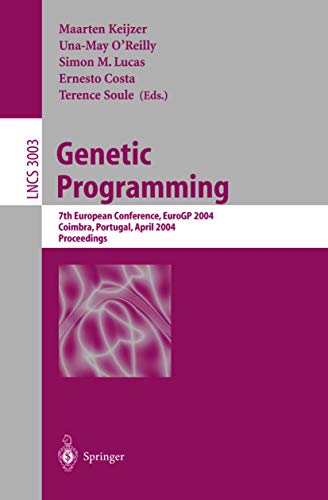
Genetic Programming: 7th European Conference, EuroGP 2004, Coimbra, Portugal, April 5-7, 2004, Proceedings (Lecture Notes in Computer Science, 3003, Band 3003) - Softcover
Inhaltsangabe
In this volume we present the accepted contributions for the 7th European C- ference on Genetic Programming (EuroGP 2004). The conference took place on 5 7 April 2004 in Portugal at the University of Coimbra, in the Department of Mathematics in Pra¸ ca Dom Dinis, located on the hill above the old town. EuroGP is a well-established conference and the sole one exclusively de- ted to Genetic Programming. Previous proceedings have all been published by Springer-Verlag in the LNCS series. EuroGP began as an international wor- hop in Paris, France in 1998 (14 15 April, LNCS 1391). Subsequently the wor- hop was held in G¨ oteborg, Sweden in 1999 (26 27 May, LNCS 1598) and then EuroGP became an annual conference: in 2000 in Edinburgh, UK (15 16 April, LNCS 1802), in 2001 at Lake Como, Italy (18 19 April, LNCS 2038), in 2002 in Kinsale, Ireland (3 5 April, LNCS 2278), and in 2003 in Colchester, UK (14 16 April, LNCS 2610). From the outset, there have always been specialized wor- hops, co-located with EuroGP, focusing on applications of evolutionary al- rithms (LNCS 1468, 1596, 1803, 2037, 2279, and 2611). This year the EvoCOP workshop on combinatorial optimization transformed itself into a conference in its own right, and the two conferences, together with the EvoWorkshops, EvoBIO, EvoIASP, EvoMUSART, EvoSTOC, EvoHOT, and EvoCOMNET, now form one of the largest events dedicated to Evolutionary Computation in Europe.
Die Inhaltsangabe kann sich auf eine andere Ausgabe dieses Titels beziehen.
Über die Autorin bzw. den Autor
Diego Perez Liebana is a Lecturer in Computer Games and AI at Queen Mary University of London (QMUL) and hold a Ph.D. in Computer Science from the University of Essex (2015). His research interests are search algorithms, evolutionary computation, and reinforcement learning applied to real-time games and general video game playing. He is published more than 60 papers in leading conferences and journals in the area, including best paper awards (CIG, EvoStar). He is the main organizer behind popular AI game-based competitions in the field, serves as a reviewer in top conferences and journals, and he was general chair of the 2019 IEEE Conference on Games (QMUL). He has experience in the video games industry with titles published for both PC and consoles, and also in developing AI tools for games.Simon M. Lucas is a professor of Computer Science at Queen Mary University of London (UK) where he is the Head of School and leads the Game Artificial Intelligence Group. He holds a Ph.D. (1991) in Electronics and Computer Science from the University of Southampton. His main research interests are games, evolutionary computation, and machine learning, and he has published widely in these fields with over 180 peer-reviewed papers. He is the inventor of the scanning n-tuple classifier and is the founding Editor-in-Chief of the IEEE Transactions on Computational Intelligence and AI in Games.Raluca D. Gaina is currently studying for her Ph.D. in Intelligent Games and Games Intelligence at Queen Mary University of London, in the area of rolling horizon evolution in general video game playing, after completing a B.Sc. and M.Sc. in Computer Games at the University of Essex. In 2018, she did a three-month internship at Microsoft Research Cambridge, working on the Multi-Agent Reinforcement Learning in Malmo Competition (MARLO, aka.ms/marlo). She is the track organizer of the Two-Player General Video Game AI Competition (gvgai.net). Her research interests include general video game playing AI, reinforcement learning, and evolutionary computation algorithms.Julian Togelius is an Associate Professor in the Department of Computer Science and Engineering, New York University, USA. He works on artificial intelligence for games and games for artificial intelligence. His current main research directions involve search-based procedural content generation in games, general video game playing, player modeling, generating games based on open data, and fair and relevant benchmarking of AI through game-based competitions. He is the Editor-in-Chief of IEEE Transactions on Games and has been chair or program chair of several of the main conferences on AI and games. Togelius holds a B.A. from Lund University, an M.Sc. from the University of Sussex, and a Ph.D. from the University of Essex. He has previously worked at IDSIA in Lugano and at the IT University of Copenhagen.Ahmed Khalifa is a Ph.D. student at New York University working on procedural content generation and automated game playing. He also works as a game developer and designer in his free time and has released more than 30 games algorithms.Jialin Liu is currently a Research Assistant Professor at the Department of Computer Science and Engineering of Southern University of Science and Technology (SUSTech, China). Before joining SUSTech, she was a Postdoctoral Research Associate at Queen Mary University of London(QMUL, UK) and one of the founding members of the Game AI research group of QMUL. Her research interests include AI and games, noisy optimization, portfolio of algorithms, and meta-heuristics. Jialin served as Program Co-Chair of 2018 IEEE Computational Intelligence and Games (CIG2018), and Competition Chair of FDG2018, FDG2019, and CEC2019. Jialin received her Ph.D. in Computer Science from the Inria Saclay and the Universite Paris-Saclay (France) in December 2015 and a Master's in Bioinformatics and Biostatistics from the Ecole Polytechnique and
Von der hinteren Coverseite
In this volume we present the accepted contributions for the 7th European C- ference on Genetic Programming (EuroGP 2004). The conference took place on 5-7 April 2004 in Portugal at the University of Coimbra, in the Department of Mathematics in Prä ca Dom Dinis, located on the hill above the old town. EuroGP is a well-established conference and the sole one exclusively de- ted to Genetic Programming. Previous proceedings have all been published by Springer-Verlag in the LNCS series. EuroGP began as an international wor- hop in Paris, France in 1998 (14-15 April, LNCS 1391). Subsequently the wor- hop was held in G¿ oteborg, Sweden in 1999 (26-27 May, LNCS 1598) and then EuroGP became an annual conference: in 2000 in Edinburgh, UK (15-16 April, LNCS 1802), in 2001 at Lake Como, Italy (18-19 April, LNCS 2038), in 2002 in Kinsale, Ireland (3-5 April, LNCS 2278), and in 2003 in Colchester, UK (14-16 April, LNCS 2610). From the outset, there have always been specialized wor- hops, co-located with EuroGP, focusing on applications of evolutionary al- rithms (LNCS 1468, 1596, 1803, 2037, 2279, and 2611). This year the EvoCOP workshop on combinatorial optimization transformed itself into a conference in its own right, and the two conferences, together with the EvoWorkshops, EvoBIO, EvoIASP, EvoMUSART, EvoSTOC, EvoHOT, and EvoCOMNET, now form one of the largest events dedicated to Evolutionary Computation in Europe.
„Über diesen Titel“ kann sich auf eine andere Ausgabe dieses Titels beziehen.
Suchergebnisse für Genetic Programming: 7th European Conference, EuroGP...

Foto des Verkäufers
Genetic Programming : 7th European Conference, EuroGP2004, Coimbra, Portugal, April 5-7, 2004, Proceedings
Anbieter: GreatBookPricesUK, Woodford Green, Vereinigtes Königreich
Verkäuferbewertung 5 von 5 Sternen

Zustand: New. Artikel-Nr. 3462759-n
Neu kaufen
EUR 68,06
EUR 17,98 Versand
Versand von Vereinigtes Königreich nach USA
Versand von Vereinigtes Königreich nach USA
Anzahl: Mehr als 20 verfügbar
Foto des Verkäufers
Genetic Programming : 7th European Conference, EuroGP2004, Coimbra, Portugal, April 5-7, 2004, Proceedings
Anbieter: GreatBookPricesUK, Woodford Green, Vereinigtes Königreich
Verkäuferbewertung 5 von 5 Sternen
Zustand: As New. Unread book in perfect condition. Artikel-Nr. 3462759
Gebraucht kaufen
EUR 69,27
EUR 17,98 Versand
Versand von Vereinigtes Königreich nach USA
Versand von Vereinigtes Königreich nach USA
Anzahl: Mehr als 20 verfügbar
Beispielbild für diese ISBN
Genetic Programming: 7th European Conference, EuroGP 2004, Coimbra, Portugal, April 5-7, 2004, Proceedings (Lecture Notes in Computer Science, 3003)
Anbieter: Ria Christie Collections, Uxbridge, Vereinigtes Königreich
Verkäuferbewertung 5 von 5 Sternen
Zustand: New. In English. Artikel-Nr. ria9783540213468_new
Neu kaufen
EUR 69,09
EUR 21,97 Versand
Versand von Vereinigtes Königreich nach USA
Versand von Vereinigtes Königreich nach USA
Anzahl: Mehr als 20 verfügbar
Foto des Verkäufers
Genetic Programming : 7th European Conference, EuroGP 2004, Coimbra, Portugal, April 5-7, 2004, Proceedings
Anbieter: AHA-BUCH GmbH, Einbeck, Deutschland
Verkäuferbewertung 5 von 5 Sternen
Taschenbuch. Zustand: Neu. Druck auf Anfrage Neuware - Printed after ordering - Papers.- Evaluation of Chess Position by Modular Neural Network Generated by Genetic Algorithm.- Coevolution of Algorithms and Deterministic Solution of Equations in Free Groups.- Designing Optimal Combinational Digital Circuits Using a Multiple Logic Unit Processor.- A Data Structure for Improved GP Analysis via Efficient Computation and Visualisation of Population Measures.- Boosting Technique for Combining Cellular GP Classifiers.- Co-evolving Faults to Improve the Fault Tolerance of Sorting Networks.- Toward an Alternative Comparison between Different Genetic Programming Systems.- Lymphoma Cancer Classification Using Genetic Programming with SNR Features.- A Practical Approach to Evolving Concurrent Programs.- Evolutionary Induction of Grammar Systems for Multi-agent Cooperation.- Genetic Programming Applied to Mixed Integer Programming.- Efficient Crossover in the GAuGE System.- Grammatical Evolution by Grammatical Evolution: The Evolution of Grammar and Genetic Code.- Constrained Molecular Dynamics as a Search and Optimization Tool.- On the Performance of Genetic Operators and the Random Key Representation.- Analysis of GP Improvement Techniques over the Real-World Inverse Problem of Ocean Color.- Evolution and Acquisition of Modules in Cartesian Genetic Programming.- How to Choose Appropriate Function Sets for Gentic Programming.- Improving Grammar-Based Evolutionary Algorithms via Attributed Derivation Trees.- Posters.- Evolved Matrix Operations for Post-processing Protein Secondary Structure Predictions.- Genetic Programming for Natural Language Parsing.- Comparing Hybrid Systems to Design and Optimize Artificial Neural Networks.- An Evolutionary Algorithm for the Input-Output Block Assignment Problem.- Genetic Programming for Subjective Fitness Function Identification.- Saving Effort in Parallel GP by Means of Plagues.- Sampling of Unique Structures and Behaviours in Genetic Programming.- The Evolution of Concurrent Control Software Using Genetic Programming.- Extending Grammatical Evolution to Evolve Digital Surfaces with Genr8.- Evolving Text Classifiers with Genetic Programming.- Automatic Synthesis of Instruction Decode Logic by Genetic Programming.- Alternatives in Subtree Caching for Genetic Programming.- Structural Risk Minimization on Decision Trees Using an Evolutionary Multiobjective Optimization.- Global Distributed Evolution of L-Systems Fractals.- Reusing Code in Genetic Programming.- Exploiting Reflection in Object Oriented Genetic Programming.- Evolutionary Feature Construction Using Information Gain and Gini Index.- On the Evolution of Evolutionary Algorithms.- Genetic Programming with Gradient Descent Search for Multiclass Object Classification. Artikel-Nr. 9783540213468
Neu kaufen
EUR 67,23
EUR 35,00 Versand
Versand von Deutschland nach USA
Versand von Deutschland nach USA
Anzahl: 1 verfügbar
Foto des Verkäufers
Genetic Programming | 7th European Conference, EuroGP 2004, Coimbra, Portugal, April 5-7, 2004, Proceedings
Anbieter: preigu, Osnabrück, Deutschland
Verkäuferbewertung 5 von 5 Sternen
Taschenbuch. Zustand: Neu. Genetic Programming | 7th European Conference, EuroGP 2004, Coimbra, Portugal, April 5-7, 2004, Proceedings | Maarten Keijzer (u. a.) | Taschenbuch | xi | Englisch | 2004 | Springer | EAN 9783540213468 | Verantwortliche Person für die EU: Springer Verlag GmbH, Tiergartenstr. 17, 69121 Heidelberg, juergen[dot]hartmann[at]springer[dot]com | Anbieter: preigu. Artikel-Nr. 102471111
Neu kaufen
EUR 50,45
EUR 70,00 Versand
Versand von Deutschland nach USA
Versand von Deutschland nach USA
Anzahl: 5 verfügbar
Foto des Verkäufers
Genetic Programming: 7th European Conference, EuroGP 2004, Coimbra, Portugal,.
Anbieter: Vulkaneifel Bücher, Birgel, Deutschland
Verkäuferbewertung 5 von 5 Sternen
Zustand: Neu. neu, noch in Schutzfolie, Versand spätestens am nächsten Werktag Sprache: Deutsch Gewicht in Gramm: 650. Artikel-Nr. 314022
Neu kaufen
EUR 45,95
EUR 124,40 Versand
Versand von Deutschland nach USA
Versand von Deutschland nach USA
Anzahl: 1 verfügbar