
Verwandte Artikel zu Database and XML Technologies: First International...
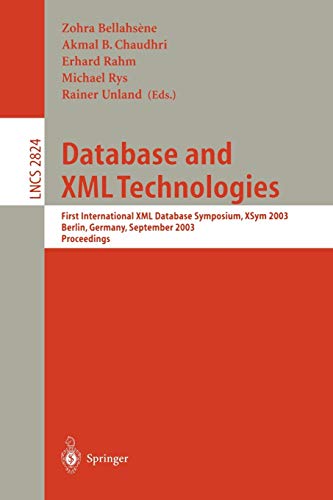
Database and XML Technologies: First International XML Database Symposium, XSYM 2003, Berlin, Germany, September 8, 2003, Proceedings (Lecture Notes in Computer Science, 2824, Band 2824) - Softcover
Inhaltsangabe
The Extensible Markup Language (XML) is playing an increasingly important role in the exchange of a wide variety of data on the Web and elsewhere. The database c- munity is interested in XML because it can be used to represent a variety of data f- mats originating in different kinds of data repositories while providing structure and the possibility to add type information. The theme of this symposium is the combination of database and XML te- nologies. Today, we see growing interest in using these technologies together for many Web-based and database-centric applications. XML is being used to publish data from database systems on the Web by providing input to content generators for Web pages, and database systems are increasingly being used to store and query XML data, often by handling queries issued over the Internet. As database systems incre- ingly start talking to each other over the Web, there is a fast-growing interest in using XML as the standard exchange format for distributed query processing. As a result, many relational database systems export data as XML documents, import data from XML documents, provide query and update capabilities for XML data. In addition, so-called native XML database and integration systems are appearing on the database market, and it’s claimed that they are especially tailored to store, maintain and easily access XML documents.
Die Inhaltsangabe kann sich auf eine andere Ausgabe dieses Titels beziehen.
Über die Autorinnen und Autoren
Dr. Erhard Rahm studierte Informatik und promovierte an der Universität Kaiserslautern. Danach war er für ein Jahr als Gastwissenschaftler am IBM T.J. Watson Research Center in Yorktown Heights, NY, USA, beschäftigt. Derzeit ist er Dozent und Leiter eines Forschungsprojektes über Hochleistungstransaktionssysteme am Fachbereich Informatik der Universität Kaiserslautern.
Günther Pernul hat an der Universität Wien Wirtschaftsinformatik und an der Technischen Universität Wien Informatik studiert. Der Abschluß des Studiengangs Wirtschaftsinformatik erfolgte im Jahre 1985. Von 1986 - 1989 war er wissenschaftlicher Mitarbeiter am Institut für Statistik und Informatik der Universität Wien. Im Jahr 1989 erfolgte seine Promotion zum Doktor der Sozial- und Wirtschaftswissenschaften. In den Jahren 1990 und 1991 war Günther Pernul Gastforscher am Database Systems Research and Development Center der University of Florida, Gainesville und am College of Computing des Georgia Institute of Technology in Atlanta. Von 1991-1995 war er Universitätsassistent am Institut für Angewandte Informatik und Informationssysteme der Universität Wien. Im Jahr 1993 erfolgte dort an der Fakultät für Sozial- und Wirtschaftswissenschaften seine Habilitation für Informatik. Von Oktober 1995 bis September 2002 war er C4-Professor an der Universität Duisburg-Essen. Seit Oktober 2002 hat er den Lehrstuhl für Wirtschaftsinformatik I an der Universität Regensburg inne.
Von der hinteren Coverseite
The Extensible Markup Language (XML) is playing an increasingly important role in the exchange of a wide variety of data on the Web and elsewhere. The database c- munity is interested in XML because it can be used to represent a variety of data f- mats originating in different kinds of data repositories while providing structure and the possibility to add type information. The theme of this symposium is the combination of database and XML te- nologies. Today, we see growing interest in using these technologies together for many Web-based and database-centric applications. XML is being used to publish data from database systems on the Web by providing input to content generators for Web pages, and database systems are increasingly being used to store and query XML data, often by handling queries issued over the Internet. As database systems incre- ingly start talking to each other over the Web, there is a fast-growing interest in using XML as the standard exchange format for distributed query processing. As a result, many relational database systems export data as XML documents, import data from XML documents, provide query and update capabilities for XML data. In addition, so-called native XML database and integration systems are appearing on the database market, and it¿s claimed that they are especially tailored to store, maintain and easily access XML documents.
„Über diesen Titel“ kann sich auf eine andere Ausgabe dieses Titels beziehen.
Suchergebnisse für Database and XML Technologies: First International...

Beispielbild für diese ISBN
Database and XML Technologies: First International XML Database Symposium, XSYM 2003, Berlin, Germany, September 8, 2003, Proceedings (Lecture Notes in Computer Science, 2824)
Anbieter: Ria Christie Collections, Uxbridge, Vereinigtes Königreich
Verkäuferbewertung 5 von 5 Sternen

Zustand: New. In English. Artikel-Nr. ria9783540200550_new
Neu kaufen
EUR 68,85
EUR 13,49 Versand
Versand von Vereinigtes Königreich nach USA
Versand von Vereinigtes Königreich nach USA
Anzahl: Mehr als 20 verfügbar
Foto des Verkäufers
Database and Xml Technologies : First International Xml Database Symposium, Xsym 2003, Berlin, Germany, September 8, 2003 : Proceedings
Anbieter: GreatBookPricesUK, Woodford Green, Vereinigtes Königreich
Verkäuferbewertung 5 von 5 Sternen
Zustand: As New. Unread book in perfect condition. Artikel-Nr. 2001154
Gebraucht kaufen
EUR 66,30
EUR 17,92 Versand
Versand von Vereinigtes Königreich nach USA
Versand von Vereinigtes Königreich nach USA
Anzahl: Mehr als 20 verfügbar
Foto des Verkäufers
Database and XML Technologies : First International XML Database Symposium, XSYM 2003, Berlin, Germany, September 8, 2003, Proceedings
Anbieter: AHA-BUCH GmbH, Einbeck, Deutschland
Verkäuferbewertung 5 von 5 Sternen
Taschenbuch. Zustand: Neu. Druck auf Anfrage Neuware - Printed after ordering - The Extensible Markup Language (XML) is playing an increasingly important role in the exchange of a wide variety of data on the Web and elsewhere. The database c- munity is interested in XML because it can be used to represent a variety of data f- mats originating in different kinds of data repositories while providing structure and the possibility to add type information. The theme of this symposium is the combination of database and XML te- nologies. Today, we see growing interest in using these technologies together for many Web-based and database-centric applications. XML is being used to publish data from database systems on the Web by providing input to content generators for Web pages, and database systems are increasingly being used to store and query XML data, often by handling queries issued over the Internet. As database systems incre- ingly start talking to each other over the Web, there is a fast-growing interest in using XML as the standard exchange format for distributed query processing. As a result, many relational database systems export data as XML documents, import data from XML documents, provide query and update capabilities for XML data. In addition, so-called native XML database and integration systems are appearing on the database market, and it's claimed that they are especially tailored to store, maintain and easily access XML documents. Artikel-Nr. 9783540200550
Neu kaufen
EUR 66,40
EUR 35,00 Versand
Versand von Deutschland nach USA
Versand von Deutschland nach USA
Anzahl: 1 verfügbar