
Verwandte Artikel zu Introduction to the Theory of Matroids (Lecture notes...
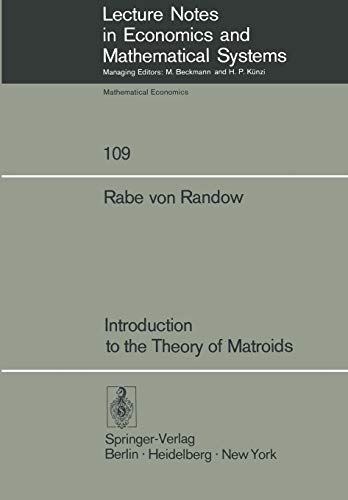
Introduction to the Theory of Matroids (Lecture notes in economics and mathematical systems, vol.109) - Softcover
Inhaltsangabe
Matroid theory has its origin in a paper by H. Whitney entitled "On the abstract properties of linear dependence" [35], which appeared in 1935. The main objective of the paper was to establish the essential (abstract) properties of the concepts of linear dependence and independence in vector spaces, and to use these for the axiomatic definition of a new algebraic object, namely the matroid. Furthermore, Whitney showed that these axioms are also abstractions of certain graph-theoretic concepts. This is very much in evidence when one considers the basic concepts making up the structure of a matroid: some reflect their linear algebraic origin, while others reflect their graph-theoretic origin. Whitney also studied a number of important examples of matroids. The next major development was brought about in the forties by R. Rado's matroid generalisation of P. Hall's famous "marriage" theorem. This provided new impulses for transversal theory, in which matroids today play an essential role under the name of "independence structures", cf. the treatise on transversal theory by L. Mirsky [26J. At roughly the same time R.P. Dilworth estab lished the connection between matroids and lattice theory. Thus matroids became an essential part of combinatorial mathematics. About ten years later W.T. Tutte [30] developed the funda mentals of matroids in detail from a graph-theoretic point of view, and characterised graphic matroids as well as the larger class of those matroids that are representable over any field.
Die Inhaltsangabe kann sich auf eine andere Ausgabe dieses Titels beziehen.
Suchergebnisse für Introduction to the Theory of Matroids (Lecture notes...

Foto des Verkäufers
Introduction to the Theory of Matroids Lecture notes in economics and mathematical systems, vol. 109
Anbieter: books4less (Versandantiquariat Petra Gros GmbH & Co. KG), Welling, Deutschland
Verkäuferbewertung 5 von 5 Sternen

Broschiert. Zustand: Gut. 102 Seiten Das hier angebotene Buch stammt aus einer teilaufgelösten Bibliothek und kann die entsprechenden Kennzeichnungen aufweisen (Rückenschild, Instituts-Stempel.); der Buchzustand ist ansonsten ordentlich und dem Alter entsprechend gut. In ENGLISCHER Sprache. Sprache: Englisch Gewicht in Gramm: 195. Artikel-Nr. 2201833
Gebraucht kaufen
EUR 11,95
EUR 9,95 Versand
Versand von Deutschland nach USA
Versand von Deutschland nach USA
Anzahl: 1 verfügbar
Beispielbild für diese ISBN
Introduction to the Theory of Matroids (Lecture Notes in Economics and Mathematical Systems)
Anbieter: Revaluation Books, Exeter, Vereinigtes Königreich
Verkäuferbewertung 5 von 5 Sternen
Paperback. Zustand: Brand New. reprint edition. 120 pages. 9.30x6.30x0.30 inches. In Stock. Artikel-Nr. x-3540071776
Neu kaufen
EUR 77,60
EUR 11,63 Versand
Versand von Vereinigtes Königreich nach USA
Versand von Vereinigtes Königreich nach USA
Anzahl: 2 verfügbar
Foto des Verkäufers
Introduction to the Theory of Matroids
Anbieter: AHA-BUCH GmbH, Einbeck, Deutschland
Verkäuferbewertung 5 von 5 Sternen
Taschenbuch. Zustand: Neu. Druck auf Anfrage Neuware - Printed after ordering - Matroid theory has its origin in a paper by H. Whitney entitled 'On the abstract properties of linear dependence' [35], which appeared in 1935. The main objective of the paper was to establish the essential (abstract) properties of the concepts of linear dependence and independence in vector spaces, and to use these for the axiomatic definition of a new algebraic object, namely the matroid. Furthermore, Whitney showed that these axioms are also abstractions of certain graph-theoretic concepts. This is very much in evidence when one considers the basic concepts making up the structure of a matroid: some reflect their linear algebraic origin, while others reflect their graph-theoretic origin. Whitney also studied a number of important examples of matroids. The next major development was brought about in the forties by R. Rado's matroid generalisation of P. Hall's famous 'marriage' theorem. This provided new impulses for transversal theory, in which matroids today play an essential role under the name of 'independence structures', cf. the treatise on transversal theory by L. Mirsky [26J. At roughly the same time R.P. Dilworth estab lished the connection between matroids and lattice theory. Thus matroids became an essential part of combinatorial mathematics. About ten years later W.T. Tutte [30] developed the funda mentals of matroids in detail from a graph-theoretic point of view, and characterised graphic matroids as well as the larger class of those matroids that are representable over any field. Artikel-Nr. 9783540071778
Neu kaufen
EUR 61,09
EUR 35,00 Versand
Versand von Deutschland nach USA
Versand von Deutschland nach USA
Anzahl: 1 verfügbar
Beispielbild für diese ISBN
Introduction to the Theory of Matroids (Lecture Notes in Economics and Mathematical Systems, 109)
Anbieter: Ria Christie Collections, Uxbridge, Vereinigtes Königreich
Verkäuferbewertung 5 von 5 Sternen
Zustand: New. In English. Artikel-Nr. ria9783540071778_new
Neu kaufen
EUR 105,61
EUR 10,89 Versand
Versand von Vereinigtes Königreich nach USA
Versand von Vereinigtes Königreich nach USA
Anzahl: Mehr als 20 verfügbar