
Verwandte Artikel zu Logistic Optimization of Chemical Production Processes
Inhaltsangabe
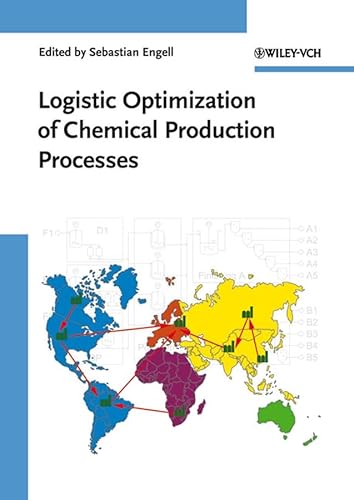
In this first book dedicated to the logistics of chemical plants and production processes, authors from academia and industry -- such as Bayer, Degussa, Merck -- provide an overview of the field, incorporating the knowledge and experience gathered over the last 10 years. In so doing, they describe the latest ideas on efficient design, illustrating when to produce which part of the equipment and with which resources, so as to optimize chemical plants for high capacity and flexibility.
This book gives an overview of the state-of-the-art of the whole logistic chain of chemical production processes.
Alongside the fundamentals, tools and algorithms, and integration issues, the book features five significant industrial case studies.
Die Inhaltsangabe kann sich auf eine andere Ausgabe dieses Titels beziehen.
Über die Autorin bzw. den Autor
Sebastian Engell received the Dipl.-Ing. degree in Electrical Engineering from the Ruhr-Universitat Bochum, Germany, in 1978, and the Dr.-Ing. degree from the Universitat Duisburg, Germany in 1981. In 1987 the Universitat Duisburg granted him the venia legendi in Automatic Control
Since 1990 he has been Professor of Process Control in the Department of Biochemical and Chemical Engineering, Universitat Dortmund, Germany. 1996-1999 he served as the Department Chairman, and from 2002-2005 as Vice-Rector for Research, Promotion of Young Scientists and International Relations of Universitat Dortmund. Since 2005, he is a member of the selection committee for the Leibniz-Prize of the Deutsche Forschungsgemeinschaft.
In 2006 Sebastian Engell was appointed Fellow of the International Federation of Automatic Control.
His areas of research are control design, modeling and control of chemical and biochemical processes, hybrid systems, logic control and scheduling in the process industries.
Von der hinteren Coverseite
In the demand-driven operation of chemical, biochemical and pharmaceutical production plants, the efficient use of the available resources is of crucial importance to the economic performance of today's chemical companies. As the first of its kind, this book addresses the logistic optimization of chemical production processes, both from a practical and an academic point of view. All the chapters discuss real-world applications or case studies derived from authentic industrial problems. This book reviews the main problems in supply-chain optimization, the description of the methods and tools currently used in industry, logistic simulation, campaign planning under uncertainty, up to heuristics-and optimization-based production planning and scheduling, and recently proposed advanced optimization algorithms and their integration in ERP systems.
Throughout, the authors represent industrial users of tools for logistic optimization, developers and vendors of such tools and software systems as well as academic researchers. the result is an up-to-date survey of the field, which can equally be used as a textbook in courses on the operation of chemical plants.
Auszug. © Genehmigter Nachdruck. Alle Rechte vorbehalten.
Logistic Optimization of Chemical Production Processes
John Wiley & Sons
Copyright © 2008 WILEY-VCH Verlag GmbH & Co. KGaA, WeinheimAll right reserved.
ISBN: 978-3-527-30830-9
Chapter One
Supply Chain and Supply Chain ManagementMario Stobbe
1.1 Introduction
The design, planning and controlling of networks of business processes with multiple stages in order to improve competitiveness has been a theme of operations research since the 1950s. In practice, international operating companies with large supply and distribution networks especially applied the research results. Since the 1980s, the interest in the theme of networks in general as a competitive means has increased for the following reasons:
• globalization of the markets for distributing and procuring materials;
• internationalization of site structures;
• emerging customer expectations regarding quality, time of delivery and price;
• significant improvements of information technology as a means of dealing with increasing complexity.
The increased interest led to new terms such as supply chain and supply chain management and – at least in the US – an abundance of new research. In this introductory article, we discuss the characteristics of a supply chain and supply chain management.
1.2 Terms and Definitions
1.2.1 Supply Chain
1.2.1.1 Structure
The word chain in supply chain is misleading as it implies a linear structure. However, the structure of a supply chain is usually a network structure and only in rather seldom cases a linear chain. The supply chain can be described in different levels of detail as will be outlined below when discussing the Supply Chain Organizations Reference Model (SCOR-model). For a first characterization, a supply chain will be considered here as a network of organizations exchanging materials, service and information in order to fulfill customers' demands. In a broad sense, the organizations are companies (legal entities). In a narrow sense, this definition applies to large companies with numerous sites in different countries providing a variety of materials and services as well. Some authors term the latter an intra-company supply chain and the former an inter-company supply chain. The setting of a complex intra-company supply chain is typical for large chemical companies.
The structure of a supply chain in the broader sense is comparable to a virtual corporation. A virtual corporation is a network of legally independent companies which cooperate for a limited time in order to achieve a given objective.
1.2.1.2 Function
Defining a supply chain solely by its structure and its components will be inadequate. From a functional point of view, the supply chain is comparable with logistics networks. A closer look at the characteristics of logistics networks and at supply chains will show some significant differences even when applying a modern characterization of logistics. In a classical sense, logistics only comprises storage and transportation of materials. Nowadays, logistics is treated as an enabling function including tasks such as procurement, production, distribution and disposal of materials. Both definitions have in common that logistics are seen from the point of view of a single company. A holistic definition of logistics includes suppliers and consumers as participants. Some authors equate this holistic concept with supply chain management as both concepts share some essential characteristics regarding organization and tasks. These characteristics are process orientation, co-ordination of information and material flow.
Process orientation means that the organizational structure corresponds to the key processes. This is in strong contrast to the functional organization where (parts of) processes are assigned to departments and, thus, processes are organized according to the structure of the departments. Besides the typical logistic processes, order acquisition, order processing and product development are typical key processes. These processes may cross the legal boundaries between companies in order to serve the needs of the customer which leads to the necessity of co-ordination of material and information flow.
However, the players in a logistics network are participants whereas in the supply chain they are (or should be) partners. This becomes apparent when looking at planning processes. Participants make decisions on their own trying to improve some variable – usually the profit – related to their own company. In contrast, partners in a supply chain make their decisions based on a collaborative and holistic consideration of effects along the supply chain in order to achieve a competitive advantage for the supply chain as a whole. The decisions include not only operational/ short-term decisions but also tactical and strategic decisions regarding the design of the supply chain. Eventually, the intended purpose of a supply chain is to fulfill the customers' demands in a most efficient manner and to outperform other supply chains.
1.2.2 Supply Chain Management
Based on the characterization of a supply chain, supply chain management (SCM) can be defined as "a process oriented approach to procuring, producing, and delivering end products and services to customers." It includes sub-suppliers, suppliers, internal operations, trade customers, retail customers and end users. It covers the management of materials, information, and fund flows.
A large variety of definitions of SCM exist which cannot be discussed in detail here. A look at the origins of the term will partly explain how different and sometimes misleading definitions evolved. The term SCM was established by consultants in 1982. They were the first to treat logistics as a top management concern. They argued that only the top management can balance the conflicting objectives of different functional units, e.g., long production runs (production) vs low inventories (finance). From this fact it becomes apparent that SCM is a management concept (!) and that it has evolved from practice. Theoretic considerations and interpretations followed some years later and often reflect the theoretical background of the author.
Managing the supply chain generally comprises three elements of activity:
• supply chain analysis
• supply chain planning
• supply chain execution
Before starting an improvement process, a clear picture of the supply chain has to be obtained. Therefore, Supply Chain Analysis is a critical success factor. Usually, this analysis will describe the "as-is" status and the desired "to-be" status. As a supply chain is built up of different companies for a limited time, it is essential that all partners speak the same "language" to describe and measure the as-is-status as well as to evaluate the to-be-status. For this purpose, usually a widely accepted model called the SCOR-model is used.
Supply Chain Planning (SCP) comprises all planning activities at the operational, tactical and strategic levels. Well known activities at the operational level are demand forecasting, network planning and scheduling. In order to ease these complex activities, so-called Advanced Planning Systems (APS) are used. At a strategic level, SCP includes supply chain design. Supply Chain Design comprises the selection of partners, the definition of the core business of each partner, selection of outsourcing strategies, supplier management and the selection of enabling technologies such as e-commerce and e-procurement.
Finally, Supply Chain Execution means putting agreed operational plans into practice with minimum effort.
1.3 Network Dynamics and Management of the Supply Chain
Although the term SCM first appeared in 1982, several effects connected with SCM were investigated long before then. From systems theory it is well known that the behavior of complex systems is more than the sum of its components and therefore cannot be understood solely by the analysis of its parts.
In 1958, Forrester started studies on an effect which is nowadays often referred to as the bullwhip effect. The bullwhip effect describes the amplification of temporal variations of the orders in a supply chain the more one moves away from the retail customer. Forrester showed that small changes in consumer demand result in large variations of orders placed upstream. It is interesting that this effect occurs even if the demand of final products is almost stable. For his studies, he assumed that some time delay exists between placing an order and the realization of this order (production). Furthermore, he assumed that each part of the supply chain plans its production and places its orders upstream taking into account only the information about the demands of its direct customer.
One may argue that Forrester investigated this effect theoretically; however, several authors were able to prove that this effect also occurs in reality. This shows that an unmanaged supply chain is not inherently stable.
Nowadays, the bullwhip effect is best known from the so-called beer game. The Beer Game is a simulation developed at MIT in the 1960s to clarify the advantages of taking an integrated approach to managing the supply chain. A detailed description of the beer game and a playable version can be accessed via the internet (http://beergame.mit.edu/). In the beer game, the human players take the role of a part of a linear supply chain, e.g., a retailer, a wholesaler, a distributor or a manufacturer. The objective of the game is to minimize the total costs of the supply chain by maintaining low stocks but nevertheless managing to deliver all orders. There exists only one product called Lovers's Beer which is manufactured in units of one crate of beer. Two different costs have to be taken into account: inventory costs and backlog costs. Orders can be placed each week and it takes another two weeks before the supplier receives the order and two weeks before the orders reach the next part of the supply chain. If a part of the supply chain is unable to deliver in time, the orders are backlogged and the units have to be delivered the next week. The game is started in week one and each player has to decide how many units he wants to order from his supplier. The first round is finished by checking how many orders are delivered in time and how many orders are backlogged. The next round is started by placing the orders for the next week.
Usually, the game is started assuming that the only information a player gets are the orders of the player he supplies with beer. This is referred to as placing orders on local information. In this setting, human actors provided with local information usually tend to overact by an amplification of orders placed. Together with the inherent dynamics of the system, a slight variation of the end user demand in the beginning of the game is sufficient to introduce a persistent oscillation of demands resulting in boosting stocks and number of orders and high costs for operating the supply chain.
In another setting, the human players are provided with global information about the system. This means that all players are informed about inventory levels and orders placed for each of the components of the supply chain. Furthermore, they are encouraged to work out co-operative strategies to deal with the dynamics of the system. Compared to the local information structure, this usually results in lower inventory levels and less out-of-stock-situations for all participants. Typically, the stocks and the number of orders in this setting are much lower, resulting in much lower costs for operating the supply chain and lower costs for each player as well.
The beer game demonstrates the value of sharing information across the various supply chain components. In practice, supply chains are usually more complex and much harder to manage. Current research has investigated that in practice the bullwhip effect is due to the following reasons:
• overreaction to backlogs;
• neglecting to order in an attempt to reduce inventory;
• no communication up and down the supply chain;
• no coordination up and down the supply chain;
• delay times for information and material flow;
• shortage gaming: customers order more than they need during a period of short supply, hoping that the partial shipments they receive will be sufficient;
• demand forecast inaccuracies: everybody in the chain adds a certain percentage to the demand estimates. The result is invisibility of true customer demand.
The identification of these reasons led to recommendations how to avoid the bullwhip effect. Some of these recommendations are:
• ordering decisions should be based on the demand of the ultimate customer instead of upstream forecast updates;
• eliminate gaming in shortage situations;
• stabilize prices in order to avoid large variations of demands;
• avoid order batching.
Many of these recommendations can be achieved using modern means of information technology. Standardized order procedures based on widely accepted information protocols will help to reduce the delay of information and current systems for advanced planning and scheduling (APS) provide means to support humans in decision making in complex networks. Building blocks of APS systems are:
• strategic planning
• forecasting
• global network planning
• distribution planning
• transportation planning
• production planning
• scheduling
Electronic data exchange is the enabler for these building blocks as manual data administration is error-prone, time-consuming and costly.
1.4 Design Criteria/Integration Concepts
Operating the supply chain has a major impact on its efficiency. Efficiency in this sense means that the operating expense in terms of time and money for a given design of the supply chain is as low as possible. However, the operating expenses are influenced by the design of the supply chain as well and the design varies according to the company's business and strategy. This is usually referred to as effectiveness. Effectiveness in this sense means that the design of the supply chain enables low operating expenses for a given business.
The design of the supply chain has different levels of interest. The driver of the supply chain design is the strategy the supply chain has agreed to follow. On this level, the partners agree on a strategy (e.g., prioritization of products and customers) and controlling issues (e.g., common performance indicators). These decisions are the drivers of the design of the other levels.
On the level of material flow, physical properties of the network are designed, i.e., decisions upon the existence of plant sites, warehouses and distribution centers, the transportation links between these components and their capacities are made. The decision upon the customer order decoupling point is a good example of how strategic decisions may influence the level of material flow.
The decoupling point is the boundary between the order-driven and the forecast-driven operations within a supply chain. Operations upstream of the decoupling point are forecast-driven, i.e., production for a certain time period is started before all customer orders are known. Operations downstream of the decoupling point are order-driven, i.e., production for a certain period of time starts after all customer orders are known. Furthermore, the decoupling point dictates the form in which inventory is held. Upstream, it is usually held as semi-finished goods while downstream it is held as finished goods. The semi-finished goods are generic in the sense that they allow for customization. Customization is related to the product (viscosity, color, water content, etc.) as well as to the choice of some other attributes such as packaging material, packaging size and pallet size. In order to gain flexibility, several authors recommend to design a supply chain such that it carries inventory in a generic form awaiting final processing or treatment so as to postpone product customization. Besides flexibility, postponement leads to lower inventories as it enables the production of materials according to customer orders and prevents building stocks resulting from inaccurate forecasts.
Many of the problems exhibited on the level of material flow are the result of the distortion of marketplace sales information as it is transferred upstream through the supply chain. Therefore, the design of the information flow is as important for the effectiveness and efficiency of supply chains as the design of the material flow. The information flow is obviously influenced by the level of material flow. However, the information flow is not necessarily dependent on the material flow. Introducing new information links or improving existing ones may have no causes in material or process flow while having an impact on the efficiency of the supply chain, e.g., exchanging information regarding the sales planning between suppliers and distributors enhances planning quality enabling lower response times and lower storage costs.
(Continues...)
Excerpted from Logistic Optimization of Chemical Production Processes Copyright © 2008 by WILEY-VCH Verlag GmbH & Co. KGaA, Weinheim. Excerpted by permission of John Wiley & Sons. All rights reserved. No part of this excerpt may be reproduced or reprinted without permission in writing from the publisher.
Excerpts are provided by Dial-A-Book Inc. solely for the personal use of visitors to this web site.
„Über diesen Titel“ kann sich auf eine andere Ausgabe dieses Titels beziehen.
Suchergebnisse für Logistic Optimization of Chemical Production Processes

Beispielbild für diese ISBN
Logistic Optimization of Chemical Production Processes
Anbieter: Majestic Books, Hounslow, Vereinigtes Königreich
Verkäuferbewertung 4 von 5 Sternen

Zustand: New. pp. xiv + 284 Illus. Artikel-Nr. 7502761
Neu kaufen
EUR 263,52
EUR 7,58 Versand
Versand von Vereinigtes Königreich nach USA
Versand von Vereinigtes Königreich nach USA
Anzahl: 1 verfügbar